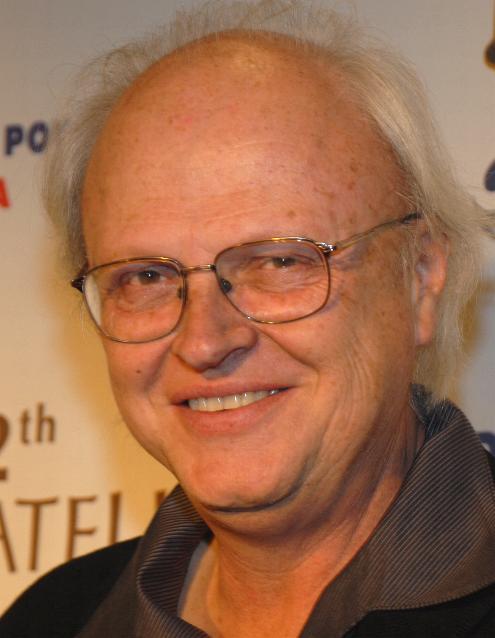
Dennis Muren
American visual effects artistWikipedia
5
MENTIONS
5
EPISODES
5
PODCASTS
Search complete. 5 mentions across 5 episodes found for "Dennis Muren".
Oct 6, 2026

Matt WallenPANELIST
There was kind of this schism in visual effects, like in the '90s, not like a, a really negative one, but where people would, you know, some, some supervisors would wanna get everything in 3D, and that was really important.
Matt WallenPANELIST
And then other supervisors that I had the pleasure of working with, including George Murphy, they, you know, sometimes it was great to get it in 3D if you could, but a lot of times they'd be like, "Well, you know, we, we could probably pull that off in comp and get it in 2D, and it would look fine in the film." You know? Like, uh, Dennis Muren was like that, and I think George was like that.
Matt WallenPANELIST
And George used to say this thing that I, I tell my students this every, every, uh, class where we're teaching 3D.
Matt WallenPANELIST
George would always say, "Well, you know, in the end, it's all 2D." [laughs]

Matthew WardGUEST
And then they'd make their shot list against the, the screenplay.
Matthew WardGUEST
And there's great, there's great footage of Return of the Jedi Videomatics that were done by, um, Dennis Muren and others at, uh, Industrial Light & Magic planning out the speeder chase in, uh, the forest Endor.
Matthew WardGUEST
So I think, um, that's just evolved to testing something out really fast, proving it can succeed or fail, and seeing where the problems lie prior to you being on the day you're actually shooting.
Matthew WardGUEST
You've got film in the canister, and you have no idea what the plan is, so.

Phil TippettGUEST
And I, you know, spent a lot of time working out and, you know, getting a bunch of rigs built and for Jurassic park.
Phil TippettGUEST
It was really Dennis Muren that really pushed for building an input device that would allow stop-motion animators to go in.
Phil TippettGUEST
And it was essentially a stop-motion puppet of, say, like the Raptors or the T-Rex that was about this big.
Phil TippettGUEST
and that they each joint had an encoder on it and so when you move the thing it would move the wire frame because computers were so slow at that time you just had to work with a wire frame and you know build the performance that way and the technology guys at ilm were kind of going you just have to visualize what the thing is what its anatomy is and what its muscles would do as you move things along.

EmHOST
Compared to Star Wars, which had 360 effects shots, The Empire Strikes Back had 600.
EmHOST
The effects team, supervised by Richard Edlund and Brian Johnson, included Steve Gawley, Dennis Muren, Bruce Nicholson, Lorne Peterson, Nilo Rodis-Jamero, Tom St. Amand, and Phil Tippett.
EmHOST
Up to 100 people worked on the project daily, including Stuart Freeborn, who was responsible mainly for crafting the Yoda puppet.
EmHOST
Various techniques, including miniatures, map paintings, stop motion, articulated models, and full-size vehicles were used to create the many effects in The Empire Strikes Back.

Matt BrownHOST
So that must be ILM who were getting all that.
Matt BrownHOST
And ILM, the special effects supervisor was Dennis Muren.
Stephen MurrayHOST
Oh, okay.
Matt BrownHOST
So he had worked a lot with George Lucas and Spielberg.