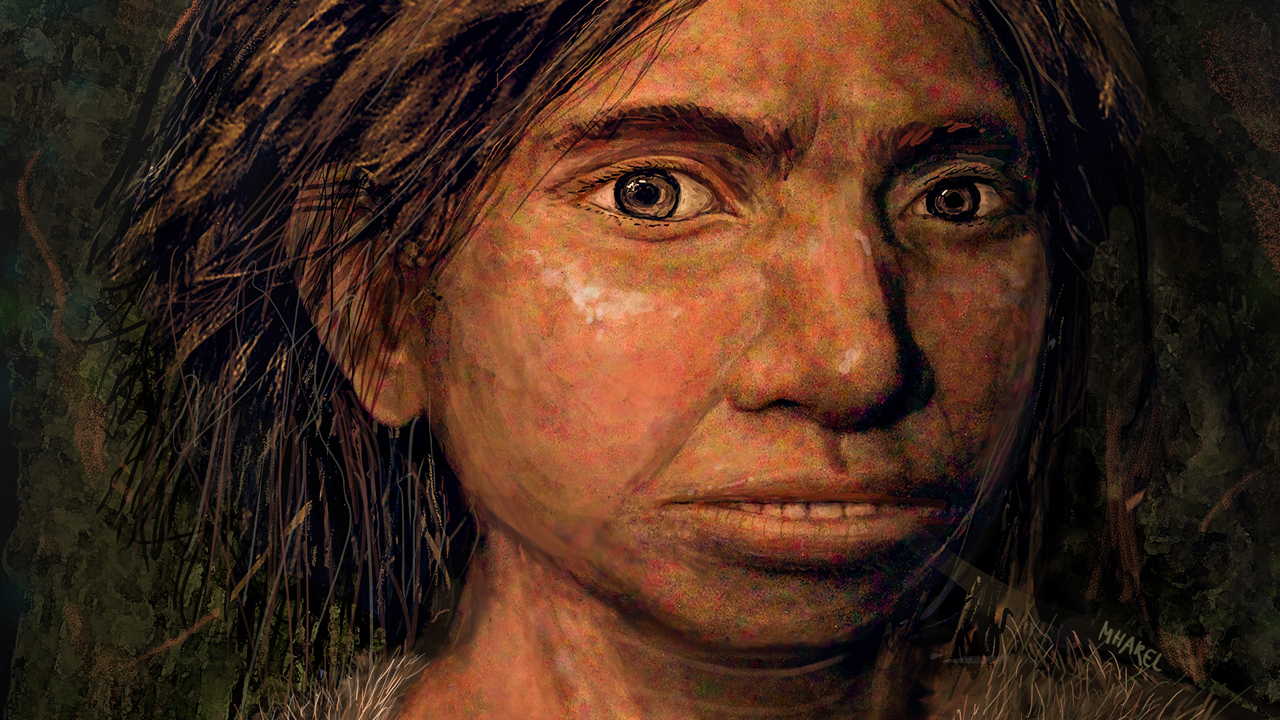
Denisovan
279
MENTIONS
78
EPISODES
63
PODCASTS
Search complete. 279 mentions across 78 episodes found for "Denisovan".
Sep 22, 2026

SnakeGUEST
Uh, it's definitely human.
SnakeGUEST
Um, basically what the DNA shows is the, the 58.5% Neanderthal is also includes Denisovan, and that Denisovan is, uh, Asian Neanderthal.
SnakeGUEST
And so you have this European Neanderthal, uh, this, uh, Denisovan, and then you also have some indigenous people's DNA in it.
SnakeGUEST
So it shows a clear, uh, kind of trajectory if you're looking ge- geographically that it, you know, from Europe all the way over to the Americas, kinda like how, um, humans spread across the, the globe.
SnakeGUEST
The- these also did that before the Bering land straight closed.

speaker_5NARRATOR
Modern non-African populations carry Neanderthal DNA, typically about 1-2% of their genome.
speaker_5NARRATOR
Some Asian and Oceanian populations carry Denisovan DNA, sometimes as much as 4-6%.
speaker_5NARRATOR
We're all hybrids, all carrying genes from species that no longer exist.
speaker_5NARRATOR
But those genes weren't random.
speaker_5NARRATOR
It was like a genetic shortcut.
speaker_5NARRATOR
Instead of spending hundreds of thousands of years evolving cold-weather adaptations, our ancestors just borrowed them from Neanderthals who'd already done the work.
speaker_5NARRATOR
Denisovan DNA in Tibetan populations helps them survive at high altitudes.
speaker_5NARRATOR
Denisovan DNA in Oceanian populations might help with fat metabolism.
speaker_8NARRATOR
Modern humans and Neanderthals.
speaker_8NARRATOR
Modern humans and Denisovans.
speaker_8NARRATOR
Neanderthals and Denisovans.
speaker_8NARRATOR
These interbreeding events leave distinctive genetic signatures, patterns that can confuse population genetic models if you're not accounting for them properly.
speaker_8NARRATOR
Here's the scenario.
27 MINS LATER
speaker_8NARRATOR
They became the Neanderthals, robust and powerful, perfectly suited to hunting ahassive Ice Age mammals in brutally cold climates.
speaker_8NARRATOR
Others moved east across Asia, spreading from the Middle East to Indonesia.
speaker_8NARRATOR
They became the Denisovans, mysterious and successful, leaving their genetic mark across populations from Siberia to the Pacific Islands, and some stayed in Africa.

Shane SimonsenGUEST
But I mean, pretty much anything else you care to look at, you'll find there's a hybrid origin behind it.
Shane SimonsenGUEST
I mean, even humans, even humans, we've recently discovered that we cross with Neanderthals and Denisovans as we spread across the planet.
Shane SimonsenGUEST
And that probably helped us adapt to cold places and high altitude places in a way that we couldn't have done on our own.
Catie PayneHOST
And what determines if something can successfully cross and then have viable offspring? Like why don't honey eaters and magpies cross to make like hag pies? Why don't species of birds? Why aren't things just crossing all over the shop?

SadhguruHOST
Uh, but see, it's all among ourselves, the same species.
SadhguruHOST
Th- there are some Nepalese, they may be Denisovans, uh, you know, there's a sister species.
SadhguruHOST
Some of them are little bit, just check your ears.
SadhguruHOST
If your ear is stuck to the face, that means you have a little bit of maybe a few percentage points of Denisovans.
SadhguruHOST
[laughs] Uh, so otherwise, they're all Homo sapiens, whether they're, uh, white, Black, yellow, brown, whatever they are.
SadhguruHOST
All right? So it's always among ourselves.

Jon PoundersHOST
Mm-hmm.
William BleschGUEST
And when I started doing this...
William BleschGUEST
This kind of goes off on another small rabbit trail, but, uh, Christians have struggled for a very long time to explain where various hominids came from, right? If the theory of evolution is not true, if there is no evolving of one species into another over vast eons of time, et cetera, so where did these, where did these beings come from? Some Christian organizations argue that specific hominids, like Neanderthal or the Denisovans, uh, were actually just very intelligent man-like animals.
William BleschGUEST
But they didn't bear the image of God, and they, you know, they, they just weren't anything more than some type of really smart, you know, man-like creature.
William BleschGUEST
Uh, but that, that totally ignores the idea of the Nephilim, and when you- That, by the way, I go into a lot of peer-reviewed literature in my book about this particular subject.
speaker_4ADVERTISER
Visit spinquest.com for more details.
William BleschGUEST
As time has gone on, we've discovered that that's not true.
William BleschGUEST
Neanderthals and Denisovans lived for a significant period of time alongside Homo sapiens sapiens before they went extinct.

Chris PerezGUEST
And there's another human species that was discovered not that long ago in Siberia, Asia, called the Nisova.
Chris PerezGUEST
Denisovans.
Chris PerezGUEST
Denisovans.
Chris PerezGUEST
Yes.
Chris PerezGUEST
And we know, thanks again to genetics, we know that all of those humans mingled with one another.

Matt DavisHOST
oldest? Maybe.
Matt DavisHOST
I think she's the oldest, right? The Denisovans might be older.
Matt DavisHOST
Yeah, it's one of those two.
Matt DavisHOST
Maybe
speaker_0NARRATOR
Within another 10,000 years, they would be completely gone.
speaker_0NARRATOR
Further east, modern humans encountered a different group of archaic humans, the Denisovans.
speaker_0NARRATOR
We know even less about the physical meetings between modern humans and Denisovans because the archaeological evidence is so sparse.
speaker_0NARRATOR
But the genetic evidence is unambiguous.
speaker_0NARRATOR
Modern humans and Denisovans interbred extensively, probably in multiple locations across Asia over thousands of years.
speaker_0NARRATOR
Today, people with ancestry from Papua New Guinea carry up to 5% Denisovan DNA, far more than the Neanderthal contribution in Europeans.
speaker_0NARRATOR
Other Asian populations carry smaller but significant amounts.
speaker_0NARRATOR
That's natural selection preserving a useful adaptation inherited from an extinct species.

Linda Moulton HoweHOST
I've heard that before and I know that there is an argument for that, that humans can be pretty rough.
Linda Moulton HoweHOST
But the other question, words before that are, then why did you make us so rough? Because as far as I know, Homo sapien, Neanderthalensis, Denisovan, they've all been biological genetic experiments on this planet by extraterrestrials.
Linda Moulton HoweHOST
And if somebody was dividing who they were going to meet with, talk with, by whether or not they were rough, or not, why did they make us so emotional? Got
Ian HorlingHOST
some more comments here.
68 more episodes mention Denisovan.
Create an account to see the whole feed, search across every transcript, and follow the entities you care about.