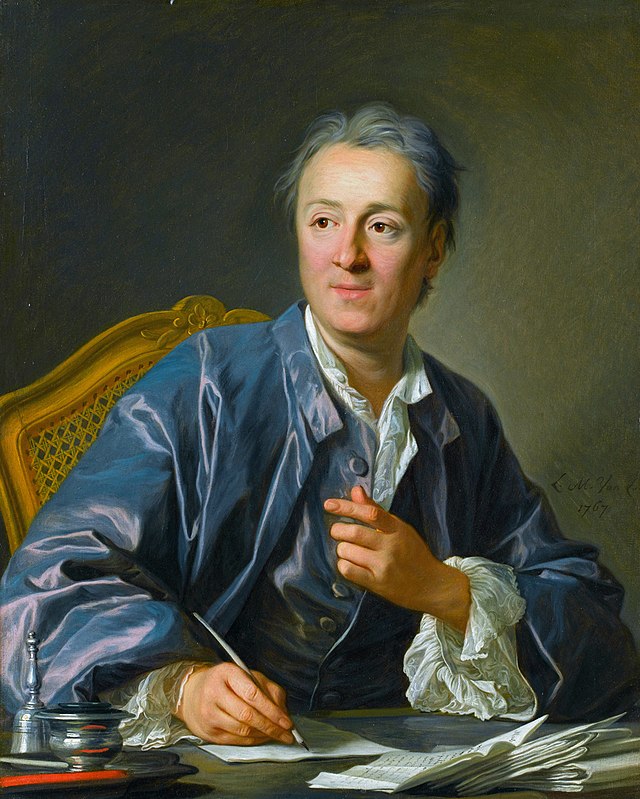
Denis Diderot
French philosopher and art criticWikipedia
182
MENTIONS
68
EPISODES
55
PODCASTS
Search complete. 182 mentions across 68 episodes found for "Denis Diderot".
Nov 25, 2026

Dorian LynskeyHOST
It's part of the advertising of the project.
Dorian LynskeyHOST
And all of this stuff is happening in this great kind of enlightenment phase, this idea of collecting all human knowledge, right? So you've got Diderot's French Encyclopédie is published in...
Dorian LynskeyHOST
many volumes starting in 1751.
Dorian LynskeyHOST
Encyclopedia Britannica first appears in 1768.

Keegan KjeldsenPANELIST
I'm thinking also of, you know, if we go back to when we first started to talk about the idea of modernity being enlightened.
Keegan KjeldsenPANELIST
Oftentimes you think about Voltaire or, you know, Diderot and the French Enlightenment.
Keegan KjeldsenPANELIST
But the first time people really started to talk about this was under the reign of Louis XIV, which was an absolutist monarch with a sort of zealous Roman Catholicism.
Keegan KjeldsenPANELIST
I believe it was Charles Perrault was the brother of the guy who expanded the Louvre.

Stephen HicksGUEST
And the decision is we need to write an encyclopedia, this vast multi-volume, I think it ended up being 25 volumes or so, of everything that we know now that we are more or less enlightened.
Stephen HicksGUEST
And that big, huge project, Diderot was the longest running editor there, started in 1751.
Stephen HicksGUEST
But then Turgot, Lamarck, Condorcet coming along other landmark thinkers in the French Enlightenment as well.
Stephen HicksGUEST
And the point here is to get the chronology right.
20 MINS LATER
Stephen HicksGUEST
Maybe in terms of rhetorical style, since if you think of Ayn Rand, rhetorical style, and a lot of that does get baked into objectivism's movement, sometimes not necessarily for the good, but she does have a take no prisoner.
Stephen HicksGUEST
She is an intellectual warrior.
Stephen HicksGUEST
And I think in that sense, she is more in the Voltaire spirit, perhaps also in the Denis Diderot spirit.
Stephen HicksGUEST
And so that more fiery, willing to engage in the rhetorical warfare that philosophical activism requires.

speaker_6NARRATOR
We mentioned Voltaire already.
speaker_6NARRATOR
His French Enlightenment colleague, Denis Diderot, also made a quip to object to Pascal's wager.
speaker_6NARRATOR
A Muslim might make the exact same argument, and still be right.
speaker_6NARRATOR
Very true.

Ernst PatinamaNARRATOR
History proves this at every turn.
Ernst PatinamaNARRATOR
Is the ferment of the peoples of the West at the end of the 18th century and their drive eastward explained by the activity of Louis XIV, XV, and XVI, their mistresses and ministers, and by the lives of Napoleon, Rousseau, Diderot, Beaumarchais, and others? is the movement of the Russian people eastward to Kazan and Siberia, expressed by details of the morbid character of Ivan the Terrible and by his correspondence with Kurbsky.
Ernst PatinamaNARRATOR
Is the movement of the peoples at the time of the Crusade, explained by the life and activity of the Godfrey's and the Louise's and their ladies? For us, that movement of the peoples from west to east, without leaders, with a crowd of vagrants and with Peter the Hermit, remains incomprehensible.
Ernst PatinamaNARRATOR
And yet more incomprehensible is the cessation of that movement when a rational and sacred aim for the Crusade, the deliverance of Jerusalem, had been clearly defined by historic leaders.
Keegan KjeldsenPANELIST
I'm thinking also of, if we go back to when we first started to talk about the idea of modernity being enlightened.
Keegan KjeldsenPANELIST
Oftentimes you think about Voltaire or Diderot and the French Enlightenment.
Keegan KjeldsenPANELIST
But the first time people really started to talk about this was under the reign of Louis XIV, which was an absolutist monarch with a sort of zealous Roman Catholicism.
Keegan KjeldsenPANELIST
I believe it was Charles Perrault was the brother of the guy who expanded the Louvre.

Larry WilsonNARRATOR
In 1770, French readers were startled by the appearance of Baron Dobach's System of Nature, in which God's existence and the immortality of the soul were denied, and the world declared to be matter spontaneously moving.
Larry WilsonNARRATOR
Dobach was a friend of Diderot, who had also come to reject deism.
Larry WilsonNARRATOR
All the leading ideas in the revolt against the Church had a place in Diderot's great work, the Encyclopedia, in which a number of leading thinkers collaborated with him.
Larry WilsonNARRATOR
It was not merely a scientific book of reference.
Larry WilsonNARRATOR
It was representative of the whole movement of the enemies of faith.
Larry WilsonNARRATOR
It was intended to lead men from Christianity, with its original sin, to a new conception of the world as a place which can be made agreeable, and in which the actual evils are due not to radical faults of human nature, but to perverse institutions and perverse educations.
Larry WilsonNARRATOR
to divert interest from the dogmas of religion to the improvement of society, to persuade the world that men's felicity depends not on revelation but on social transformation, this was what Diderot and Rousseau, in their different ways, did so much to effect, and their work influenced those who did not abandon orthodoxy.
Larry WilsonNARRATOR
It affected the spirit of the Church itself.

Laurie Ann WaldenNARRATOR
The titles are sufficient to indicate the scope of these works.
Laurie Ann WaldenNARRATOR
that of the latter points back to descartes who had applied the mechanical theory to animals only and not to man lametri extended his application to include man the implications of this theory did not escape lametri's contemporaries diderot in his encyclopaedia A definite period in the history of thought is certainly marked by the successful attempt on the part of a group of progressive thinkers to extend the circle open to scientific ideas by the publication of an encyclopedia which should contain all the latest knowledge and speculation.
Laurie Ann WaldenNARRATOR
the credit for this notable performance was due to diderot who in spite of immense difficulties which were aggravated by the ecclesiastical authorities and the supporters of reaction in general carried the work through to a triumphant conclusion the first volume appeared in seventeen fifty one the work was composed with an eye to current prejudices the language was guarded but the anti-clerical tendency of the whole was by no means obscure Diderot, however, did not obtrude in the Encyclopedia the definitely anti-religious opinions which he had developed and which are revealed in his correspondence.
Laurie Ann WaldenNARRATOR
Holbach.
Laurie Ann WaldenNARRATOR
A disciple of the encyclopedist, Holbach, a young German settled in Paris, was bolder than his master, and published, under the name of a savant who had recently died, a book which became widely notorious, and has been called the Bible of Materialism, the Systeme de la Nature, 1770.
Laurie Ann WaldenNARRATOR
It contains no really new thoughts.
Laurie Ann WaldenNARRATOR
Its significance lies in the energy and indignation with which every spiritualistic and dualistic view was run to earth on account of its injuriousness both in practice and in theory, is the estimate of a distinguished and impartial writer.
Laurie Ann WaldenNARRATOR
Rumour gave the credit of its authorship to Diderot, who was so disturbed by the compliment as hastily to leave Paris for the frontier.

Justin Smith-RuiuGUEST
I think many people, Marxists included, would be inclined to say, well, you know, the revolution would have happened no matter what the intellectuals were saying.
Justin Smith-RuiuGUEST
It was not the intellectuals who stormed the Bastille, that was the sans-culottes, and they never read any Diderot or Rousseau or etc., right? And that's, you know, one way of seeing it.
Justin Smith-RuiuGUEST
But nonetheless, there was an awful lot of talk going on in the years preceding the French Revolution.
Justin Smith-RuiuGUEST
And in that talk, there was a kind of general tendency towards this ultimate upgrade event, as we called it, as the inevitable result of the circulation of these Enlightenment ideas.

Dave FarinaHOST
It is there that he started selling his frozen treats to the public.
Dave FarinaHOST
Robespierre, Hugo, Balzac, Voltaire, and Diderot were all seen at his Café Procope, and even Napoleon, Benjamin Franklin, Thomas Jefferson, and Oscar Wilde visited this establishment for intellectual conversation, coffee, and of course, gelato.
Dave FarinaHOST
This favorite treat spread all over Europe, and eventually came to America, brought in the late 18th century by the Italian Filippo Lenzi.
Dave FarinaHOST
But today, American ice cream differs quite a bit from gelato, because by using milk cream, it adds up to 50% more calories and fat.
58 more episodes mention Denis Diderot.
Create an account to see the whole feed, search across every transcript, and follow the entities you care about.