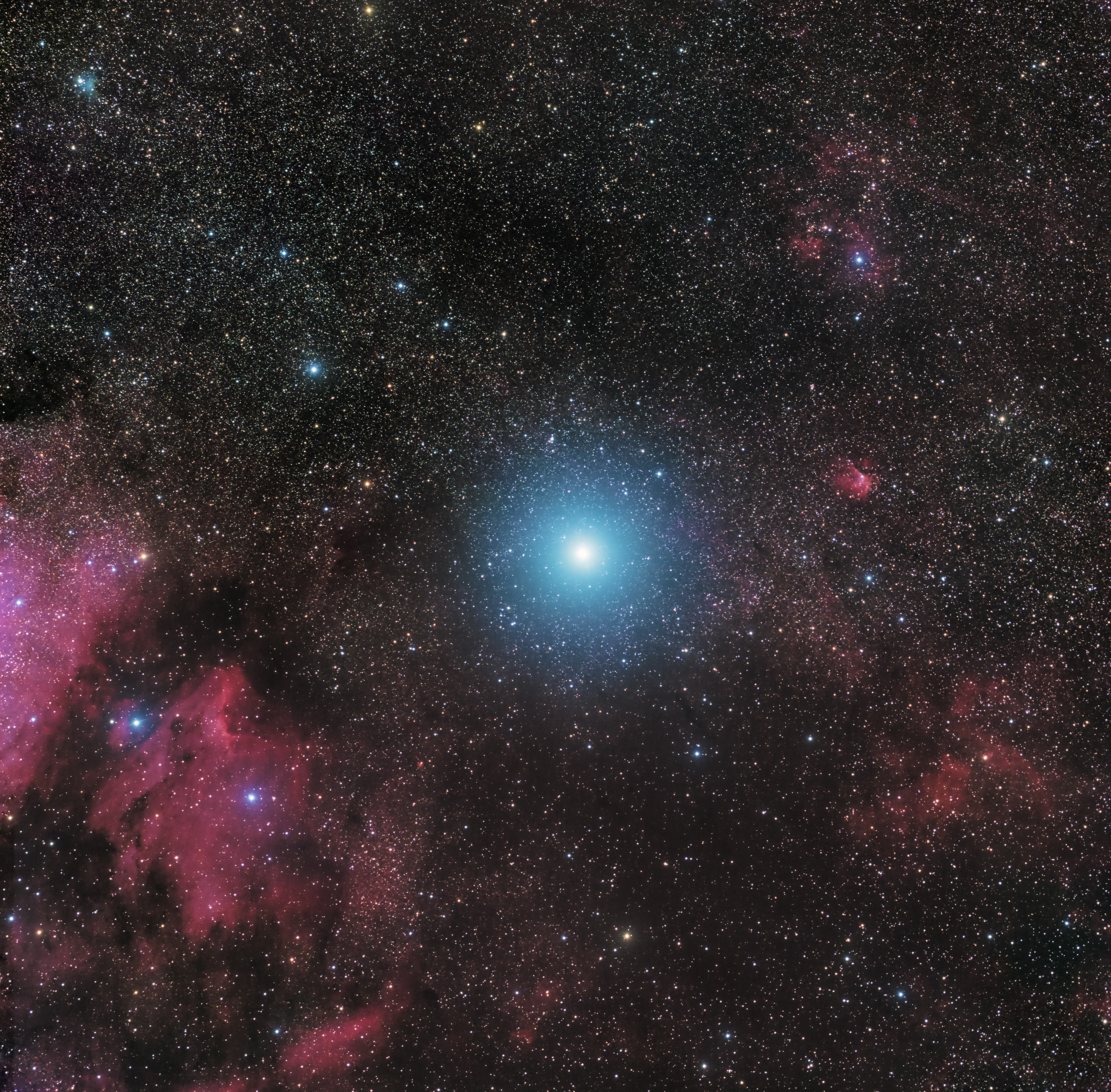
Deneb

Deneb

Search complete. 94 mentions across 24 episodes found for "Deneb".

Sep 16, 2026

Gregory L. LittleGUEST
35:37
And the Northern Cross is the Cygnus constellation.
Gregory L. LittleGUEST
35:41
And the Cygnus constellation has a very prominent star called Deneb.
Gregory L. LittleGUEST
35:48
was the other portal.
Gregory L. LittleGUEST
35:49
That was the final portal.
Gregory L. LittleGUEST
36:25
That was one of the things.
Gregory L. LittleGUEST
36:26
It could go to the underworld if it didn't pass the test, or it could go to the other world and go back with the ancestors and all of those yet to be born.
Gregory L. LittleGUEST
36:35
So the star Deneb of the Cygnus constellation, you will always find aligned at the same sites that had the path of souls.
Gregory L. LittleGUEST
36:45
And most of those sites are called Mississippian sites.
David KippingHOST
3:41
Stars become so brilliant as giants that we can see them from far, far further away.
David KippingHOST
3:47
For example, Deneb in the constellation Cygnus is easily visible by eye despite being roughly 2,000 light years away.
David KippingHOST
3:55
But the nearest star, Proxima Centauri, just four light years away, isn't visible by eye at all.
David KippingHOST
4:02
And to cap this argument off, my favorite example of a dissection bias would have to be supernovae.
David HansenGUEST
66:41
Can you see my video?
PhilHOST
66:42
Uh, Deneb.
BenHOST
66:43
Yeah.
PhilHOST
66:43
Deneb was the pole star.
PhilHOST
66:44
Deneb in Cygnus was the pole star 18,000 years ago.
BenHOST
66:48
Yeah.
David HansenGUEST
66:49
18,000.
Avivah YamaniHOST
4:16
New Moon occurs on September eleven, making the middle of the month a particularly good time to escape city lights and explore the darker sky.
Avivah YamaniHOST
4:25
After evening twilight, look overhead for three bright stars, Vega, Altair, and Deneb.
Avivah YamaniHOST
4:32
Together, they form the famous Summer Triangle.
Avivah YamaniHOST
4:35
From equatorial latitudes, this large stellar triangle stretches prominently across the evening sky and makes a useful starting point for navigating the stars.

Unknown podcast

We Can Travel at Light Speed... And It Still Won_t Be Fast Enough

Sep 5 · 2 Mentions

speaker_4NARRATOR
10:24
and Betelgeuse is still within our local spiral arm, still within a tiny sliver of the Milky Way, still practically next door by galactic standards.
speaker_4NARRATOR
10:34
Deneb, the luminous supergiant anchoring the tail of Cygnus the Swan, is one of the most intrinsically brilliant stars visible to the naked eye.
speaker_4NARRATOR
10:43
It burns with a luminosity estimated between 55,000 and 200,000 times greater than our Sun, depending on its true distance.
speaker_4NARRATOR
10:53
visible across astonishing distances despite sitting roughly 1500 to 2500 light years away with the most widely accepted modern estimate near the lower end.
speaker_4NARRATOR
11:04
At light speed reaching Deneb takes between 15 and 25 centuries depending on which distance measurement proves correct.
speaker_4NARRATOR
11:13
The traveller departs and arrives to discover that on Earth, the entirety of Western civilization unfolded during their commute.
speaker_4NARRATOR
11:21
When they launched, ancient Greece was nearing its classical zenith.
Chris BeckettHOST
4:04
Any other, uh, observing? I can't remember.
Chris BeckettHOST
4:06
We recorded last week, so I guess we talked about the star party and all the wet weather I had down there, so... [chuckles]
Shane LudtkeHOST
4:15
Yeah, yeah, which was unfortunate.
Shane LudtkeHOST
4:17
And then I had a little bit of an illness that kept me from, uh, doing much, but, uh, we'll see.
Chris BeckettHOST
5:15
Um, it's just quite b- beautiful to see, uh, when you're looking at the nighttime sky.
Shane LudtkeHOST
5:20
Mm-hmm.
Chris BeckettHOST
5:22
Uh, double star.
Chris BeckettHOST
5:24
Uh, I think...

Unknown podcast

The True Scale of the Orion Arm... And How Tiny We Actually Are

Sep 3 · 3 Mentions

speaker_3NARRATOR
2:58
filling the gaps then if the air is clear and the horizon is dark you will start to see a faint band of light stretching across the sky from one edge to the other that soft luminous river is the milky way thousands of generations of humans have looked up at it and felt a sense of place the stars look close they look familiar they look like yours they are not almost everything you see when you look at the night sky with your bare eyes is a lie of proximity not a lie in the sense that the stars are fake they are real they are nuclear furnaces burning through millions of tons of hydrogen every second but the picture they paint of the galaxy is radically incomplete the roughly 9 000 stars visible to the human eye under ideal conditions represent an almost unthinkably small sample of the milky way The vast majority of those 9,000 stars sit within about 1,000 light years of Earth.
speaker_3NARRATOR
3:55
A handful of exceptionally luminous supergiants, stars like Deneb or Betelgeuse or Rigel, can be seen from distances of 1,000 or 2,000 light years, and in rare cases even farther.
speaker_3NARRATOR
4:06
But those are the outliers.
speaker_3NARRATOR
4:08
For the most part, the stars you see when you step outside are your immediate neighbours.

20 MINS LATER

speaker_3NARRATOR
24:16
That sounds far until you remember that the Orion Arm is 20,000 light-years long.
speaker_3NARRATOR
24:21
Polaris is 2% of the way across the arm.
speaker_3NARRATOR
24:23
Deneb, the brilliant blue-white star at the tail of Cygnus the Swan, is one of the most distant bright stars in the sky at roughly 2,600 light-years.
speaker_3NARRATOR
24:33
It is an extreme outlier among naked-eye stars.

Unknown podcast

The Distance Between Stars Is Worse Than You Think

Sep 3 · 2 Mentions

speaker_3NARRATOR
17:40
Betelgeuse is approximately 700.
speaker_3NARRATOR
17:43
Deneb, one of the most luminous stars visible from Earth, sits roughly 2,500 light years away.
speaker_3NARRATOR
17:51
These are the stars that dominate your sky, that create the illusion of a packed and crowded cosmos.
speaker_3NARRATOR
17:58
And they are all vastly farther than the one star that actually qualifies as nearest.

1 HR 17 MINS LATER

speaker_3NARRATOR
94:56
Sirius is showing you what it looked like 8.6 years ago.
speaker_3NARRATOR
94:59
Betelgeuse is showing you roughly 700 years ago.
speaker_3NARRATOR
95:03
Deneb is showing you 2500 years ago.
speaker_3NARRATOR
95:08
The stars in the Milky Way band are showing you a patchwork of moments stretching from decades to millennia into the past.
speaker_4VOICE_ACTOR
19:14
You know, you can relate the things you find, discover, with other things.
speaker_4VOICE_ACTOR
19:19
On Earth, or Deneb, or Helestra, or...
speaker_4VOICE_ACTOR
19:24
You know.
speaker_4VOICE_ACTOR
19:25
But here...
Kelly BeattyHOST
9:52
Start at Vega and slide your gaze by about two and a half fists eastward in the direction opposite Arcturus to a prominent star.
Kelly BeattyHOST
10:00
That's Deneb.
Kelly BeattyHOST
10:02
It's roughly 100 times farther away than Vega, but it's still quite the sparkler, isn't it? That's because Deneb is a real powerhouse of a star, pumping out up to 200,000 times more light than our Sun does.
Kelly BeattyHOST
10:16
Now look for a third bright star, Altair, about three-fifths to the south of Vega and four from Deneb.
Kelly BeattyHOST
10:23
Week by week, this trio of easy-to-spot stars, known collectively as the Summer Triangle, is gradually migrating westward in the sky.
Kelly BeattyHOST
10:33
If you're lucky enough to live in a really dark location, far from city lights, you'll have no trouble seeing a delicately glowing river of light that we call the Milky Way, vaulting high across the summer sky.
Kelly BeattyHOST
10:45
That's the combined light of countless stars in our galaxy's midsection.
Kelly BeattyHOST
10:49
As it turns out, some of the Milky Way's richest concentrations of stars are in the vicinity of Deneb.

14 more episodes mention Deneb.

Create an account to see the whole feed, search across every transcript, and follow the entities you care about.

We value your privacy

We use cookies to understand how you use our platform and to improve your experience. Click “Accept All” to consent, or “Decline non-essential” to opt out of non-essential cookies. Read our Privacy Policy.