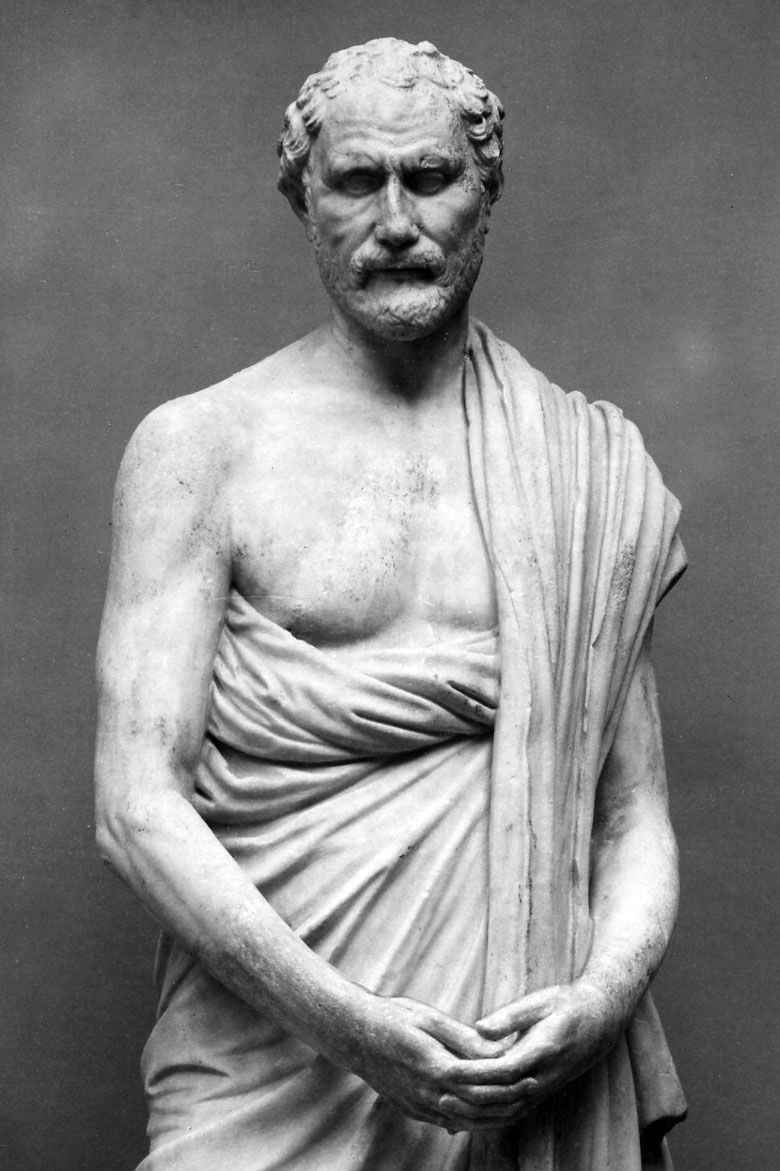
Demosthenes
Greek statesman and oratorWikipedia
698
MENTIONS
151
EPISODES
131
PODCASTS
Search complete. 698 mentions across 151 episodes found for "Demosthenes".
Sep 17, 2026

Amelia ChesleyNARRATOR
he is to place them as judges of his work.
Amelia ChesleyNARRATOR
How would Homer, how would Demosthenes, have been affected by what I have written? This is practical counsel, and even the most florid modern author, after polishing a paragraph, may tear it up when he has asked himself, what would Addison have said about this eloquence of mine, or Saint-Beuve, or Mr.
Amelia ChesleyNARRATOR
Matthew Arnold? In this way, what we call inspiration, that is, the performance of the heated mind, perhaps working at its best, perhaps overstraining itself and overstating its idea, might really be regulated.
Amelia ChesleyNARRATOR
But they are few who consider so closely, fewer perhaps they who have the heart to cut out their own fine or refined things.
23 MINS LATER
Amelia ChesleyNARRATOR
The great passions, when left to their own blind and rash impulses without the control of reason, are in the same danger as a ship let drive at random without ballast.
Amelia ChesleyNARRATOR
Often they need the spur, but sometimes also the curb.
Amelia ChesleyNARRATOR
The remark of Demosthenes with regard to human life in general, that the greatest of all blessings is to be fortunate, but next to that and equal in importance is to be well advised, for good fortune is utterly ruined by the absence of good counsel, may be applied to literature if we substitute genius for fortune and art for counsel.
Amelia ChesleyNARRATOR
Then again, and this is the most important point of all, A writer can only learn from art when he is to abandon himself to the direction of his genius.

LambdaNARRATOR
Once he attempted to eat raw meat, but he could not digest it.
LambdaNARRATOR
On one occasion, he found Demosthenes, the orator, dining in an inn, and as he was slipping away, he said to him, You will now be ever so much more in an inn.
LambdaNARRATOR
Footnote.
LambdaNARRATOR
This line is from Erepedes, Media, 411.
LambdaNARRATOR
End of footnote.
LambdaNARRATOR
Once, when some strangers wished to see Demosthenes, he stretched out his middle finger and said, this is the great demagogue of the athenian people when someone had dropped a loaf and was ashamed to pick it up again he wishing to give him a lesson tied a cord round the neck of a bottle and dragged it all through the he used to say that he imitated the teachers of choruses for that they spoke too loud in order that the rest might catch up the proper tone another of his sayings was that most men were within the finger's breadth of being mad if then any one were to walk along stretching out his middle finger he will seem to be mad But if he puts his forefinger, he will not be thought so.
LambdaNARRATOR
Another of his sayings was that the things of great value were often sold for nothing, and vice versa.
LambdaNARRATOR
Accordingly, that a statue would fetch three thousand rakhmas and a bushel of meal, only two obols.

speaker_6NARRATOR
In the days when Pindar and the nine lyric poets feared to attempt Homeric verse, there was no private tutor to stifle budding genius.
speaker_6NARRATOR
I need not cite the poets for evidence, for I do not find that either Plato or Demosthenes was given to this kind of exercise.
speaker_6NARRATOR
A dignified, and if I may say it, a chaste style is neither elaborate nor loaded with ornament.
speaker_6NARRATOR
It rises supreme by its own natural purity.
speaker_6NARRATOR
Nor yearn for the courts of proud princes who frown in their might, nor scheme with the riffraff a client in order to dine, nor can he with evil companions his wit drown in wine, nor sit as a hireling applauding an actor's grimace.
speaker_6NARRATOR
But whether the fortress of arms-bearing Tritonis smile upon him, or land which the Spartan colonials grace, or home of the Sirens with poetry let him beguile the years of young manhood, and at the Maenalian spring his fortunate soul drink his fill.
speaker_6NARRATOR
Then when later the lore of Socrates' school he has mastered, the reins let him fling, and brandish the weapons that mighty Demosthenes bore.
speaker_6NARRATOR
Then steeped in the culture and music of Greece, let his taste be ripened and mellowed by all the great writers of Rome.

LambdaNARRATOR
Once he attempted to eat raw meat, but he could not digest it.
LambdaNARRATOR
On one occasion, he found Demosthenes, the orator, dining in an inn, and as he was slipping away, he said to him, You will now be ever so much more in an inn.
LambdaNARRATOR
Footnote.
LambdaNARRATOR
This line is from Erepedes, Media, 411.
LambdaNARRATOR
End of footnote.
LambdaNARRATOR
Once, when some strangers wished to see Demosthenes, he stretched out his middle finger and said, this is the great demagogue of the athenian people when someone had dropped a loaf and was ashamed to pick it up again he wishing to give him a lesson tied a cord round the neck of a bottle and dragged it all through the he used to say that he imitated the teachers of choruses for that they spoke too loud in order that the rest might catch up the proper tone another of his sayings was that most men were within the finger's breadth of being mad if then any one were to walk along stretching out his middle finger he will seem to be mad but if he puts his forefinger he will not be thought so another of his sayings was that the things of great value were often sold for nothing and vice versa accordingly that a statue would fetch three thousand drachmas and a bushel of meal only two obols when zaneidas had bought him he said to him come do what you are ordered to and when he said the streams of sacred river now run backwards to their source suppose rejoined diogenes you had been sick and you had bought a physician could you refuse to be guided by him and tell him the streams of sacred rivers now run backwards to their source once a man came to him and wished to study philosophy as his pupil and he gave him a footnote the zapata was a croquiness a kind of fish when salted and made him follow him and as he from shame threw it away and departed he soon afterwards met him and laughing said to him a zapata has dissolved your friendship for me but diocles tells this story in the following manner that when some one had said to him give me a commission diogenes he carried him off and gave him half a penny worth of cheese to carry and as he refused to carry it see said diogenes a half a penny worth of cheese has broken off our friendship on one occasion he saw a child drinking out of its hands and so he threw away the cup which belonged to his wallet saying that child has beaten me in simplicity he also threw away his spoon after seeing a boy when he had broken his vessel take up his lentils with a crust of bread and he used to argue thus everything belongs to the gods and wise men are the friends of the gods all things are in common among friends therefore everything belongs to the wise men once he saw a woman falling down before the gods in an unbecoming attitude he wishing to cure her of her superstitions as zolius of perga tells us came up to her and said are you not afraid o woman to be in such an indecent attitude when some god may be behind you for every place is full of him he consecrated a man to aesculapius who was to run up and beat all those who prostrated themselves with their faces to the ground and as he was in the habit of saying that the tragic course had come upon him for that he was houseless and cityless a piteous exile from his dear native land a wandering beggar scraping a pit and spoor from day to day and another of his sayings was that he opposed confidence to fortune nature to law and reason to suffering once while he was sitting in the sun in the cranium alexander was standing by and said to him ask any favour you choose of me and he replied cease to shade me from the sun on one occasion a man was reading some long passages and when he came to the end of the book and showed that there was nothing more written be of good cheer my friends exclaimed diogenes i see land a man once proved to him syllogistically that he had hounds so he put up his hand to his forehead and said i do not see them and in a similar manner he replied to one who had been asserting that there was no such thing as motion by getting up and walking away when a man was talking about the heavenly bodies and meteors pray how many days said he to him is it since you came down from the heaven a profligate nunch had written on his house let no evil thing enter in where said diogenes is the master of the house going after having anointed his feet with perfume he said that the ointment from his head mounted up to heaven and that from his feet up to his nose when the athenians entreated him to be initiated in the eleusinian mysteries and said that in the shades below the initiated had the best seats it will he replied be an absurd thing if hegesliaus and epaminondas are to live in the mud and some miserable britches who have been initiated are to be in the islands of the blessed.
LambdaNARRATOR
Some mice crept up to his table, and he said, See, even Diogenes maintains his favourites.
LambdaNARRATOR
Once when he was leaving the bath, and a man asked him whether many men were bathing, he said, No.

David WalesNARRATOR
To pursue the story of the modern world in the pages of Hume, Macaulay, Thiers, and Sismonde, and our own Prescott, Motley, and Bancroft.
David WalesNARRATOR
To enjoy afresh the eloquence of Demosthenes and the polished and splendid diction of Cicero.
David WalesNARRATOR
To drink in the wisdom of philosophers and to walk with Socrates, Plato, and the Stoics through the groves of academia.
David WalesNARRATOR
To be kindled by the saintly utterances of prophets and apostles, St. Paul's high reasoning of immortality, or the seraphic visions of St. John.

speaker_6NARRATOR
They might try to make us feel that they knew what it was and this they have done.
speaker_6NARRATOR
But that which Demosthenes called the first, the second and the third part of it, so far as it relates to them, has died with them.
speaker_6NARRATOR
We have no idea of it.
speaker_6NARRATOR
But we are men no less than they are.
1 HR 52 MINS LATER
speaker_20NARRATOR
Qui peut les plus, peut les moins.
speaker_20NARRATOR
I have seen it recommended, when practising articulation, to place corks between the teeth.
speaker_20NARRATOR
Demosthenes is said to have practised on the seashore with pebbles in his mouth.
speaker_20NARRATOR
We do not know where he placed them.
Graham RedmanNARRATOR
That he travelled extensively over Greece, visited Asia Minor, Egypt, and Italy, and resided much at Rome, may be inferred from his writings, as most that is known about him must be inferred.
Graham RedmanNARRATOR
At Rome he was in charge of certain public business, so that he had not time to learn thoroughly the Latin language, as he himself confesses in the introduction to his Demosthenes.
Graham RedmanNARRATOR
But Greek was the language of literary and polite society at Rome, and cultivated Greeks, especially philosophers, were welcomed there.
Graham RedmanNARRATOR
As a Greek philosopher and a popularizer of Platonism, Plutarch read and lectured at Rome much as he did in the small but select circle of his intimates and friends at home.
Graham RedmanNARRATOR
This pair, or book, of lives is unfortunately lost.
Graham RedmanNARRATOR
With Camillus, who saved Rome from the Gauls, he matched Themistocles, who saved Athens from the Persians.
Graham RedmanNARRATOR
Then followed, as nearly as the order can be determined, for the order of the lives in our collection is not the original one, the Cimon and Lucullus, the Lycurgus and Numa, the Demosthenes and Cicero, the Pelopidas and Marcellus, the Lysander and Sulla, the Philopæmen and Flamininus, the Pericles and Fabius Maximus, the Aristides and Cato Major, and thirteen other pairs.
Graham RedmanNARRATOR
Eighteen of the twenty-two pairs which have come down to us close with a formal comparison of the two careers and characters.

John BurlinsonNARRATOR
It is said, and with good reason, that the favour and affection which Socrates showed him contributed not a little to his reputation.
John BurlinsonNARRATOR
Certain it is that Nicias, Demosthenes, Lamachus, Formio, Thrasybulus, and Theramenes were prominent men and his contemporaries, and yet we cannot so much as name the mother of any of them.
John BurlinsonNARRATOR
Whereas in the case of Alcibiades, we even know that his nurse, who was a Spartan woman, was called Amycla, and his tutor Zopyrus.
John BurlinsonNARRATOR
The one fact is mentioned by Antisthenes, the other by Plato.
51 MINS LATER
John BurlinsonNARRATOR
During the deliberations of the people on the extent and character of the armament, Nicias again tried to oppose their wishes and put a stop to the war.
John BurlinsonNARRATOR
But Alcibiades answered all his arguments and carried the day.
John BurlinsonNARRATOR
And then Demosthenes, the orator, formally moved that the generals have full and independent powers in the matter of the armament and of the whole war.
John BurlinsonNARRATOR
After the people had adopted this motion, and all things were made ready for the departure of the fleet, there were some unpropitious signs and portents, especially in connection with the festival, namely the Aedonia.

Phil ChenevertNARRATOR
No need to worry about that, sir.
Phil ChenevertNARRATOR
Wims may have us a little shook up, but he hasn't flipped us yet." i hope we can all say that when tomorrow ends the captain said fervently the company command post had been set up under a cluster of dispirited pines obviously suffering from tired sap but in spite of the ragged shade they provided against the mild mid-morning sun captain aronson was perspiring excessively and becoming increasingly unsettled He glanced uneasily over at the somewhat planetary bulk of General Phyfe, surrounded by his satellite colonels and other aides, and muttered to his lieutenant, If old Brassbottom came down here to observe the exercise, then why the devil doesn't he go over to the hill and observe instead of hanging around here like a sort of Demosthenes? I think you mean Damocles, Captain, the lieutenant corrected.
Phil ChenevertNARRATOR
Demosthenes was the orator.
speaker_0ADVERTISER
This message comes from Viking, committed to exploring the world in comfort.
speaker_0ADVERTISER
Journey through the heart of Europe on an elegant Viking longship with thoughtful service, destination-focused dining, and cultural enrichment on board and on shore.

Maria KasperNARRATOR
It was in current use.
Maria KasperNARRATOR
Greek was comparatively new in Western schools, and though from their beginnings the Jesuits were famous teachers, we can hardly suppose that in their new and small college at Vienna the boys were much troubled by the speech of Plato and Demosthenes.
Maria KasperNARRATOR
Of their games it is hard to know much at this late day.
Maria KasperNARRATOR
Sword-play and bouts of a soldierly sort were common enough.
141 more episodes mention Demosthenes.
Create an account to see the whole feed, search across every transcript, and follow the entities you care about.