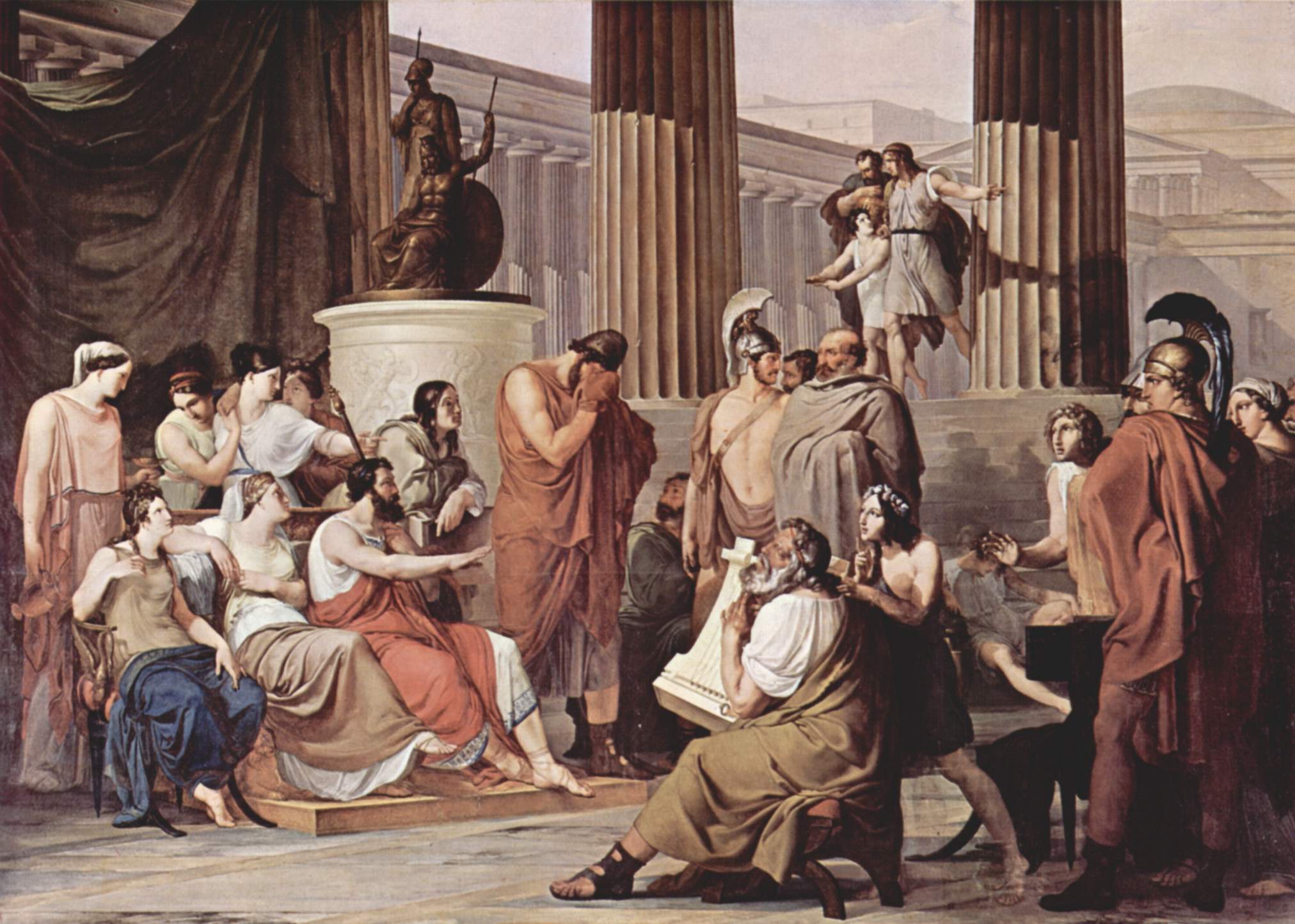
Demodocus
Mythological characterWikipedia
69
MENTIONS
17
EPISODES
14
PODCASTS
Search complete. 69 mentions across 17 episodes found for "Demodocus".
Sep 17, 2026

Peter YearsleyNARRATOR
chapter seven when it was daylight alcinous caused it to be proclaimed by the heralds about the town that there was come to the palace a stranger shipwrecked on their coast that in mien and person resembled a god and inviting all the chief people of the city to come and do honour to the stranger The palace was quickly filled with guests, old and young, for whose cheer and to grace Ulysses more, Alcinous made a kingly feast with banquetings and music.
Peter YearsleyNARRATOR
Ulysses being seated at a table next the king and queen, in all men's view, after they had feasted, Alcinist ordered Demodocus, the court singer to be called, to sing some songs of the deeds of heroes, to charm the ear of his guest.
Peter YearsleyNARRATOR
Demodocus came and reached his harp, where it hung between two pillars of silver.
Peter YearsleyNARRATOR
And then the blind singer, to whom in recompense of his lost sight the muses had given an inward discernment, a soul and a voice to excite the hearts of men and gods to delight, began in grave and solemn strains to sing the glories of men highest famed.
Peter YearsleyNARRATOR
He chose a poem whose subject was the stern strife stirred up between Ulysses and great Achilles, as at a banquet sacred to the gods in dreadful language, they expressed their difference, while Agamemnon sat rejoiced in soul to hear those Grecians jar.
Peter YearsleyNARRATOR
For the oracle in Pytho had told him that the period of their wars in Troy should then be when the kings of Greece, anxious to arrive at the wished conclusion, should fall to strife and contend which must end the war, force or stratagem.
Peter YearsleyNARRATOR
this brave contention he expressed so to the life in the very words which they both used in the quarrel as brought tears to the eyes of ulysses at the remembrance of past passage of his life and he held his large purple weed before his face to conceal it then craving a cup of wine he poured it out in secret libation to the gods who had put into the mind of demodocus unknowingly to him so much honour But when the moving poet began to tell of other occurrences where Ulysses had been present, the memory of his brave followers who had been with him in all difficulties, now swallowed up and lost in the ocean, and of those kings that had fought with him at Troy, some of whom were dead, some exiles like himself, forced itself so strongly upon his mind that forgetful where he was, he sobbed outright with passion, which yet he restrained, but not so cunningly, but so alcenous perceived it, and without taking notice of it to Ulysses, privately gave signs that domodocus should cease from his singing next followed dancing in the phaetian fashion when they would show respect to their guests which was succeeded by trials of skill games of strength running racing hurling of the coit mock fights hurling of the javelin shooting with the bow in some of which ulysses modestly challenging his entertainers performed such feats of strength and prowess as gave the admiring physicians fresh reason to imagine that he was either some god or hero of the race of the gods these solemn shows and pageants in honour of his guest king alcinous continued for the space of many days as if he could never be weary of showing courtesies to so worthy a stranger In all this time he never asked him his name, nor sought to know more of him than he of his own accord disclosed.
Peter YearsleyNARRATOR
till on a day as they were seated feasting, after the feast was ended, Demodocus being called, as was the custom, to sing some grave matter, sang how Ulysses, on that night when Troy was fired, made dreadful proof of his valour, maintaining singly a combat against the whole household of Diphobus, to which the divine expressor gave both act and passion.

Landon SolanoHOST
And when they had burnt the pieces of the thighs, they shared the glorious feast and made merry.
Landon SolanoHOST
And among them harped the divine minstrel Demodocus, whom the people honored.
Landon SolanoHOST
But Odysseus would never turn his head toward the splendor of the sun as one fain to hasten his setting.
Landon SolanoHOST
for verily he was most eager to return.

TristanHOST
All right.
NoahHOST
One of my favorite, uh, lines or, or bits was, um, towards the, mm, towards the beginning I think, there was a festival or something and Demodocus comes.
NoahHOST
Oh, and her dad is talking about, he's, he's criticizing, like, the idea that the Trojan War really took place based on, like, Helen, that they really pursued it because of Helen.
NoahHOST
And then Nausicaa, uh, makes a...

Alex PetkasHOST
In Homer's biased view, glory, kleos, is the highest prize that a hero can compete for.
Alex PetkasHOST
Biased, I say, because an epic bard like Homer himself is the chief distributor of such glory.
Alex PetkasHOST
Because the technical definition of glory in this context would be having your story sung by an epic bard.
Alex PetkasHOST
And what is an epic bard really? Well, we're about to meet one in the next book.
Alex PetkasHOST
They all go to bed, and Book Seven ends.
Alex PetkasHOST
When you really break it down, there are not too many experiences we have today that the ancients just couldn't relate to.
Alex PetkasHOST
And when they all get there, the king speaks up.
Alex PetkasHOST
"All right, folks, this man here wants a ride home, and we're gonna give it to him.

Josh ClarkHOST
And, um, he almost certainly lived during this age that they attribute it to.
Josh ClarkHOST
And they also are, are like, it's possible that he might be a known historic blind bard named, uh, Demo- Demodocus.
Chuck BryantHOST
[laughs]
Josh ClarkHOST
Demodocus.
Chuck BryantHOST
Yeah.
Josh ClarkHOST
That's the hardest one, I think, out of this whole, whole, uh, article.
Chuck BryantHOST
So-
Josh ClarkHOST
Right.

Russell HawkeHOST
So as part of the, you know, getting ready for the podcast, I sent you through a few excerpts from the poem, which I thought I'd ask you to read.
Russell HawkeHOST
And so I wondered, could you read the one where, is it, Demodocus sings about the Trojan horse?
Armand D'AngourGUEST
Yes.
Armand D'AngourGUEST
So what happens is that Odysseus ends up on this island of Scaria, and there's a singer called Demodocus.
Armand D'AngourGUEST
And Odysseus hears him sing and says, you sang beautifully, because he hears him sing in the sack of Troy.
Armand D'AngourGUEST
And he says, but come, he says now, sing of the wooden horse, a pair spilt with Athena's help, the cunning trap that good Odysseus brought one day to the heights of Troy, filled with fighting men who laid the city waste.

Geoffrey EdwardsNARRATOR
Now, Theodotus himself is dead, and therefore he, at any rate, will not seek to stop him.
Geoffrey EdwardsNARRATOR
And there is Paralus, the son of Demodocus, who had a brother, Theges.
Geoffrey EdwardsNARRATOR
And Ademantus, the son of Ariston, whose brother Plato is present.
Geoffrey EdwardsNARRATOR
and Aeontodorus, who is the brother of Apollodorus, whom I also see.

speaker_6NARRATOR
I am giving these instructions to the young men who will form the crew." For as regards you aldermen and town counselors, you will join me in entertaining our guests in the cloisters.
speaker_6NARRATOR
I can take no excuses, and we will have Demodocus to sing for us, for there was no bard like him, whatever he may choose to sing about.
speaker_6NARRATOR
Alcinus then led the way, and the others followed after, while a servant went to fetch Demodocus.
speaker_6NARRATOR
The fifty-two picked oarsmen went to the seashore as they had been told, and when they got there, they drew the ship into the water, got her mast and sails inside her, bound the oars to the thulpins with twisted thongs of leather, all in due course, and spread the white sails aloft.
speaker_6NARRATOR
They moored the vessel a little way out from land, and then came on shore and went to the house of King Alcinus.
speaker_6NARRATOR
The outhouses, yards, and all the precincts were filled with crowds of men in great multitudes both old and young, and Alcinus killed them a dozen sheep, eight full-grown pigs, and two oxen.
speaker_6NARRATOR
These were skinned and dressed so as to provide a magnificent banquet, A servant presently led in the famous bard Demodocus, whom the muse had dearly loved, but to whom she had given both good and evil.
speaker_6NARRATOR
For though she had endowed him with a divine gift of song, she had robbed him of his eyesight.
speaker_4NARRATOR
Then they went to the house of Alcinous to get dinner, and he sacrificed a bull for them in honour of Jove, who is the lord of all.
speaker_4NARRATOR
They set the steaks to grill and made an excellent dinner, after which the inspired bard Demodocus, who was a favourite with everyone, sang to them.
speaker_4NARRATOR
But Ulysses kept on turning his eyes towards the sun as though to hasten his setting, for he was longing to be on his way.
speaker_4NARRATOR
As one who has been all day ploughing a fallow field with a couple of oxen keeps thinking about his supper and is glad when night comes that he may go and get it, for it is all his legs can do to carry him, even so did Ulysses rejoice when the sun went down, and he at once said to the Phaeacians, addressing himself more particularly to King Alcinous, Sir, and all of you, farewell.

JimmyHOST
Even the blindness, the one thing everybody knows about Homer, dissolves under inspection.
JimmyHOST
The Odyssey features a blind bard named Demodocus who sings at a royal court, and later Greeks seem to have read him as a self-portrait of Homer.
JimmyHOST
An early hymn to Apollo contains a passage where the singer describes himself as a blind man from rocky chios.
JimmyHOST
The historian Thucydides, a much more rigorous scholar than Herodotus, cited those lines as Homer's own words about himself.
7 more episodes mention Demodocus.
Create an account to see the whole feed, search across every transcript, and follow the entities you care about.