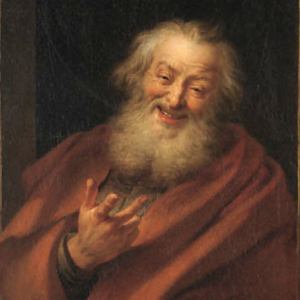
Democritus
Greek philosopherWikipedia
382
MENTIONS
124
EPISODES
53
PODCASTS
Search complete. 382 mentions across 124 episodes found for "Democritus".
Nov 26, 2026

Geoffrey EdwardsNARRATOR
Everything else, they think, is moved by the soul, but the soul is moved by itself, and this because they never see anything cause motion without itself being in motion.
Geoffrey EdwardsNARRATOR
Similarly, the soul is said to be the moving principle by Anaxagoras and all others who have held that mind sets the universe in motion, but not altogether in the same sense as by Democritus.
Geoffrey EdwardsNARRATOR
The latter indeed absolutely identified soul and mind, holding that the presentation to the senses is the truth.
Geoffrey EdwardsNARRATOR
hence he observed homer had well sung of hector in his swoon that he lay with other thoughts democritus then does not use the term mind to denote a faculty conversant with truth but regards mind as identical with soul anaxagoras however is less exact in his use of the terms in many places he speaks of mind as the cause of goodness and order but elsewhere he identifies it with the soul as where he attributes it to all animals both great and small high and low as a matter of fact however mind in the sense of intelligence would not seem to be present in all animals alike nor even in all men Those, then, who have directed their attention to the motion of the animate being, conceived the soul as that which is most capable of causing motion, while those who laid stress on its knowledge and perception of all that exists identified the soul with the ultimate principles, whether they recognized a plurality of these or only one.
37 MINS LATER
Geoffrey EdwardsNARRATOR
how then can this cause of motion be a unit for if it were so there must be some difference between it and the other units but what is there to differentiate points which are units except position if then the units that is the points in the body are distinct from the units of soul the units of soul will be in the same place as the points for each unit will occupy the space of a point And yet, if two things can be in the same place, why not an infinite number? When the place which things occupy is indivisible, the things themselves are also indivisible.
Geoffrey EdwardsNARRATOR
If, on the other hand, the number of the soul consists of the points in the body, or if the soul is the number of such points, why are not all bodies possessed of soul? for in all bodies there would seem to be points nay an infinity of points and further how can the points be separated and set free from the bodies to which they belong unless indeed we are prepared to resolve lines into points CHAPTER V.
Geoffrey EdwardsNARRATOR
It comes to this, then, as we have said, first, that this view coincides with that which makes of the soul a body composed of fine particles, next, that its agreement with Democritus as to the manner in which he makes the body to be moved by the soul gives it an especial absurdity of its own.
Geoffrey EdwardsNARRATOR
If the soul resides in the whole sentient body, on the assumption that the soul is a sort of body, it necessarily follows that two bodies occupy the same space.
Geoffrey EdwardsNARRATOR
Yet, in common with other thinkers, he affirms that the elements are many.
Geoffrey EdwardsNARRATOR
Thus, Empedocles holds that the corporeal elements are four, while all the elements, including those which initiate movement, are six in number, whereas Anaxagoras agrees with Leucippus and Democritus that the elements are infinite.
Geoffrey EdwardsNARRATOR
anaxagoras posits as elements the homeomeres viz bone flesh marrow and every thing else which is such that part and whole are the same in name and nature while democritus and leucippus say that there are indivisible bodies infinite both in number and in the varieties of their shapes of which every thing else is composed the compounds differing one from another according to the shapes positions and groupings of their constituents for the views of the school of anaxagoras seemed diametrically opposed to those of the followers of empedocles empedocles says that fire water air and earth are four elements and are thus simple rather than flesh bone and bodies which like these are homomeres but the followers of anaxagoras regard the homoeomeries as simple and elements whilst they affirm that earth fire water and air are a composite for each of these is according to them a common seminary of all the homoeomeries Those then who construct all things out of a single element must maintain that coming to be and passing away are alteration, for they must affirm that the underlying something always remains identical and one, and change of such a substratum is what we call altering.
Geoffrey EdwardsNARRATOR
those on the other hand who make the ultimate kinds of things more than one must maintain that alteration is distinct from coming to be for coming to be and passing away result from the consilience and the dissolution of the many kinds That is why Empedocles, too, uses language to this effect, when he says, There is no coming to be of anything, but only a mingling and a divorce of what has been mingled.
Geoffrey EdwardsNARRATOR
Not only then, but also now, if and because they change their qualities— and to judge by what he says the qualities are such that they can be attached to things and can again be separated from them especially since strife and love are still fighting with one another for the mastery it was owing to this same conflict that the elements were generated from a one at the former period i say generated for presumably fire earth and water had no distinctive existence at all while merged in one there is another obscurity in the theory of empedocles are we to regard the one as his original real or is it the many i e fire and earth and the bodies co-ordinate with these for the one is an element in so far as it underlies the process as matter as that out of which earth and fire come to be through a change of qualities due to the motion on the other hand in so far as the one results from composition by a consilience of the many whereas they result from disintegration the many are more elementary than the one and prior to it in their nature chapter two we have therefore to discuss the whole subject of unqualified coming to be and passing away we have to inquire whether these changes do or do not occur and if they occur to explain the precise conditions of their occurrence we must also discuss the remaining forms of change, viz., growth, and alteration.
Geoffrey EdwardsNARRATOR
For though no doubt Plato investigated the conditions under which things come to be and pass away, he confined his inquiry to these changes, and he discussed not all coming to be, but only that of the elements.
Geoffrey EdwardsNARRATOR
he asked no questions as to how flesh or bones or any of the other similar compound things come to be nor again did he examine the conditions under which alteration or growth are attributable to things A similar criticism applies to all our predecessors, with the single exception of Democritus.
Geoffrey EdwardsNARRATOR
Not one of them penetrated below the surface, or made a thorough examination of a single one of the problems.

speaker_2NARRATOR
The early physiologists had generally written in verse.
speaker_2NARRATOR
The prose writers, like Democritus and Anaxagoras, as far as we can judge from their fragments, never attained to a periodic style.
speaker_2NARRATOR
And hence, we find the same sort of clumsiness in the Timaeus of Plato, which characterizes the philosophical poem of Lucretius.
speaker_2NARRATOR
There is a want of flow, and often a defect of rhythm.
2 HRS 33 MINS LATER
speaker_6NARRATOR
Yet perhaps Plato may regard these sides or faces as only the forms which are impressed on pre-existent matter.
speaker_6NARRATOR
It is remarkable that he should speak of each of these solids as a possible world in itself, though upon the whole he inclines to the opinion that they form one world, and not five.
speaker_6NARRATOR
To suppose that there is an infinite number of worlds, as Democritus, Hippolytus, refutation of all heresies, 113, had said, would be, as he satirically observes, the characteristic of a very indefinite and ignorant mind.
speaker_6NARRATOR
55c.d. the twenty triangular faces of an icosahedron form the faces or sides of two regular octahedrons and of a regular pyramid twenty equals eight by two plus four and therefore according to plato a particle of water when decomposed is supposed to give two particles of air and one of fire So because an octahedron gives the sides of two pyramids, 8 equals 4 times 2, a particle of air is resolved into two particles of fire.

speaker_5NARRATOR
He will not set forth the principles of Ecclesiastes, Ptolemaeus, and Huron, but neither will he be pained by the tumid vaunts of uncultured men.
speaker_5NARRATOR
He will make no display of the doctrines of Plato and Aristotle and Pyrrhon, and the names of any Democritus, and Heraclitus, Oxanagoras, Cleanthes, and Epicurus, and all the other members of the venerable portent academy.
speaker_5NARRATOR
But neither will he trouble himself with the solution of their cunning syllogisms.
speaker_5NARRATOR
What need of further details? Yet here are some which all men honor or desire.

speaker_7NARRATOR
which happened to be a very old one.
speaker_7NARRATOR
The theory of Democritus that the material universe contains nothing but a multitude of solid atoms coursing through infinite space.
speaker_7NARRATOR
But Locke added a religious note to this materialism by suggesting that infinite space, in its subtlety, must be an attribute of God.
speaker_7NARRATOR
He also believed what few materialists would venture to assert that if we could thoroughly examine the cosmic mechanism, we should see the demonstrable necessity of every complication that ensues, even of the existence and character of mind, for it was no harder for God to endow matter with the power of thinking than to endow it with the power of moving.
speaker_7NARRATOR
But it is all a picture, prophesying what we might see through a sufficiently powerful microscope.
speaker_7NARRATOR
The important philosophical question is the one raised by the other half of Locke's natural philosophy, by optics and the general criticism of perception.
speaker_7NARRATOR
How far, if at all, may we trust the images in our minds to reveal the nature of external things? On this point of doctrine, Locke, through Descartes, was also derived from Democritus.
speaker_7NARRATOR
It was that all the sensible qualities of things, except position, shape, solidity, number, and motion, were only ideas in us, projected and falsely regarded as lodged in things.

Daniel RayHOST
And I know the materialist philosopher of the Greco-Roman world who has said the phrase, all is atoms in the void.
Daniel RayHOST
It was Democritus, I believe.
Daniel RayHOST
Not the same kind of atomistic concept that we have in modern physics today, but there's a similar strain there, Dr. Portris, about the... declaring what's out there is the ultimate declaration of what is.
Daniel RayHOST
It reminds you of Carl Sagan and Cosmos saying that the cosmos is all there is.
Daniel RayHOST
But we're told by naturalists and materialists that the physical world, just like Democritus, is all there is.
Daniel RayHOST
But as you just pointed out, our Western world is coming apart at the seams trying to figure out there has to be something more.
Daniel RayHOST
than what naturalism or materialism has been telling us for centuries.
Vern S. PoythressGUEST
Everything else is composed of matter.

Beth ThomasNARRATOR
But in those days it was probably the case, as it is now, that if a man did not form speculative opinions in youth, the pressure of affairs would not leave him leisure to do so later.
Beth ThomasNARRATOR
the life-span of zeno the founder of stoicism was from b c three forty seven to two seventy five he did not begin teaching till three fifteen at the mature age of forty aristotle had passed away in three twenty two and with him closed the great constructive era of greek thought The Ionian philosophers had speculated on the physical constitution of the universe, the Pythagoreans on the mystical properties of numbers, Heraclitus had propounded his philosophy of fire, Democritus and Leucippus had struck out a rude form of the atomic theory, Socrates had raised questions relating to man, Plato had discussed them with all the freedom of the dialogue, while Aristotle had systematically worked them out.
Beth ThomasNARRATOR
the later schools did not add much to the body of philosophy what they did was to emphasize different sides of the doctrine of their predecessors and to drive views to their logical consequences the great lesson of greek philosophy is that it is worth while to do right irrespective of reward and punishment and regardless of the shortness of life this lesson the stoics so enforced by the earnestness of their lives and the influence of their moral teaching that it has become associated more particularly with them cicero though he always classed himself as an academic exclaims in one place that he is afraid the stoics are the only philosophers and whenever he is combating epicureanism his language is that of a stoic Some of Virgil's most eloquent passages seem to be inspired by Stoic speculation.
Beth ThomasNARRATOR
Even Horace, despite his banter about the sage, in his serious moods, borrows the language of the Stoics.
Beth ThomasNARRATOR
But at that point their agreement ended.
Beth ThomasNARRATOR
As to the nature of happiness, there was the utmost variety of opinion.
Beth ThomasNARRATOR
Democritus had made it consist in mental serenity, Anaxagoras in speculation, Socrates in wisdom, Aristotle in the practice of virtue with some amount of favor from fortune.
Beth ThomasNARRATOR
aristippus simply in pleasure these were opinions of the philosophers but besides these there were the opinions of ordinary men as shown by their lives rather than by their language zeno's contribution to thought on the subject does not at first sight appear illuminating he said that the end was to live consistently the implication doubtless being that no life but the passionless life of reason could ultimately be consistent with itself Cleanthes, his immediate successor in the school, is credited with having added the words with nature, thus completing the well-known Stoic formula that the end is to live consistently with nature.

David KippingHOST
What Carl Sagan so eloquently pondered is a question which has haunted humanity since at least antiquity.
David KippingHOST
For example, in ancient Greece, Epicurus suggested that there were an infinite variety of worlds and Democritus posited there were innumerable worlds, some living and some not.
David KippingHOST
Amongst infinities, all possibilities will occur, infinite times in fact, yet proportionally they could still be incredibly rare instantiations.
David KippingHOST
That's what really matters.

speaker_0NARRATOR
Yet around 2400 years ago in ancient Greece, one man working on his own and without even a small hadron collider came up with some remarkable insights.
speaker_0NARRATOR
This one had the promising name of Democritus, who declared that all matter was comprised of atoms, and his footprint is hard to overlook.
speaker_0NARRATOR
These atoms were, he said, physically but not geometrically indivisible.
speaker_0NARRATOR
He also believed that between atoms, there lay empty space.

Shane GreenupNARRATOR
after so many speculations on the conflagration of the universe, was filled with water internally, and died smeared all over with mud.
Shane GreenupNARRATOR
And lice destroyed Democritus, and other lice killed Socrates.
Shane GreenupNARRATOR
What means all this? Thou hast embarked, thou hast made the voyage, thou art come to shore, get out.
Shane GreenupNARRATOR
If indeed to another life there is no want of gods, not even there.
114 more episodes mention Democritus.
Create an account to see the whole feed, search across every transcript, and follow the entities you care about.