Deimos
Natural satelliteWikipedia
37
MENTIONS
9
EPISODES
9
PODCASTS
Search complete. 37 mentions across 9 episodes found for "Deimos".
Sep 17, 2026

speaker_0HOST
He describes the MMX mission and his role as the PI for the Idafex rover, a French-German contribution named after the loyal dog from the Asterix comics.
speaker_0HOST
Dr. Ulemesh is a principal investigator for the 25kg rover, which is packed with sophisticated technology designed to survive and operate in the ultra-low gravity of the Martian moon, primarily Phobos, but it will investigate Deimos too.
speaker_0HOST
Dr. Ulamesh explains the bouncing delivery method where the rover is dropped from the main spacecraft at an altitude of 40 to 100 metres, eventually uprighting itself using an elegant and intricate deployment system.
speaker_0HOST
And you can see the deployment simulation online.
speaker_0HOST
You've served on projects including Philia, the Rosetta lander that touched down on a comet in 2014, and as a payload manager on Mascot, which landed on the asteroid Ryugu, part of the Japanese Hayabusa-2 mission.
Stefan UlamecGUEST
Yes, I'm located in Germany, one of the centers of DLR, but of course there are many institutes of DLR involved in these missions, so I'm closely working together also with the colleagues in DLR in Berlin and also in Oberpfaffenhofen, which is close to Munich.
speaker_0HOST
To summarise this MMX mission, it's JAXA-led and it's launching later this year to orbit Mars and study the moons Phobos and Deimos and return a sample from the surface of Phobos to Earth by about 2031.
speaker_0HOST
That's the mission in brief.

Nigel CarringtonNARRATOR
Chapter Twenty-One.
Nigel CarringtonNARRATOR
Deimos and the Voyage from Mars through Space.
Nigel CarringtonNARRATOR
Higher and higher did we rise from the Ice Mountain.
Nigel CarringtonNARRATOR
At our feet, the green expanse of the Delarue Ocean opened wider and wider, with the verdant billows rolling one after another in long lines, like the huge pampa grass of your American plains, with now and then a white snow cloud resting on expanse.
Nigel CarringtonNARRATOR
Nonetheless so, because every point we could see had now for us some pleasing reminiscence of what we had beheld when viewing it more nearly.
Nigel CarringtonNARRATOR
Higher still we went, till Mars seemed as a huge globe beneath our feet.
Nigel CarringtonNARRATOR
Our first start was, as I said, for the moon of Deimos, one of the two little satellites of Mars.
Nigel CarringtonNARRATOR
It is one of the smallest of the worlds of the solar system, for few even of the planetoids are so minute.

Seth Adam ScherrNARRATOR
The nearer of these moons, Phobos, is only three thousand seven hundred miles from the surface of Mars, and we watched it traveling around the planet three times in the course of every day.
Seth Adam ScherrNARRATOR
The more distant one, Deimos, twelve thousand five hundred miles away, required considerably more than one day to make its circuit.
Seth Adam ScherrNARRATOR
It now happened that the two had come into conjunction, as I have said, just over our heads, and throwing myself down on my back on the deck of the electrical ship, for a long time I watched the race between the two satellites, until Phobos, rapidly gaining upon the other, had left its rival far behind.
Seth Adam ScherrNARRATOR
Suddenly Colonel Smith, who took very little interest in these astronomical curiosities, touched me, and pointing ahead, said, There they are.
8 MINS LATER
Seth Adam ScherrNARRATOR
Why not rendezvous at one of the moons, said an astronomer.
Seth Adam ScherrNARRATOR
Neither of the two moons is of much consequence as far as size goes, but still it would serve as a sort of anchorage ground, and while there, if we were careful to keep on the side away from Mars, we should escape detection.
Seth Adam ScherrNARRATOR
This suggestion was immediately accepted, and the squadron, having been signaled to assemble, quickly bore off in the direction of the more distant moon of Mars, Deimos.
Seth Adam ScherrNARRATOR
We knew that it was slightly smaller than Phobos, but its greater distance gave promise that it would better serve our purpose of temporary concealment.

speaker_3HOST
Yeah.
speaker_2HOST
You know, Phobos and Deimos.
speaker_3HOST
And to understand the sheer audacity of this, we have to look at the isotopic and chemical signatures locked inside those 10 grams.
speaker_2HOST
Right.
speaker_2HOST
The primary objective is to eventually touch down on Phobos, the larger of Mars' two moons, scoop up that minimum of 10 grams of surface material, and launch a return capsule back to Earth.
speaker_3HOST
And there's a secondary objective too.
speaker_2HOST
Yeah, to conduct close flyby observations of the other moon, Deimos, without actually landing.
speaker_3HOST
And if the entire sequence executes successfully, the sample capsule detaches from the main spacecraft upon returning to our planetary neighborhood, reenters Earth's atmosphere at a blistering speed, and parachutes down into the remote Australian Outback around the year 2031.

AveryHOST
Well, technically just past it, to one of its two little moons.
AnnaHOST
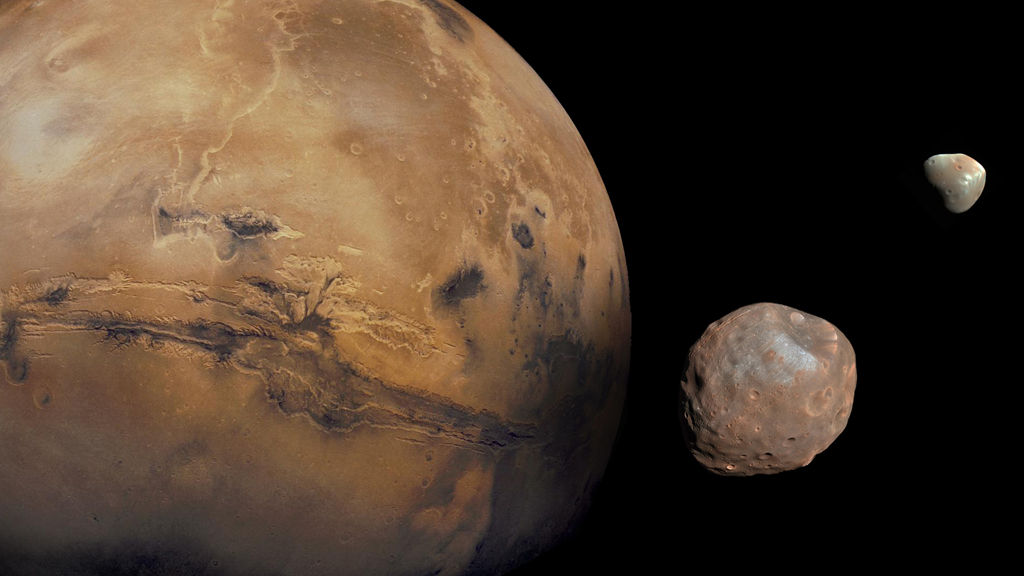
Deimos, the smaller and more distant of Mars' two moons, it's always been a bit of an odd duck.
AnnaHOST
It's shaped like a lumpy potato, it's got an unexplained depression near its south pole, and its surface is oddly smooth and dusty for a body that small.
AveryHOST
And somebody's finally worked out why?
AnnaHOST
A team led by Sabina Radican, now at the Vrije Universiteit Brussel, working with Martin Jutzi at the University of Bern, published the answer in Nature Astronomy.
AnnaHOST
And this is the first published study to use actual flyby data from ESA's Hera mission, which swung past Deimos on its way out to the asteroid Dimorphos.
AveryHOST
What did they find?
AnnaHOST
A single asteroid impact explains both quirks at once.

AveryHOST
Two Nobel laureates defending an accelerating universe.
AveryHOST
One very old asteroid strike solving two mysteries on Deimos.
AveryHOST
And everything you need to get outside tonight.
AnnaHOST
If you enjoyed today's episode, the best thing you can do for us is leave a rating or review wherever you're listening and share it with a fellow space nerd.

ChaseNARRATOR
Diese Kollision riss einen Teil der Marshalkugel weg.
ChaseNARRATOR
Die Trümmer formten sich schließlich zu den Monden Phobos und Deimos, die ihn noch heute umkreisen.
ChaseNARRATOR
Jetzt in sechzehn Millionen Kilometern Entfernung wäre Jupiter auf der Zielgeraden.
ChaseNARRATOR
Von der Erde aus würde man ihn hell und deutlich sehen können.

John GreenHOST
unveiled the spacecraft for their upcoming Martian moons exploration mission.
John GreenHOST
Ooh So they're gonna go to the moons of Mars, so not to the Moon or to Mars, but to the moons of Mars, Phobos and Deimos.
John GreenHOST
It's, they're, it, they're actually gonna land on Phobos with a rover- Hmm ... that's gonna, it's a, like, a little rover.
John GreenHOST
And we were just talking about moon buggies on very light, like, things with very s- small gravity.
John GreenHOST
Um- Well, we'll figure that out.
John GreenHOST
And- That'll be for next week ... uh, s- and then the...
John GreenHOST
it will also be sort of, like, looking at Deimos, uh, rather than, rather than landing there.
John GreenHOST
Um- Hmm ...