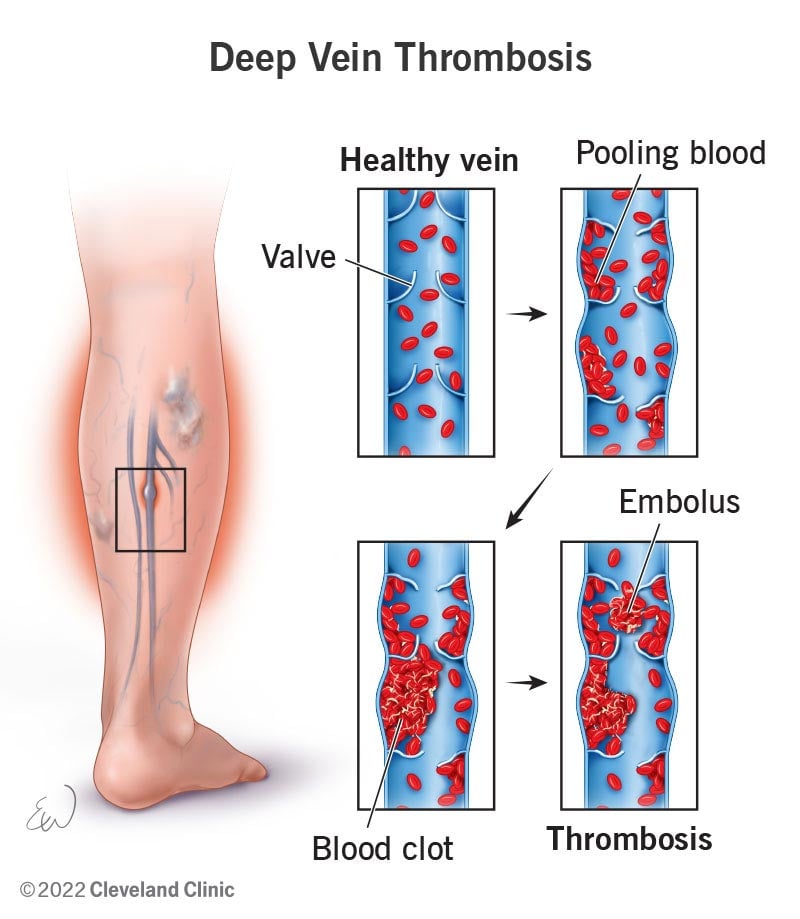
deep vein thrombosis
DiseaseWikipedia
312
MENTIONS
143
EPISODES
132
PODCASTS
Search complete. 312 mentions across 143 episodes found for "deep vein thrombosis".
Oct 27, 2026

MegganHOST
It can help prevent blood clots.
MegganHOST
So sitting for long periods, and I think that's what we might have talked about before, can cause DVT, which is deep vein thrombosis.
MegganHOST
And again, the socks can help the blood from pooling and causing a clot.
MegganHOST
They also reduce swelling from fluid buildup known as edema.

Leonardo LopezGUEST
But before the patient gets to malignant catatonia, there are a lot of risks.
Leonardo LopezGUEST
So the primary medical risks are thromboembolic events, DVTs from prolonged immobility.
Leonardo LopezGUEST
decubitus ulcers, also prolonged immobility, renal failure as a consequence of muscle breakdown and CK release into the bloodstream, and pneumonia, which typically happens as a consequence of aspiration because the patient isn't swallowing properly.
Leonardo LopezGUEST
There's quite a bit of data on this.

Pamela ScottGUEST
This is an area where CDI can identify that wound care has evaluated the patient and educate physicians to include the information in their documentation.
Pamela ScottGUEST
Review the lower extremity venous Doppler report also can help us see that when a doctor documents right or left DVT, you can get the specific vessel from that report.
Pamela ScottGUEST
For coding amputations, the coder needs to know if this is a level of low, mid, or high portion of the bone in order to even assign a code.
Pamela ScottGUEST
Our documentation that says three centimeters below the tibial tuberosity alone is insufficient for code assignment.

Matthew WattoHOST
Friends of the show, homegrown Dr. Cyrus Askin and a friend of the show, Dr. Nick Mark from the Critical Care Time podcast are here talking about pulmonary embolism, favorite topic of us and our audience.
Matthew WattoHOST
We've done so many pulmonary embolism, VTE, DVT episodes, and this is our latest.
Matthew WattoHOST
So Paul, before we get to introducing our guests, what is it that we do on The Curbsiders?
Paul WilliamsHOST
So sure, Matt, for our listeners, as a reminder, we are the Internal Medicine Podcast.
14 MINS LATER
Cyrus AskinGUEST
And so, like I said, I'll pause there as far as that goes, because I know we're going to unpack that a bit further.
Cyrus AskinGUEST
But so the YEARS algorithm, that looks at, is the patient pregnant? And so, obviously, we're focusing on folks that can get pregnant.
Cyrus AskinGUEST
And then we're looking for signs of DVT.
Cyrus AskinGUEST
You're doing also compression ultrasonography of the symptomatic leg, if they have a symptomatic leg, to sort of evaluate for... potential um dbt there you're looking at the d-dimer so it's um md calc has a great little flow um flow chart i guess you could say that you can go through i'm not sure how much it really adds to the perk but i suppose in your pregnant patients it's a good tool to have And then you have the Wells criteria as well.

speaker_4HOST
giving the body time for its own thrombolytic system to safely break it down.
speaker_4HOST
So while there are a number of indications for these drugs, I've narrowed it down to the three highest yield that will be tested on that you need to know, starting with venous thromboembolism, like PEs and DVTs.
speaker_4HOST
Anticoagulant therapy is used in most patients to prevent the existing clot from growing and to reduce the risk of additional clots forming.
speaker_4HOST
Also used prophylactically to prevent VTE in high-risk settings, such as after major orthopedic surgery.

John SolomonHOST
Wow.
John SolomonHOST
So I think a lot of people think of DVT, well, that's an old person's problem.
John SolomonHOST
But in fact, there's a growing number of people that are getting it much earlier in life.
John SolomonHOST
Some of it's a sedentary lifestyle.
John SolomonHOST
But what are some of the factors that have made the DVT syndrome a lot more common than we used to see?
Peter McCulloughGUEST
Both COVID and the COVID vaccines can promote blood clotting and deep venous thrombosis and pulmonary embolism.
Peter McCulloughGUEST
We now find that there are genetic factors.

Tiffany BaileyHOST
So apparently on October 14th, the Eagles announced in a statement they made a day later that there had been movement in the small clot.
Tiffany BaileyHOST
But on October 19th, the team and Hertz's agent announced that further testing had actually revealed a DVT, otherwise known as a deep vein thrombosis, as well as bilateral pulmonary emboli.
Tiffany BaileyHOST
Now, that means that there were clots in the lungs on both sides.
Tiffany BaileyHOST
Now, this public statement said that he was very stable, he would be treated with anticoagulation, and he would not be able to participate in any contact sports while he was on treatment.
Tiffany BaileyHOST
And so the difference between the word superficial and deep is really just relation to where these sit.
Tiffany BaileyHOST
It has nothing to do with how painful a clot can be if you develop it.
Tiffany BaileyHOST
Now a clot in the superficial vein is not the same diagnosis as a DVT because the level of concern that we have in the medical community has more to do with the size of the clot and then the actual location of the clot.
Tiffany BaileyHOST
A clot in the superficial vein is not the same diagnosis as a deep vein thrombosis.

Sharon MaloneSOUNDBITE_SPEAKER
right? No, but that's separate.
Sharon MaloneSOUNDBITE_SPEAKER
This is listed as separate in part because it's DVTs or deviant thromboses or pulmonary emboli.
Sharon MaloneSOUNDBITE_SPEAKER
And that was reported separately.
Mark HymanHOST
But estrogen does mechanistically cause an increase in clotting risk.

Razia OthmanHOST
But when a clot forms where it shouldn't, it can become life-threatening.
Razia OthmanHOST
Deep vein thrombosis or DVT occurs when a clot forms in a deep vein, often in the leg.
Razia OthmanHOST
If part of that clot breaks off and travels to the lungs, it causes a pulmonary embolism which can be fatal.
Razia OthmanHOST
In Uganda, there are limited studies showing the burden.
34 MINS LATER
Dan Oriba LangoyaGUEST
Thank you, Razia.
Dan Oriba LangoyaGUEST
Listening to what Hathman said, it's a very typical story of someone with a blood clot.
Dan Oriba LangoyaGUEST
seems to have had, you know, DVT, which went to the lungs as well.
Dan Oriba LangoyaGUEST
And then just to give some pure statistics is that most people actually with a DVT, what we call blood clot in their leg, about 30%, a third of those patients actually have a silent blood clot in their lungs already.

Ross WalkerHOST
And strangely, these women weren't well anyhow, and it made them sicker.
Ross WalkerHOST
They had more strokes and breast cancer and DVTs and a whole lot of horrible.
Ross WalkerHOST
And it was just a stupid study.
Ross WalkerHOST
But the evidence now is showing that the more body-identical hormones, where you use an estrogen gel and a thing called Prometrium, are quite safe.
133 more episodes mention deep vein thrombosis.
Create an account to see the whole feed, search across every transcript, and follow the entities you care about.