Deep time
127
MENTIONS
30
EPISODES
24
PODCASTS
Search complete. 127 mentions across 30 episodes found for "Deep time".
Oct 27, 2026

Tommy LohmanGUEST
The question that sits behind it is...
Tommy LohmanGUEST
Why are they there when they are clearly not stable enough to survive deep time processes, temperature changes, infiltration of water and chemicals? If a bone has been in the ground and exposed to these volatile changes in the ground for millions of years, one would logically deduce that they should have been gone, completely destroyed a long time ago.
Tommy LohmanGUEST
And so we're simply asking the question, why are they still there? And the fact that they're still there challenges the conventional paradigm of deep time.
Tommy LohmanGUEST
Now, when we go back into Scripture, we see, as I've already argued, that I believe the days of Genesis chapter 1 are literal, normal, typical days.
Tommy LohmanGUEST
And so if you flesh out just a basic timeline from Scripture, we're talking a little over 6,000 years of Earth's history from the beginning to now.
8 MINS LATER
Tommy LohmanGUEST
But it's interesting, the range of rocks they tested did not all produce the exact same date.
Tommy LohmanGUEST
They produced a range of dates.
Tommy LohmanGUEST
And so here's a rock, we know its age, and yet it still produces deep time ages.

Rebecca BurnsHOST
In this talk, Beatrice takes us to the peatlands of Donegal and asks what might happen if we approach the bog as a teacher.
Rebecca BurnsHOST
Through storytelling, somatic practice, folklore, ecology and encounters with people who work with the land, she explores the bog as a place of deep time, memory, restraint and relationship.
Rebecca BurnsHOST
She asks what the bog might teach us about care, stewardship and responsibility, and what becomes possible when we slow down enough to listen before naming, taking or trying to understand.
Rebecca BurnsHOST
In her talk, she also explores the bog as an archive, a place that holds bodies, histories, ecological change, grief and memory, without necessarily resolving or revealing them.
16 MINS LATER
Beatrice JarvisGUEST
Housed in my own question, the bog closes again, sealing its depth.
Beatrice JarvisGUEST
She knows when to stop.
Beatrice JarvisGUEST
So I'm really interested in this idea of deep time and responsibility.
Beatrice JarvisGUEST
So we have to understand that within Borg, carbon sinks and this idea that actually peatlands, by contrast, really are mechanisms designed to render action legible through electoral cycles and economic planning horizons.

speaker_0ANNOUNCER
I want
DhivanGUEST
to introduce you to this idea of deep time as opposed to human time.
DhivanGUEST
So I'm going to make this distinction between deep time and human time.
DhivanGUEST
Some of you might be familiar with that.
DhivanGUEST
Others might be thinking, what? Has he made this up? I haven't made it up, honest.
DhivanGUEST
And it's one that I think links up quite interestingly or maybe inspiringly, both with the theme of this year's Buddhafield Festival, imagination.
DhivanGUEST
but also potentially to some extent with the whole idea of awakening in the Buddhist tradition.
DhivanGUEST
So I'm going to make an argument as best I can that a deep time perspective is one that to some extent at least can help us in the journey to awakening.

speaker_2NARRATOR
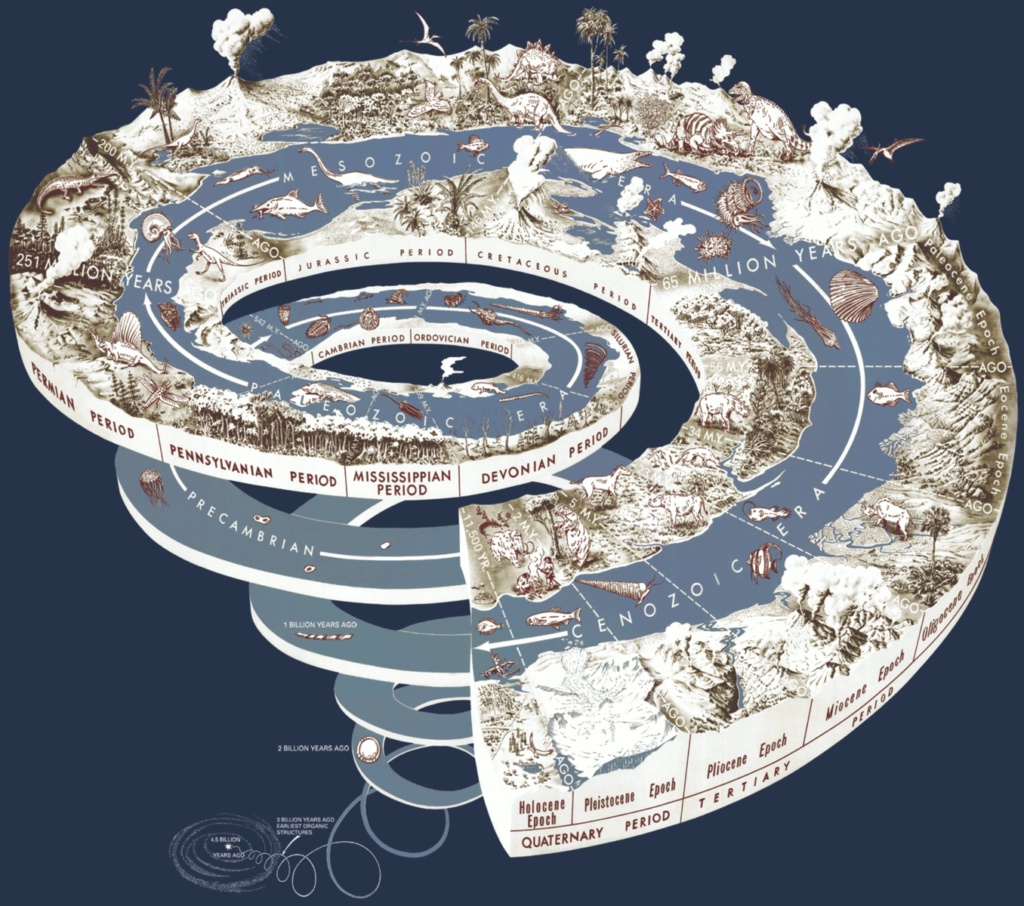
These numbers are precise, supported by radiometric dating and stratigraphy and the careful work of generations of geologists, but they are not comprehensible.
speaker_2NARRATOR
The human mind did not evolve to understand deep time.
speaker_2NARRATOR
It evolved to understand seasons, to track the movements of game animals across a landscape, to remember which plants are edible and which are poisonous, to navigate social relationships in groups of a few hundred individuals.
speaker_2NARRATOR
Deep time, the time of geology, the time of waterfalls, the time in which a river can erode a cliff and a cliff can retreat 11 kilometers, is beyond the reach of intuition.
speaker_2NARRATOR
And the only way to approach it is through numbers and analogies and the patient, systematic reasoning that science provides.
speaker_2NARRATOR
And yet the waterfalls themselves do not care about deep time any more than they care about you.
speaker_2NARRATOR
They are not monuments to geological processes.
speaker_2NARRATOR
They are not demonstrations of erosion.

Katie PatersonGUEST
They've declared their first glacier totally dead and they're melting so fast.
Manoush ZomorodiHOST
Through glaciers, stars, the universe, much of Katie Paterson's artwork explores deep time.
Katie PatersonGUEST
Anything way beyond the human lifespan, going really back in time into the Earth's deep history and even beyond that, back into the cosmic time of the universe.
Katie PatersonGUEST
So we're thinking about millions of years, thousands, but more millions and billions of years.
Katie PatersonGUEST
And what the number represents is the number of sunrises that have ever happened since the Earth began.
Katie PatersonGUEST
And we ended up working with many different astronomers and the Astronomer Royal of Scotland.
Katie PatersonGUEST
And it was a big challenge because when you go back to the very deep time of the Earth's very early years, when it was just coming into existence, we don't really know its orbit rate at that time.
Katie PatersonGUEST
So there's kind of periods in the Earth's history that we feel very certain about and then there's periods that are very speculative.

Stuart KendallGUEST
He wants to write in historical and anthropological frames, but also, as we see in Celestial Bodies, with attention to biological, geological, chemical, and even cosmological facts.
Stuart KendallGUEST
So the deepest and widest frame of deep time.
Stuart KendallGUEST
The first draft of Accursed Share attempts to describe the disposition of matter and energy, so the problem of expenditure, in three ecologies, the material and environmental, the social, the individual.
Stuart KendallGUEST
But these tensions, all of these types of history, these types of durations, pull the project apart, and it fails.
18 MINS LATER
Stuart KendallGUEST
This is supposed to be enough for us to talk about today and tomorrow.
Stuart KendallGUEST
So I'm leaving some stuff on the table.
Stuart KendallGUEST
I want to think about deep time, the privileged instant, and sustainability.
Stuart KendallGUEST
The point there is, what is the instant for Bataille? Now, Tears of Eros begins with a challenging lament.

Robert MacfarlaneGUEST
So I suppose the only other thing I'd say is that I've realized a number of kind of key ideas have really animated me over 20 to 25 years.
Robert MacfarlaneGUEST
Now, one is increasingly this idea of deep time or intergenerational thinking, which I wrote most about in Underland, but has been there right from the beginning at Mountains of the Mind.
Robert MacfarlaneGUEST
And that's this idea, which is that Planetary history extends vertiginously behind us.
Robert MacfarlaneGUEST
And if we, as it were, turn and look over our temporal shoulders, we see an abyss of engulfing immensity.
Robert MacfarlaneGUEST
that have left their legacies and enabled ours.
Robert MacfarlaneGUEST
And we in turn, our legacy, leave us.
Robert MacfarlaneGUEST
We leave on in deep time and we live on in deep time.
Robert MacfarlaneGUEST
And for me, that sharpens rather than annihilating the responsibilities that we have to those who will come after us.
speaker_0NARRATOR
The cave operates on geological time, on a timescale where six hundred years of human history is a rounding error, a blip, a single tick of a clock whose face is measured in millions of years.
speaker_0NARRATOR
The silence at Predjama is the silence of deep time.
speaker_0NARRATOR
And if you stand in the cave behind the castle and turn off your flashlight and wait, you will hear it.
speaker_0NARRATOR
Or rather, you will hear the absence of it, the vast empty nothing that the mountain contains, the darkness that was there before the first torch was lit and that will be there after the last tourist leaves and the last guidebook goes out of print and the last wall falls and the cave mouth returns to what it was before anyone thought to put a door on it, which is a hole in a mountain and nothing more and nothing less.

speaker_2NARRATOR
They deepen it, and in doing so, they invite us to contemplate the vast stretches of time that separate us from the Mesozoic era.
speaker_2NARRATOR
If you enjoy these gentle journeys through deep time, I invite you to like, subscribe, or share a thought below.
speaker_2NARRATOR
It helps others find their way here too, one sleepy soul at a time.
speaker_2NARRATOR
But for now, there is nothing to do but relax.
31 MINS LATER
speaker_2NARRATOR
Others may have remained in their territories year round.
speaker_2NARRATOR
The fossil record preserves evidence of seasonal variations in the size and composition of dinosaur herds, suggesting that seasonal changes did indeed affect dinosaur populations.
speaker_2NARRATOR
As we come to the end of our journey through deep time and ancient worlds, you can almost feel the weight of millions of years settling gently around you.
speaker_2NARRATOR
Again and again, we saw that dinosaurs were not monsters frozen in a single violent moment, but rather diverse, adaptable creatures that thrived across an enormous span of time.

speaker_1HOST
with life.
speaker_0HOST
And as my hand brushes the friable bread-rock, I am touching deep time, a world that rang with the grunt and bellow that no human ever heard,
speaker_1HOST
an ancient world whose sun still
speaker_0HOST
shines upon me, The same feeling of rain gusting on westerly winds wets that world and ours.
20 more episodes mention Deep time.
Create an account to see the whole feed, search across every transcript, and follow the entities you care about.