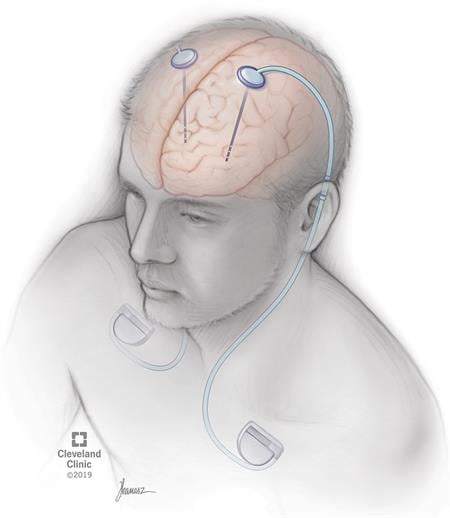
Deep brain stimulation
75
MENTIONS
15
EPISODES
13
PODCASTS
Search complete. 75 mentions across 15 episodes found for "Deep brain stimulation".
Sep 9, 2026

Noah PhilipGUEST
And, you know, I, I saw patients that were twice as sick, you know, every time I saw them and, and meds weren't helping.
Noah PhilipGUEST
And I said, "No, you know, I've just-- I've, I got to be a researcher." And so actually what I did then was I had to do not just one, but really two fellowships, one to catch up for some of the things I should have learned in a PhD, and the next into the neuromodulat- neuromodulation domain, which at that point was, uh, largely deep brain stimulation, vagus nerve stimulation, things in that space, much more invasive.
Noah PhilipGUEST
TMS didn't really exist yet.
Noah PhilipGUEST
But it's not a, it's not a direct path.
37 MINS LATER
Noah PhilipGUEST
What I am using is a fraction, a tenth, a hundredth of that energy to modulate the brain instead.
Noah PhilipGUEST
Its advantage, the thing that makes it so exciting for me, is that unlike our other forms of brain stimulation, it is able to reach deep into the brain, be highly focal, so at millimeter scale and reversible.
Noah PhilipGUEST
And so what is this? This is, this is non-invasive, reversible, deep brain stimulation.
Noah PhilipGUEST
Um, and this is an opportunity to get at, I'll call them maybe the signal generators, the core subcortical structures that we know are involved in every one of our illnesses, but they're just out of reach until now.

Stan LivingstonGUEST
And still practiced for a couple of years and then ended up deciding to retire in large part because of the Parkinson's.
Stan LivingstonGUEST
And Stan, you also recently had DBS, right? So that's another part of your story.
Stan LivingstonGUEST
DBS about last November, which was about eight, nine months ago.
Stan LivingstonGUEST
Yep.
Stan LivingstonGUEST
And Doug?
11 MINS LATER
Chris KruegerHOST
Stan, I think you had the next question, and this is maybe getting to the core of the issue.
Chris KruegerHOST
Emerging therapies are exciting, but they aren't necessarily going to make our lives less complex in all ways.
Chris KruegerHOST
We already have a lot of hard decisions with already approved therapies, and especially with the development of vial of an APCO, the infusion therapies, and DBS, all the advances that are being made there.

speaker_0HOST
And we will disclose here that David Burdett also has a relationship with NeuroPace.
speaker_0HOST
Now, shifting gears slightly from RNS to DBS or deep brain stimulation.
speaker_1HOST
Yes, a slightly different approach.
speaker_0HOST
Right.
speaker_0HOST
So the Thuberg study looked at 14 patients who underwent DBS insertion.
speaker_1HOST
Okay.
speaker_0HOST
And they observed a mean of 57.1% reduction in seizure frequency just one month after the insertion.
speaker_1HOST
Yeah, this raises an important question about how we forecast patient outcomes.

Maggie GarveyGUEST
Happily.
Maggie GarveyGUEST
So the DBS service, I'll start maybe by saying what DBS service or what DBS really is, because not everybody knows what it is.
Maggie GarveyGUEST
I think speech and language therapists do have a very good handle, but just for people that maybe, you know, it hasn't come on their radar, it's a surgical procedure aimed at helping people that have movement disorders and maybe where pharmacological treatments are no longer working for them.
Maggie GarveyGUEST
So conditions that spring to mind are Parkinson's disease, maybe an essential tremor and dystonia.
Maggie GarveyGUEST
I interviewed for that job when I was on maternity leave in 2018 with my first son and The job came about through the work of Professor Tim Lynch, a neurologist that I've worked with here in the matter and the Dublin Neurological Institute for many years.
Maggie GarveyGUEST
He's worked tirelessly behind the scenes to obtain funding to create that service.
Maggie GarveyGUEST
Similar to what, you know, years ago we'd have had patients going to the UK through the treatment abroad scheme for DBS, but he really wanted to set up a service in Ireland.
Maggie GarveyGUEST
So I think he and I have always worked well together.

Deanna HarshbargerGUEST
So it was a fantastic training.
Deanna HarshbargerGUEST
From there, I went to Boston Scientific, where I built the Deep Brain Stimulation franchise.
Deanna HarshbargerGUEST
And that was exciting from the standpoint that that was, I believe, my first foray into really understanding startup.
Deanna HarshbargerGUEST
The division I was in was actually a startup that had been purchased by Boston Scientific.

Michael LuGUEST
And that kind of puts a hole in the wrench, you know, for the next day.
Michael LuGUEST
So you haven't had the DBS surgery yet.
Eric Von FrohlichHOST
No, I haven't.
Eric Von FrohlichHOST
I've been able to monitor my path with exercise for the most part.

Adrian OwenGUEST
...
Adrian OwenGUEST
the pattern of activity that accompanies a patient when they're at their most lucid, and then try and stimulate that same pattern when they're at their least lucid? Um, and that's an idea that we've been throwing around for a year or so now with people that use so-called deep brain stimulation, which is a treatment that's used very effectively for Parkinson's disease now, where you, you put a, a microelectrode into the brain, you stimulate a part of the brain, and in the case of Parkinson's disease, it can control some of the symptoms.
Adrian OwenGUEST
Well, you know, there's, there's reasons to believe you could extend that to trying to, uh, if you, if you like, sort of, um, kickstart consciousness in some of these patients by stimulating the parts of the brain that are required for them to have some kind of subjective experience.
Adrian OwenGUEST
You can see why I called it science fiction.

Jessica KrauserHOST
Hey everyone, it's Jessica from The Secret Life of Parkinson's.
Jessica KrauserHOST
Um, there's a couple things that I wanna talk-- Well, actually, there's just one thing I wanna talk about, and it's, um, this, the symptoms that I didn't, I knew that DBS wouldn't cover, but it's something that I didn't really think about as much as I've been thinking about this past two weeks.
Jessica KrauserHOST
So I'm gonna show you two videos real quick.
Jessica KrauserHOST
One is gonna be when, uh, it's last year before my DBS of how dyskinetic I would be towards the end of the day.
Jessica KrauserHOST
Um, and then the other one is going to be, um, when I was working, so it's the same timeframe.
Jessica KrauserHOST
It's around last April of twenty-twenty five, and it shows the non-motor symptoms.
Jessica KrauserHOST
It was really the stiffness.
Jessica KrauserHOST
It was really difficult to, to deal with that.
5 more episodes mention Deep brain stimulation.
Create an account to see the whole feed, search across every transcript, and follow the entities you care about.