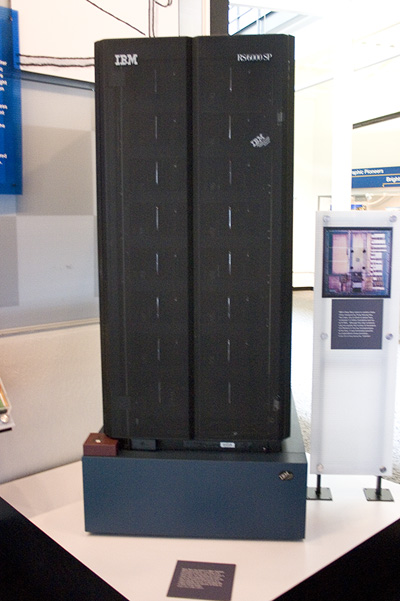
Deep Blue
Chess computerWikipedia
50
MENTIONS
16
EPISODES
13
PODCASTS
Search complete. 50 mentions across 16 episodes found for "Deep Blue".
Sep 11, 2026

Zach StaplesGUEST
Yeah, that's absolutely right.
Zach StaplesGUEST
So you had Deep Blue that built the computer that played and beat Garry Kasparov.
Zach StaplesGUEST
And then you had AlphaGo that beat one of the world's best Go players.
Zach StaplesGUEST
And then so you saw this progression in... metrics of intelligence that said, hey, the machines can solve problems.

Addison AndersonNARRATOR
During the Cold War, the Soviet Union devoted great resources to cultivating chess talent, dominating the championships for the rest of the century.
Addison AndersonNARRATOR
But the player who would truly upset Russian dominance was not a citizen of another country, but an IBM computer called Deep Blue.
Addison AndersonNARRATOR
Chess-playing computers had been developed for decades, but Deep Blue's triumph over Garry Kasparov in 1997 was the first time a machine had defeated a sitting champion.
Addison AndersonNARRATOR
Today, chess software is capable of consistently defeating the best human players.
Addison AndersonNARRATOR
But just like the game they've mastered, these machines are products of human ingenuity.

Kyle MillerHOST
In 1996, we have Kasparov, Garry Kasparov, beating the IBM chess-playing computer.
Kyle MillerHOST
It was called Deep Blue, and Kasparov won the match four to two, but Deep Blue went on to defeat Kasparov in a rematch the following year.
Kyle MillerHOST
Now, this guy, Garry Kasparov, he was considered one of the greatest chess players in history.
Kyle MillerHOST
He was born in Azerbaijan, the Russian Republic.
Kyle MillerHOST
And in 1985, he was 22 years old, and he, he became the youngest world champion in history when he defeated a guy named Anatoly Karpov.
Kyle MillerHOST
Now, the origins of Deep Blue go back to 1985, 10 years before, 11 years before, when a student at the Carnegie Mellon University started developing a chess-playing computer called ChipTest.
Kyle MillerHOST
And the computer became later known as Deep Thought after the machine in a science fiction novel, the science fiction novel The Hitchhiker's Guide to the Galaxy by Douglas Adams.
Kyle MillerHOST
Now, the developer, a guy named, an Asian gentleman by n- by the name of Feng Xu.

speaker_3HOST
Historically, we have treated computers as extremely capable calculators.
speaker_3HOST
Think about when IBM's Deep Blue beat Garry Kasparov at chess in the 90s.
speaker_2HOST
Oh, yeah.
speaker_2HOST
A huge moment.
speaker_3HOST
Right.
speaker_3HOST
But Deep Blue was brute force.
speaker_3HOST
It calculated millions of possible human moves faster than Kasparov could.
speaker_3HOST
But the moves themselves were still human logic, just executed at light speed.
speaker_5SOUNDBITE_SPEAKER
poorly.
Mark ChrislerHOST
I remember Deep Blue beating Kasparov.
speaker_5SOUNDBITE_SPEAKER
Whoa! Deep Blue Kasparov, after the move C4, has resigned.
Alex TrebekSOUNDBITE_SPEAKER
Now we come to Watson.
Alex TrebekSOUNDBITE_SPEAKER
We're looking for Bram Stoker, and we find...
33 MINS LATER
Mark ChrislerHOST
More impressive was David Cope's Emmy, or Experiment in Musical Intelligence, which he created in 1992.
Mark ChrislerHOST
Dump a bunch of any classical composer into Emmy for reference, and it will spit out some pretty convincing compositions in that style, like this one.
Mark ChrislerHOST
Then, of course, there was Deep Blue, the long-sought realization of the Mechanical Turk beating the world's greatest chess player in 1997.

RobHOST
Wow.
RobHOST
Uh, obviously, uh, you, there's the big thing of what happened in 1997 where IBM's computer Deep Blue played against, uh, Garry Kasparov in a six-game match, and, uh, Deep Blue eventually, uh, won.
RobHOST
Yeah.
RobHOST
Uh, so yeah, it's, uh, it, it has evolved, uh, a lot over the years.

HenryGUEST
It was like six games.
HenryGUEST
and overall the chess engine which is called Deep Blue ended up winning and that was a big shock not only to the chess world but to the real world that computer systems are pretty good if I recall correctly it was like Kaspar won game one lost game two they tied the next
IbrahimHOST
three games and Deep Blue won the last one
LouisHOST
oh it was really close then
IbrahimHOST
Oh, yeah.
IbrahimHOST
I was going for some of this assumption that Deep Blue can just thrash it because it's a computer, but that seems pretty...
LouisHOST
How would they have done that? Was it just like...
LouisHOST
I forgot the name of the algorithm, but...

Mark ChrislerHOST
But just because it turned out to be a hoax didn't necessarily mean it had to be.
Mark ChrislerHOST
Was it possible to do what Wolfgang von Kempelen had pretended to do? Could a machine actually play chess? Between the 10th and 17th of February 1996, Garry Kasparov, the reigning world chess champion, faced off against Deep Blue, IBM's chess-playing supercomputer.
Mark ChrislerHOST
And won, four games to two.
Mark ChrislerHOST
But a year later, an upgraded Deep Blue challenged Kasparov again and beat him.
speaker_5SOUNDBITE_SPEAKER
And he should get $300,000.
speaker_5SOUNDBITE_SPEAKER
Whoa! Deep Blue, Kasparov, after the move C4, has resigned.
Mark ChrislerHOST
It was seen by the media at the time as the birth of artificial intelligence.
Mark ChrislerHOST
But the idea went back much further.

Robert WrightGUEST
Because there was just so much kind of brute force, uh, in, in, uh, IBM's computer.
Robert WrightGUEST
I think it was named, uh, Deep Blue.
Robert WrightGUEST
And I didn't think what was going on inside the machine was very much like what's going on in, in the human mind.
Robert WrightGUEST
So I've been writing about technology, not only technology, for a very long time.
7 MINS LATER
Coleman HughesHOST
Okay.
Coleman HughesHOST
So let me, let me, um, reframe the question slightly because of your answer.
Coleman HughesHOST
So I start out by saying, okay, big progress in AI and chess, and, you know, m- m- machines can do math, but it doesn't change the world, right? Why does language and coding change the world? Um, and your answer is, well, really, the big difference is between AI that you, uh, that you program, where you're, you're basically just programming a set of instructions, which is what Deep Blue was that beat Garry Kasparov, and something like AlphaZero, which ended up being much better than Deep Blue.
Coleman HughesHOST
This is the chess engine-
Kyle MillerHOST
Today in History.
Kyle MillerHOST
It was this day in 1996 that Garry Kasparov defeated the chess-playing computer called Deep Blue.
Kyle MillerHOST
IBM made a chess-playing computer, and they went into several matches, a six-game match, in fact.
Kyle MillerHOST
And Garry Kasparov finally won the match 4-2.
Kyle MillerHOST
However, Deep Blue went on to defeat him later on in a heavily publicized rematch the following year.
Kyle MillerHOST
Kasparov was considered one of the greatest players in chess history.
Kyle MillerHOST
And, yeah, it led to a lot of controversy.
Kyle MillerHOST
But now, I'm sure AI machines now would be much, much better than Deep Blue, surely.
6 more episodes mention Deep Blue.
Create an account to see the whole feed, search across every transcript, and follow the entities you care about.