Declaratory Act

Declaratory Act

Search complete. 19 mentions across 10 episodes found for "Declaratory Act".

Oct 17, 2026

Pamela NagamiNARRATOR
139:25
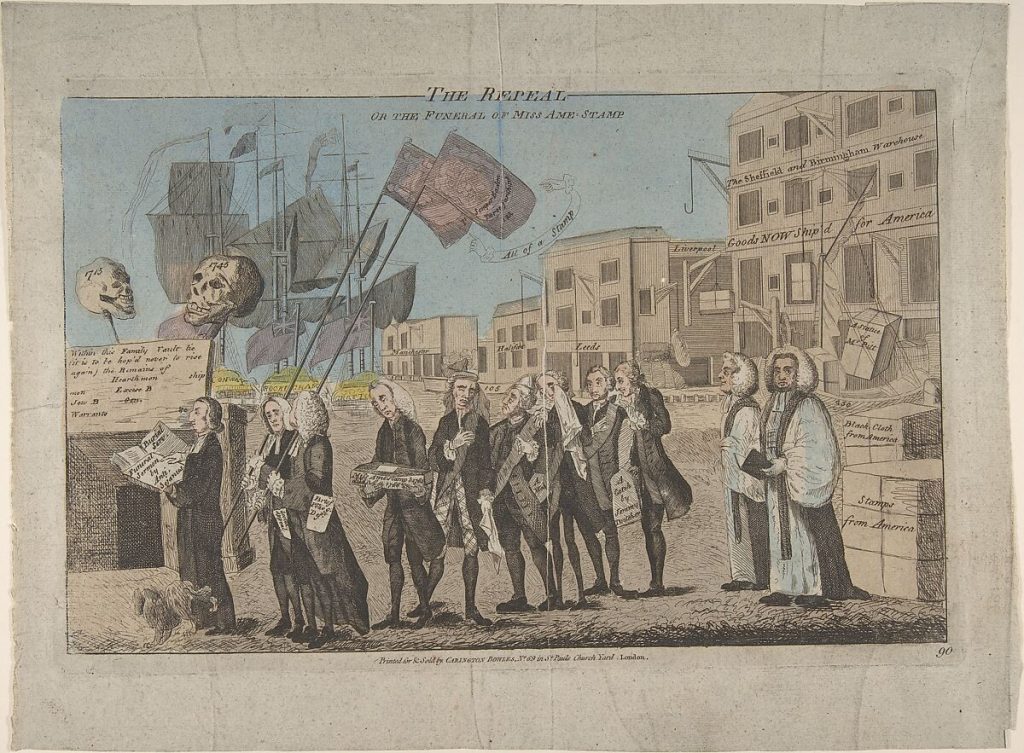
The Stamp Act, which had been very badly received by the colonists, was repealed, and America was for a time pacified.
Pamela NagamiNARRATOR
139:35
At the same time, a Declaratory Act was passed which asserted England's right to tax America, but Rockingham made no endeavor to put theory into practice.
Pamela NagamiNARRATOR
139:46
During the debate on American taxation, Pitt had asserted that England had no right to tax the colonies, for taxation and representation should go together.
Pamela NagamiNARRATOR
139:58
Though Grenville could show that Pitt's account of the theory of taxation was inadequate, it remained true that the American colonies, owing to their distance from England, were in a very different position from the unrepresented manufacturing towns of Great Britain.
Pamela NagamiNARRATOR
140:16
And the wretched state of the representative system in England was itself no argument in favor of the unstatesmanlike, though legal action of Grenville.
Pamela NagamiNARRATOR
140:27
In spite of the fact that it had recognized the inexpediency of taxing America, the new ministry failed to secure the support either of George III or of Pitt.
Pamela NagamiNARRATOR
140:39
While the king and the king's friends were opposed to Rockingham's conciliatory policy at home and abroad, Pitt objected strongly to the Declaratory Act.
Pamela NagamiNARRATOR
140:49
Henceforward the Whig party, though outwardly reconciled for a short time in 1782, was permanently divided into a less liberal and a more liberal branch.
Simon WhistlerHOST
5:05
When Lord Rockingham became prime minister and repealed the act, Cornwallis was one of those who cheered the loudest.
Simon WhistlerHOST
5:10
But Rockingham also passed the Declaratory Act, which basically said to the Americans, "Okay, fine, we won't tax you now, but we absolutely have the right to." Only five peers voted against this new, also dumb law.
Simon WhistlerHOST
5:23
Among them was Charles Cornwallis.
Simon WhistlerHOST
5:24
Yet while he cared about all this, politics wasn't Charles Cornwallis's lifeblood.
Simon WhistlerHOST
6:00
But unfortunately, Charles did not live in that world.
Simon WhistlerHOST
6:04
In this world, he was destined to not be forgotten, but to go down in infamy.[dramatic music] While Charles Cornwallis was happily slipping into retirement, the British government was happily pouring gasoline onto the Stamp Act dumpster fire.
Simon WhistlerHOST
6:23
Just a year after the Declaratory Act, the Townshend Acts had slapped duties on British exports to the colonies.
Simon WhistlerHOST
6:30
This had led to a boycott on British goods, which had in turn led to British soldiers being sent to Boston, culminating in the Boston Massacre, when soldiers fired into a mob, killing five.

Unknown podcast

Chronicles of America Volume 11 - Eve of the Revolution-Carl L. Becker

Oct 15 · 1 Mention

speaker_3UNKNOWN
151:40
No one could deny that government had yielded in the face of noisy clamor and forcible resistance.
speaker_3UNKNOWN
151:46
To yield under the circumstances may have been wise or not, but government had not yielded on any ground of right, but had on the contrary most expressly affirmed in the Declaratory Act that the King's Majesty, by and with the advice of the Lords, spiritual and temporal, and Commons of Great Britain, in Parliament assembled, had, hath, and of right ought to have full power and authority to make such laws and statutes of sufficient force and validity to bind the colonies and people of America, subjects of the Crown of Great Britain, in all cases whatsoever.
speaker_3UNKNOWN
152:20
Government had not even denied the expediency of taxing America, the total repeal of the Stamp Act, and the modification of the sugar act having been carried on a consideration of the inexpediency of these particular taxes only taxes not open to the same objection might in future be found and doubtless must be found inasmuch as the troops were still retained in america and the quartering act continued in force there for new taxes however it would doubtless be necessary to await the formation of a new ministry the formation of a new ministry was not an unusual occurrence in the early years of king george the third no one supposed that lord rockingham could hold on many months and as early as july seventeen sixty six all london knew that mr pitt had been sent for the coming and going of great men in times of ministerial crisis was always a matter of interest but the formation of that ministry of all the factions which the patriot king had long desired was something out of the ordinary the point of greatest speculation being how many irreconcilables mr pitt the earl of chatham he was now could manage to get seated about a single table from the point of view of irreconcilability no one was more eligible than mr charles townsend at that moment paymaster of the forces a kind of enfant of english politics of whom horace walpole could say with every likelihood of being believed that his speech of last friday made while half drunk was all wit and indiscretion nobody but he could have made it nobody but he would have made it if he could he beat lord chatham in language burke in metaphors grenville in presumption rigby in impudence himself in folly and everybody in good humour this gentleman much to his astonishment one day received the following note from lord chatham sir you are too great a magnitude not to be in a responsible place i intend to propose you for chancellor of the exchequer and must desire to have your answer by nine o'clock to-night Mr. Townsend was dismayed as well as astonished, his dismay arising from the fact that the office of Chancellor of the Exchequer was worth but 2,700 pounds, which was precisely 4,300 pounds less than he was then receiving as paymaster of the forces.
speaker_3UNKNOWN
154:42
To be a great magnitude on small pay had its disadvantages, and Mr. Townsend, after remaining home all day in great distress of mind, begged mr pitt to be allowed to retain the office of paymaster which was no sooner granted than he changed his mind and begged mr pitt to be allowed to accept the exchequer place which mr pitt at first refused and was only persuaded to grant finally upon the intercession of the duke of grafton the day following mr townsend accordingly informed the king that he had decided in view of the urgent representations of the earl of chatham to accept the office of chancellor of the exchequer in his majesty's new ministry no one supposed least of all himself that this delightful man would have any influence in formulating the policies of the chatham ministry lord chatham's policies were likely to be his own and in the present case so far as america was concerned they were not such as could be readily associated with mr townsend's views so far as those views were known or were not inconsistent for dealing with america the earl of shelburne because of his sympathetic understanding of colonial matters have been brought into the ministry to formulate a comprehensive and conciliatory plan as for the revenue always the least part of lord chatham's difficulties as it was the chief of mr grenville's it was thought that the possessions of the east india company if taken over by the government would bring into the treasury sums quite sufficient to pay the debt as well as to relieve the people in england and america at least of those heavy taxes which mr grenville and his party had thought necessarily involved in the extension of empire it was a curious chapter of accidents that brought all these well-laid plans to naught scarcely was the ministry formed when the earl of chatham incapacitated by the gout retired into a seclusion that soon became impenetrable and even before this resplendent orb was entirely set and while the western horizon was in a blaze with his descending glory on the opposite quarter of the heavens arose another luminary and for his hour became lord of the ascendant this luminary was mr charles townshend mr townsend was the delight and ornament of the house as edmund burke said never was a man in any country of more pointed and finished wit or where his passions were not concerned of a more refined exquisite and penetrating judgment never a man to excel him in luminous explanation and display of his subject nor ever one less tedious or better able to conform himself exactly to the temper of the house which he seemed to guide because he was always sure to follow it in seventeen sixty five mister townsend had voted for the stamp act but in seventeen sixty six when the stamp act began to be no favor he voted for the repeal and would have spoken for it too if an illness had not prevented him and now in seventeen sixty seven mister townsend was chancellor of the exchequer and as such responsible for the revenue a man without any of that temperamental obstinacy which persists in opinions once formed and without any fixed opinions to persist in but quite disposed according to habit to hit the house just between wind and water and to win its applause by speaking for the majority or by haranguing inimitably on both sides when the majority was somewhat uncertain in january seventeen sixty seven when lord chatham was absent and the majority was very uncertain mr grenville took occasion in the debate upon the extraordinaries for the army in england and america to move that america like ireland should support its own establishment the opportunity was one which mr townsend could not let pass much to the astonishment of every one and most of all to that of his colleagues in the ministry he supported mr grenville's resolution declaring himself now in favor of the stamp act which he had voted to repeal treating lord chatham's distinction between internal and external taxation as contemptuously as mr grenville had done and pledging himself able if necessary to find a revenue in america nearly adequate to the proposed project the earl of shelburne in great distress of mind at once wrote to lord chatham relating the strange if characteristic conduct of the chancellor of the exchequer and declaring himself entirely ignorant of the intentions of his colleagues it was indeed an anomalous situation if lord chatham's policies were still to be considered those of the ministry mr townsend might be said to be an opposition a circumstance which made many people think lord chatham ill at st james's only lord chatham was not ill at st james's he was most likely very well at st james's being unable to appear there thus leaving the divided ministry amenable to the king's management or helpless before a factious opposition the opportunity of the opposition came when the chancellor of the exchequer in february proposed to continue the land tax at four shillings for one year more after which time he thought it might be reduced to three shillings in view of additional revenues to be obtained from the east india company but opposition saw no reason why in view of the revenue which mr townsend had pledged himself to find in america a shilling might not be taken from the land at once a proposal which mr dowswell moved should be done and which was accordingly voted through the influence of mr grenville and the duke of bedford who had formerly carried the stamp act aided by the rockingham whigs who had formerly repealed it if lord chatham was ill at st james's this was a proper time to resign it was doubtless a proper time to resign in any case but lord chatham did not resign in march he came to london endeavoured to replace mr townsend by lord north which he failed to do and then retired to bath to be seen no more leaving mr townsend more than ever master of the revels mr townsend did not resign either but continued in office quite undisturbed by the fact that a cardinal measure of the ministry had been decisively voted down mr townsend reasoned that if opposition would not support the ministry all difficulties would be straightened out by the ministry supporting the opposition this was the more reasonable since opposition had perhaps been right after all so far as the colonies were concerned late reports from that quarter seemed to indicate that the repeal of the stamp act far from satisfying the americans had only confirmed that umbrageous people in a spirit of licentiousness which was precisely what opposition had predicted as the sure result of any weak concession the new york assembly it now appeared refused to make provision for the troops according to the terms of the quartering act new york merchants were petitioning for a further modification of the trade acts the precious bostonians wrangling refined doctrinaire points with governor bernard were making interminable difficulties about compensating the sufferers from the stamp act riots if lord chatham in february seventeen sixty seven could go so far as to say that the colonies had drunk deep of the baneful cup of infatuation mr townsend having voted for the stamp act and for its repeal might well think in may that the time was ripe for a return to rigorous measures On May 13, in a speech which charmed the House, Mr. Townsend opened his plan for settling the colonial question.
Michael BoldinHOST
16:35
Claim unlimited power.
Michael BoldinHOST
16:38
In 1766, they passed something called the Declaratory Act, and it's really the same as how the federal government today treats the Supremacy Clause.
Michael BoldinHOST
16:47
It's unlimited unless they say otherwise.
Michael BoldinHOST
16:50
He said, "Unless the people should think you cannot go- possibly go any farther, pass another solemn Declaratory Act, that kings, lords, and commons had, hath, and of right ought to have full power and authority to make statutes of sufficient force and validity to bind the unrepresented provinces in all cases whatsoever." The result? The people will realize it's mask off.
Michael BoldinHOST
17:20
The empire owns their property, their lives, even their souls.
Michael BoldinHOST
17:25
He said, "This will include spiritual with temporal, and taken together must operate wonderfully to your purpose by convincing them that they are at present under a power something like that spoken of in the scriptures, which can not only kill their bodies, but damn their souls to all eternity by compelling them, if it pleases, to worship the devil." And this still isn't enough.
Pamela NagamiNARRATOR
138:22
General warrants were declared illegal, the Stamp Act which had been very badly received by the colonists was repealed, and America was for a time pacified.
Pamela NagamiNARRATOR
138:34
At the same time a Declaratory Act was passed which asserted England's right to tax America, but Rockingham made no endeavour to put theory into practice.
Pamela NagamiNARRATOR
138:45
During the debate on American taxation, Pitt had asserted that England had no right to tax the colonies, for taxation and representation should go together.
Pamela NagamiNARRATOR
138:57
Though Grenville could show that Pitt's account of the theory of taxation was inadequate, it remained true that the American colonies, owing to their distance from England, were in a very different position from the unrepresented manufacturing towns of Great Britain.
Pamela NagamiNARRATOR
139:15
And the wretched state of the representative system in England was itself no argument in favour of the unstatesmanlike, though legal action of Grenville.
Pamela NagamiNARRATOR
139:26
In spite of the fact that it had recognised the inexpediency of taxing America, the new ministry failed to secure the support either of George III or of Pitt.
Pamela NagamiNARRATOR
139:38
While the king and the king's friends were opposed to Rockingham's conciliatory policy at home and abroad, Pitt objected strongly to the Declaratory Act.
Pamela NagamiNARRATOR
139:48
Henceforward the Whig party, though outwardly reconciled for a short time in 1782, was permanently divided into a less liberal and a more liberal branch.

Unknown podcast

The Moment the American Revolution Became Inevitable: Unseen Turning Points That Ended Peace Forever

Oct 11 · 2 Mentions

speaker_0NARRATOR
33:54
The lesson was not lost on either side.
speaker_0NARRATOR
33:57
Parliament paired repeal with the Declaratory Act, asserting full authority to legislate for the colonies in all cases whatsoever.
speaker_0NARRATOR
34:07
To British lawmakers, this restored principle without provoking unrest.
speaker_0NARRATOR
34:13
To colonial readers, it sounded like a warning disguised as reassurance.
speaker_0NARRATOR
36:28
Parliament had bowed to pressure from merchants and colonial agitation.
speaker_0NARRATOR
36:34
And many lawmakers were determined not to repeat the experience.
speaker_0NARRATOR
36:39
The Declaratory Act was meant to draw a firm line beneath the concession, reaffirming sovereignty while stepping away from the immediate conflict.
speaker_0NARRATOR
36:50
It was a statement aimed as much inward toward domestic critics as outward toward the colonies.

Unknown podcast

The Entire History of the United States of America: A Bedtime Story for Sleep, Relaxation, and Learning

Oct 11 · 1 Mention

speaker_0UNKNOWN
42:13
Fortunately for the colonies, the Parliament experienced a shift in government, which had sympathy for Whig politics, which resulted in the repeal of the Stamp Act.
speaker_0UNKNOWN
42:24
The Parliament passed the Declaratory Act in 1766, reversing the Stamp Act, but at the same time insisting that the Parliament as a legislative body had the right and power to make laws for the colonies in all cases whatsoever.
speaker_0UNKNOWN
42:40
Both sides viewed the result as a political victory, believing that their interpretation of the rights of the colonists had been heard and secured.
speaker_0UNKNOWN
42:49
The Parliament believed it had exerted its will as the governing body of the colonies, and once and for all had established their right to levy laws on them.

Unknown podcast

The American Revolution Explained: George Washington, the War for Independence, and the Birth of the United States

Oct 9 · 1 Mention

speaker_0UNKNOWN
24:17
For a moment, it seemed the storm had passed, that the comfortable old order had been restored, that loyalty and reason had won the day.
speaker_0UNKNOWN
24:26
But the celebration was built on a misunderstanding, because tucked alongside the repeal, Parliament had quietly passed another law, the Declaratory Act, which asserted in cold and absolute language that Parliament had the right to make laws binding the colonies in all cases whatsoever.
speaker_0UNKNOWN
24:44
London had backed down on the specific tax, but it had refused to surrender the principle.
speaker_0UNKNOWN
24:50
The fundamental disagreement remained unresolved, waiting, and it did not wait long.

Unknown podcast

History of the United States, Vol. II Conflict & Independence-Charles Austin Beard, Mary Ritter Beard

Sep 24 · 3 Mentions

speaker_2NARRATOR
24:06
In rescinding the Stamp Act, Parliament did not admit the contention of the Americans that it was without the power to tax them.
speaker_2NARRATOR
24:14
On the contrary, it accompanied the repeal with a declaratory act.
speaker_2NARRATOR
24:18
It announced that the colonies were subordinate to the Crown and Parliament of Great Britain, that the King and Parliament therefore had undoubted authority to make laws binding the colonies in all cases whatsoever, and that the resolutions and proceedings of the colonists denying such authority were null and void.
speaker_2NARRATOR
24:36
The repeal was greeted by the colonists with great popular demonstration.
speaker_2NARRATOR
24:40
Bells were rung, toasts to the King were drunk, and trade resumed its normal course.
speaker_2NARRATOR
24:46
The declaratory act, as a mere paper resolution, did not disturb the good humor of those who again cheered the name of King George.
speaker_2NARRATOR
24:54
Their confidence was soon strengthened by the news that even the Sugar Act had been repealed, thus practically restoring the condition of affairs before Greenville and Townsend inaugurated their policy of thoroughness.
speaker_2NARRATOR
25:07
Resumption of British revenue and commercial policies.
Brandon MurrowGUEST
1:36
Here, Thomas Jefferson's primary accusation is that the king and parliament have not just suspended colonial legislatures, but have also claimed absolute power to make laws for the colonies, even with respect to local matters.
Brandon MurrowGUEST
1:50
Unlike the earlier discussion in Grievance 5, which dealt with the exercise of the king's prerogative, This grievance goes to Parliament, exercising its authority to suspend colonial legislatures and the role of the Declaratory Act of 1766 and the New York Restraining Act of 1767 in this.
Brandon MurrowGUEST
2:07
In the Declaratory Act, Parliament asserted that it had the right to make laws that, quote, bind the colonies and people of America in all cases whatsoever.
Brandon MurrowGUEST
2:16
In the New York Restraining Act, enacted on July 2, 1767, Parliament barred the New York legislature and its governor from adopting any laws after October 1, 1767.

We value your privacy

We use cookies to understand how you use our platform and to improve your experience. Click “Accept All” to consent, or “Decline non-essential” to opt out of non-essential cookies. Read our Privacy Policy.