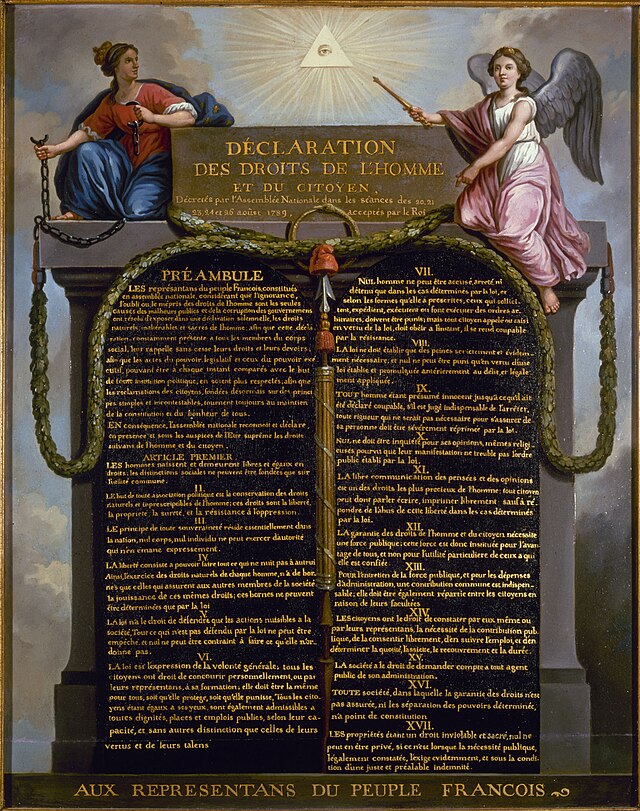
Declaration of the Rights of Man and of the Citizen
BookWikipedia
55
MENTIONS
31
EPISODES
27
PODCASTS
Search complete. 55 mentions across 31 episodes found for "Declaration of the Rights of Man and of the Citizen".
Sep 10, 2026

Jeffrey RosenHOST
Charles Sumner had introduced an amendment that said, everywhere within the limits of the United States and of each state or territory thereof, all persons are equal before the law so that no person can hold another as slave.
Jeffrey RosenHOST
And you note that Sumner was proud of this phrase, and he got it from the 1791 French Declaration of Rights declaring equality before the law.
Jeffrey RosenHOST
There's some pushback.
Jeffrey RosenHOST
Some Congress people say we're not going to allow French revolutionary language into the Constitution.
Jeffrey RosenHOST
And instead, the Judiciary Committee chooses the language from the Northwest Ordinance and basically cuts and pastes it into the text that becomes the 13th Amendment.
Jeffrey RosenHOST
You suggest that this... obviates any suggestion that the language of the exceptions clause that says that you can be held to service as punishment for a crime marked any change in the law because it had been in place since 1784 that white and black people could be forced to engage in this sort of penal servitude.

Dave MillerNARRATOR
1768, James Cook, yep, sets sail from England on the HMS Endeavour.
Dave MillerNARRATOR
1989, the Declaration of the Rights of Man and of the Citizen is approved by the National Constituent Assembly of France.
Dave MillerNARRATOR
So we've been spending a lot of time talking about the U.S. Constitution, Bill of Rights, Declaration of Independence.
Dave MillerNARRATOR
Let's dig into this and see what they were thinking in France in 1789.
Dave MillerNARRATOR
Sixteen, a society in which the observance of the law is not assured, nor the separation of powers defined, has no constitution at all.
Dave MillerNARRATOR
Seventeen, since property is inviolable and a sacred right, no one shall be deprived thereof except where publicly necessary, legally determined, and shall clearly demand it, and then only on condition that the owner shall have been previously and equitably indemnified.
Dave MillerNARRATOR
Okay, so that, the Declaration of the Rights of Man and of the Citizens, is in 1789.
Dave MillerNARRATOR
We know that Jackson spent a lot of time in France and actually sent back to Adams a great degree of information about all the other forms of governments, the constitutions, legalities.

Céline MajorNARRATOR
CHAPTER V.
Céline MajorNARRATOR
THE CONSTITUTION-MONGERS the constitution was now in full train the revolution up to the latter point was officially recognized there was no harking back for any one foulon and berthier two administrators of the first rank under the old regime had been publicly hanged at la lanterne and quartered by the people the first stratum of revolutionists was to the fore mirabeau lafayette and bailly are the central figures of the constituent assembly du pare barnave and lameth its extreme men the court de mirabeau seventeen forty nine to seventeen ninety one one of the pre-revolutionary writers was the leader of the moderate party in the assembly his stupendous powers of oratory made him a useful ally and a dangerous foe this the court was not slow in discovering and accordingly mirabeau was soon won over by bribes to do his best to frustrate every popular measure in the assembly while all the time professing devotion to the cause of liberty and the people when this failed the popular orator did not disdain to resort to actual plotting the marquis de la fayette seventeen fifty seven to eighteen thirty four of american independence notoriety another member of the noblesse who had adopted previously to the revolution the quasi advanced views then fashionable with his class was the military representative of the moderate party in his capacity of commandant of the national guard besides the henchman of mirabeau in the assembly bailly seventeen thirty six to seventeen ninety three who was elected mayor of paris the day after the taking of the bestee also coadjuted in the work of moderating the revolution alike in his official capacity and in the assembly as to the extreme men they really represented but the most moderate form of constitutional monarchy the situation of parties may be estimated by the fact that bernard advocated a suspensory veto on the part of the king while mirabeau strenuously supported the absolute veto and be it remembered at such a time the right of vetoing obnoxious measures would have been no mere matter of form it appears then that even the most advanced parliamentarians of the day were not prepared to go beyond the present prussian constitution nevertheless circumstances early forced upon this timid and comparatively reactionary assembly some drastic political measures first and foremost on the memorable night of the fourth of august the abolition of all seignorial rights and privileges at a later stage after the assembly had removed to paris a little judicious coercion from the tribunes or people's galleries which were tenanted by advanced revolutionists there is no doubt exercised a salutary influence on several occasions the members knew well enough that their lives were in the hands of the paris populace and those of their wives and children besides their property at the mercy of the populace of the rural districts the assembly's first important performance after the fall of the bastille was the declaration of the rights of man in imitation of the americans after the successful termination of the war of independence the declaration of the rights of man contains a series of articles laying down the principles of political equality most of them are unexceptionable and even trite but it is significant that number seventeen affirms categorically the absolute sacredness of private property the question which arose immediately subsequent to this on the constitution of the chamber and its relations to the king need not detain us it is sufficient to state that while the assembly was amusing itself discussing suspensory veto or absolute veto the court viz queen and company at versailles were meditating the transference of the king to metz where the mercenary german troops were stationed and once communication with the french noblesse who had emigrated and the reactionary foreign powers was easy the idea being to declare paris and the assembly rebels and march upon the city with the view of restoring the absolute monarchy These machinations at Versailles are interesting as having given the direction to the first great demonstration of the proletariat of Paris during the revolution.
Céline MajorNARRATOR
I say the direction as the proximate cause was the advice the now rising popular journalist Marat had given some days before in his Amis du Peuple when discussing the scarcity of bread.
Céline MajorNARRATOR
The revolt broke out in this way.

Tracy V. WilsonHOST
We have gotten a lot of requests over the years for an episode on Olympe de Gouges, who's known, at least outside of France, primarily for a 1791 pamphlet titled Declaration of the Rights of Woman and the Citizen.
Tracy V. WilsonHOST
And this was published as a direct response to the 1789 Declaration of the Rights of Man and the Citizen, with the Declaration of the Rights of Man using the French word citoyen and de Gouges' response using the more feminine form of that word, citoyenne.
Tracy V. WilsonHOST
They look very different in writing, but they're pronounced a little similarly.
Tracy V. WilsonHOST
Olympe de Gouges' writing and political activity, though, went way, way beyond that one pamphlet that she's famous for now.
30 MINS LATER
Tracy V. WilsonHOST
Some of the reforms that she advocated were ultimately adopted, including protections for children who were born out of wedlock and divorce rights for women.
Tracy V. WilsonHOST
These were passed into law by the National Assembly in 1792.
Tracy V. WilsonHOST
On August 26, 1789, the French National Constituent Assembly issued the Declaration of the Rights of Man and the Citizen, written by the Marquis de Lafayette and the Abbe Sieyes, along with Thomas Jefferson.
Tracy V. WilsonHOST
And that includes 17 articles outlining the fundamental rights of male citizens.

speaker_4NARRATOR
And that is why the violent uprisings all over France continued.
speaker_4NARRATOR
It is the period in which the Declaration of the Rights of Man and of the Citizen, a document which may fittingly stand side by side with the Declaration of Independence, for together they form the noblest monuments of our modern origins, was promulgated.
speaker_4NARRATOR
In the same period were the elements of the future constitution rapidly debated and laid down, and notably that national policy of a single chamber which the modern French have imprudently abandoned.
speaker_4NARRATOR
In that same period, however, appeared, and towards the close of it, another form of resistance on the part of the crown and of those who advised the crown.
speaker_4NARRATOR
The king hesitated to accept the Declaration of the Rights of Man, and similarly hesitated to promulgate the decree of the 4th of August, in which the nobility had abandoned their feudal dues.
speaker_4NARRATOR
It would be foolish to exaggerate the military aspect of what followed.
speaker_4NARRATOR
Louis did call in troops, but only in numbers sufficient for personal defense, and we can hardly believe that he intended anything more than to police the surroundings of his throne.

speaker_3HOST
They storm the Bastille and they systematically dismantle the feudal system.
speaker_3HOST
They draft the Declaration of the Rights of Man and of the Citizen, establishing a republic based on liberty, equality and popular sovereignty.
speaker_4HOST
They literally execute their king.
speaker_3HOST
They execute the king.

Regina BlessHOST
Da Dinh Square in Hanoi was the location.
Regina BlessHOST
Looking at its inspiration, the speech quoted both the American Declaration of Independence and the French Declaration of the Right of Man.
Regina BlessHOST
It marked the creation of the Democratic Republic of Vietnam.
Regina BlessHOST
Looking at the background and aftermath...

Roger PersaudGUEST
It's also the era of revolution.
Roger PersaudGUEST
You have a document that comes out of France called the Declaration of the Rights of Man.
Roger PersaudGUEST
And that document spurred on the American Revolution in 1776 and the French Revolution in 1789.
Roger PersaudGUEST
Here's a tip.

James HouserHOST
The nobility's rights, a lot of them were just lost immediately on August 4th.
James HouserHOST
But what would the new system look like? On August 26th, 1789, the Assembly published the document at the heart of the revolution, the Declaration of the Rights of Man and of the Citizen.
James HouserHOST
Initially drafted by Lafayette with a little help from the American ambassador to France, a guy named Thomas Jefferson, who had written his own declaration 13 years earlier.
James HouserHOST
So Lafayette's like, Thomas, I hear you got experience in drafting declarations.

Lawrence W. ReedGUEST
The French Revolution, which began in 1789, so only less than a decade and a half after ours began— It started out looking promising.
Lawrence W. ReedGUEST
In fact, in 1789, the Marquis de Lafayette, who had fought on our side here in America as a young man, he, along with help from Thomas Jefferson, wrote the Declaration of the Rights of Man and Citizen at the start of the French Revolution.
Lawrence W. ReedGUEST
So we had good reason to think maybe they were going to evolve as we did.
Lawrence W. ReedGUEST
But they didn't.
21 more episodes mention Declaration of the Rights of Man and of the Citizen.
Create an account to see the whole feed, search across every transcript, and follow the entities you care about.