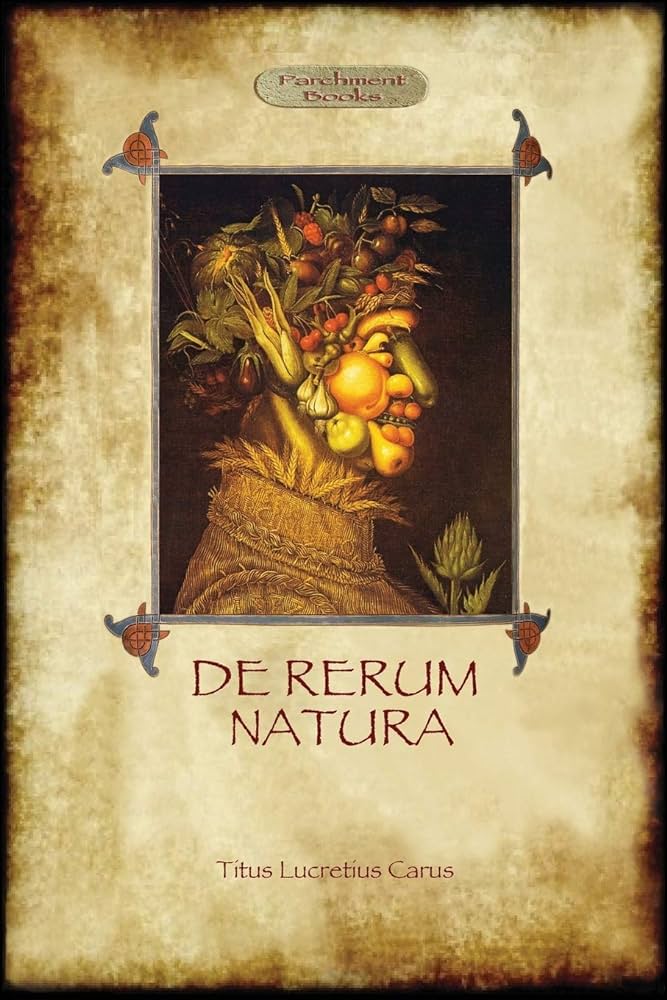
De rerum natura
Book by LucretiusWikipedia
90
MENTIONS
18
EPISODES
15
PODCASTS
Search complete. 90 mentions across 18 episodes found for "De rerum natura".
Oct 9, 2026

CassiusHOST
[intro music] Welcome to episode 354 of Lucretius Today.
CassiusHOST
This is a podcast dedicated to the poet Lucretius, who wrote On the Nature of Things, the most complete presentation of Epicurean philosophy left to us from the ancient world.
CassiusHOST
Each week, we walk you through the Epicurean texts, and we discuss how Epicurean philosophy can apply to you today.
CassiusHOST
If you find the Epicurean worldview attractive, we invite you to join us in the study of Epicurus at epicureanfriends.com, where we discuss this and all of our podcast episodes.

Joseph HattrupGUEST
So that the Iliad and the Odyssey are being retold is evident.
Joseph HattrupGUEST
After reading Lucretius, De rerum natura, it's possible to see that that Epicurean poem is being retold in the Aeneid also.
Joseph HattrupGUEST
Virgil is in the next generation after Lucretius.
Joseph HattrupGUEST
the Dei Rerum Natura, the doctrine of the Dei Rerum Natura.

Ted LinhartNARRATOR
According to Democritus, the expounder of the atomic theory of matter, images, blank, composed of the finest atoms floated from the object to the mind.
Ted LinhartNARRATOR
Lucretius has expressed the theory in De Rerum Natura, Libre 4, 48-53.
Ted LinhartNARRATOR
Dico igitur rerum effigius tenuisque figuris, mitir ab ribas sumo de corpore rerum, cui quasi membrane vel cortex nominatandast, quod specium ach formam simelum gerit ejus imagio, cucus cum que cluit de corpore fusa vagari.
Ted LinhartNARRATOR
It has appeared in one form or other ever since.

Thomas JonesHOST
That's amazing.
Thomas JonesHOST
I mean, that reminds me slightly, there's a moment in Lucretius' poem De Rerum Natura where he talks about the sound that a mother cow makes when she's mourning for her calf and a particular kind of...
Thomas JonesHOST
Yes, that's right, exactly.
Thomas JonesHOST
That would be the same sort of thing.

Steven SeitelNARRATOR
In fact, it would not be pressing our argument unduly to say that, so far as the minds of the Romans turned to speculation, it was the tendency to practical philosophy, Epicureanism or Stoicism, that was most characteristic.
Steven SeitelNARRATOR
This was true even of Lucretius, ninety-eight through fifty-five BC, author of the noble poem concerning the nature of things, De Rerum Natura.
Steven SeitelNARRATOR
In this work he writes under the inspiration of Greek philosophy.
Steven SeitelNARRATOR
His model was a poem by Empedocles on nature, the grand hexameters of which had fascinated the Roman poet.
CassiusHOST
🎵 🎵 Welcome to episode 353 of Lucretius Today.
CassiusHOST
This is a podcast dedicated to the poet Lucretius who wrote On the Nature of Things, the most complete presentation of Epicurean philosophy left to us from the ancient world.
CassiusHOST
Each week we walk you through the Epicurean texts and we discuss how Epicurean philosophy can apply to you today.
CassiusHOST
If you find the Epicurean worldview attractive, we invite you to join us in the study of Epicurus at EpicureanFriends.com, where we discuss this and all of our podcast episodes.
CassiusHOST
Music Music Welcome to episode 352 of Lucretius Today.
CassiusHOST
This is a podcast dedicated to the poet Lucretius who wrote On the Nature of Things, the most complete presentation of Epicurean philosophy left to us from the ancient world.
CassiusHOST
Each week we walk you through the Epicurean texts and we discuss how Epicurean philosophy can apply to you today.
CassiusHOST
If you find the Epicurean worldview attractive, we invite you to join us in the study of Epicurus at EpicureanFriends.com, where we discuss this and all of our podcast episodes.

Abram Van IngenHOST
She's one of the great living formalists of our day and the author of five books, but she's also a translator.
Abram Van IngenHOST
And so she's done Lucretius' De Rerum Natura and a couple of other books as well.
Abram Van IngenHOST
So she's a classicist, a poet.
Abram Van IngenHOST
She does all kinds of things and she kind of blends it all together.
8 more episodes mention De rerum natura.
Create an account to see the whole feed, search across every transcript, and follow the entities you care about.