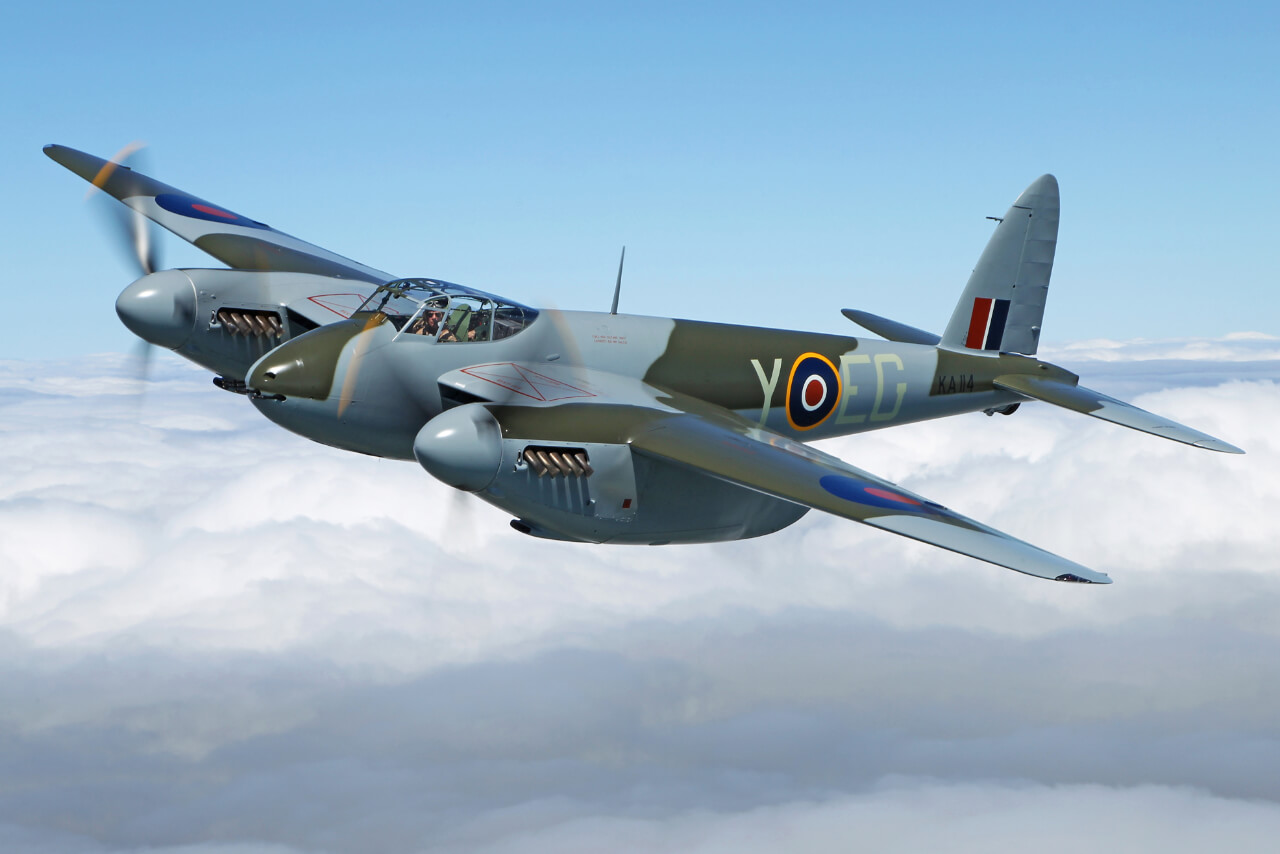
de Havilland Mosquito
32
MENTIONS
9
EPISODES
4
PODCASTS
Search complete. 32 mentions across 9 episodes found for "de Havilland Mosquito".
Sep 23, 2026

Simon WhistlerHOST
This speed and manoeuvrability, along with its ability to carry a wide variety of ordnance, made the aircraft perfect for precision strikes against small, difficult-to-reach targets.
Simon WhistlerHOST
For example, on September 25, 1942, four Mosquitos of No. 105 Squadron RAF carried out a raid on the Gestapo's Norwegian headquarters located in the Victoria Terrace building in downtown Oslo.
Simon WhistlerHOST
the raid designed to boost the morale of the norwegian people was deemed successful enough for the raf to reveal the existence of the mosquito to the british public by the war's end the rf would carry out two more precision raids against costabo headquarters in aarhus denmark on october 31 1944 and copenhagen on march the 21st 1945 but those are stories for another video In preparation for the Amiens raid, RAF photo reconnaissance aircraft flew multiple sorties over the prison.
Simon WhistlerHOST
Located along the highway connecting Amiens to the town of Albaire to the northeast, the main prison building was a cruciform structure 130 meters along the north side, 120 meters long on the south side, 200 meters wide, 90 meters tall.
7 MINS LATER
Ryan ReynoldsADVERTISER
Give it a try at mintmobile.com slash switch.
speaker_7UNKNOWN
The weather that day was worse than any 140-wing had previously flown in, with low clouds and driving snow.
Simon WhistlerHOST
But at around 1100 hours, all 18 Mosquitos managed to get safely into the air.
Simon WhistlerHOST
From Huntsman, they turned south toward Little Hampton to rendezvous with their Typhoon escorts.

Tail DraggerHOST
He was 26 years old.
Tail DraggerHOST
His de Havilland Mosquito went down over the Netherlands under circumstances that were never fully explained.
Tail DraggerHOST
He is buried there.
Tail DraggerHOST
His crash site was identified 50 years after the war.
Tail DraggerHOST
The Pathfinder Force, the precision marking organization led by Air Vice-Marshal Donald Bennett, used it to fly ahead of the main bomber stream and drop target indicators on the exact aiming point before the heavies arrived.
Tail DraggerHOST
By the time production ended after the war, de Havilland and its Commonwealth partners had built 7,781 Mosquitos in Britain, Canada, and Australia.
Tail DraggerHOST
Every one of them doing something different, most of them doing it faster and lower than anything else in the theater.
Tail DraggerHOST
Let me tell you about a mission that captures what the Mosquito was in the hands of a trained crew with a specific target and a very small margin for error.

Marcus LushHOST
Um, I think the, um, spiral spaghetti is just called diamond spirals.
Marcus LushHOST
Um, Marcus, a few months ago we spoke about the de Havilland Mosquito that John Smith stored in the shed in Maipou for 62 years.
Marcus LushHOST
It now lives at the Omaka Aviation Heritage Centre at Omaka Aerodrome.
Marcus LushHOST
On Saturday just gone, we were able to taxi her again, 74 years since it last flew.
Marcus LushHOST
Um, there are some road closures in Napi Hastings, but they are planned ones, so you will know about those.
Marcus LushHOST
If you want to look at the footage of that plane taxiing, you go to sympathetically restored to running condition.
Marcus LushHOST
Um, now, so if you go on YouTube under de Havilland Mosquito taxi at Omaka, um, that is there.
Marcus LushHOST
It's pretty good footage for itself.
Tail DraggerHOST
The Mosquito entered operations in the photo reconnaissance role first, and here it did something that changed the war in a way most people have never fully appreciated.
Tail DraggerHOST
In the summer of nineteen forty-three, photo reconnaissance Mosquitoes operating out of Scotland began returning photographs of a remote peninsula on the Baltic coast of Germany called Peenemünde.
Tail DraggerHOST
The images showed construction that the photo interpreters at Medmenham did not immediately recognize.
Tail DraggerHOST
Large horizontal cylinders, rail lines running to the water's edge, structures unlike anything in the existing intelligence catalogs.
Tail DraggerHOST
He had flown Whitleys over Germany in the early years, flown in support of the Bruneval radar raid in 1942, flown enough operations that command was trying to pull him off frontline duty.
Tail DraggerHOST
He asked to fly this one himself.
Tail DraggerHOST
18 Mosquitoes of the 2nd Tactical Air Force departed England on the morning of the 18th.
Tail DraggerHOST
The weather over the channel was ugly.

speaker_0NARRATOR
It was used for reconnaissance, weather study and as a tactical bomber.
speaker_0NARRATOR
It was originally designed in the mid-1940s as a replacement for the de Havilland Mosquito bomber, although the prototype didn't take to the skies until May 1949.
speaker_0NARRATOR
They were used by the UK's RAF right up until 2006.
speaker_0NARRATOR
On the 3rd of May, 1977, a two-man Canberra was returning to its base at RAF Whiteon, near the town of Huntingdon in Cambridgeshire, England.
Tail DraggerHOST
His frontline fighter pilots quickly corrected that impression.
Tail DraggerHOST
At one point, Goering told his staff that every time he went to brief the Fuhrer, a handful of Mosquitos were over Berlin, and the Luftwaffe could not do anything about it.
Tail DraggerHOST
He had publicly promised the German people that no Allied bomber would ever reach the capital.
Tail DraggerHOST
The Mosquito made that promise impossible to keep.
Tail DraggerHOST
Now, I want to tell you about something specific, something that I think shows what this aircraft and its crews were truly capable of.
Tail DraggerHOST
On the 18th of February 1944, 18 Mosquitos of the 2nd Tactical Air Force flew low across occupied France to the city of Amiens.
Tail DraggerHOST
Their target was the prison there, Amiens Prison, where the Gestapo was holding French resistance members awaiting execution.
Tail DraggerHOST
The plan was to breach the outer walls and destroy the guards' quarters precisely enough to allow the prisoners to escape.
Tail DraggerHOST
The company had been building aircraft since Jeffrey de Havilland himself had founded it.
Tail DraggerHOST
In 1920, they had built the Mosquito, perhaps the most versatile warplane of the Second World War.
Tail DraggerHOST
Out of wood and epoxy and sheer engineering nerve, they knew how to build aircraft.
Tail DraggerHOST
They knew how to build them fast.
Tail DraggerHOST
I'm Tail Dragger, and this is The Hangar on Radio Hangar.
Tail DraggerHOST
Today we are talking about the de Havilland mosquito, the wooden wonder.
Tail DraggerHOST
The aircraft nobody wanted until they couldn't get enough of them.
Tail DraggerHOST
Pull up a chair.
Tail DraggerHOST
With two Merlins and a clean wooden airframe, his calculations showed speeds north of 380 mph, maybe higher.
Tail DraggerHOST
The Air Ministry remained skeptical right up until the prototype flew.
Tail DraggerHOST
The first flight of the Mosquito prototype happened on 25 November 1940.
Tail DraggerHOST
Geoffrey de Havilland's son, Geoffrey Junior, was at the controls.