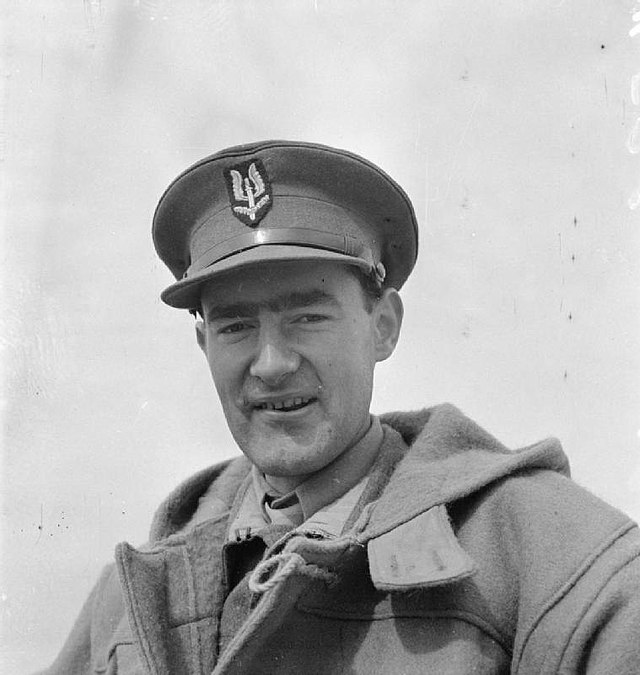
David Stirling
British army officerWikipedia
25
MENTIONS
9
EPISODES
9
PODCASTS
Search complete. 25 mentions across 9 episodes found for "David Stirling".
Oct 5, 2026

DavidGUEST
We then followed in.
Sam KileyHOST
That was David, a former SAS soldier.
Sam KileyHOST
He's never spoken publicly before about his role in those dramatic few minutes when he and his SAS colleagues stormed the Iranian embassy in central London live on TV one evening in May, 1980.
Sam KileyHOST
I'm Sam Kiley, world affairs editor at The Independent, and you are listening to SAS: The Shadow War, the story of the conflict in Northern Ireland revealed for the first time by Britain's secret soldiers in their own words.
Sam KileyHOST
The order to storm the embassy was six days in coming, but its effects have been felt for years, up to today.
DavidGUEST
It was a very good day and a very bad day all at the same time.
Sam KileyHOST
David was an SAS soldier in his early 20s when he got the call to deploy in London in the counter-terror team.
DavidGUEST
[laughs] The way that all happened, uh, we, we'd only been on the team f- I was, I think it was my third time on the team, and I was a team sniper.

speaker_0NARRATOR
At Homs, a coastal town in Western Libya, he gathered information on a new British Special Forces formation known as the Special Air Service, or SAS, a small commando unit trained for sabotage missions in the desert.
speaker_0NARRATOR
In February 1943, Shurch met Colonel David Stirling, the founder of the SAS, who was then a prisoner in Rome.
speaker_0NARRATOR
Still using his false name, Shurch tried to learn who would replace Stirling as commander.
speaker_0NARRATOR
Later that spring, he interrogated captured naval officers seeking details about British ships and operations in the Mediterranean.

Iain CarterGUEST
Now he's won in, in France, so he's making hay in the early part of the qualifying, uh, sort of period.
Iain CarterGUEST
And if you imagine those two together, and Matt made the point, um, the other week that, that he would love to be playing with his brother in foursomes in, in, um, Adare Manor, uh, next year.
Iain CarterGUEST
And given the way that they won, uh, together, um, that would be...
Iain CarterGUEST
That would, that would bring something to the Ryder Cup, wouldn't it? You know, to have a pair of brothers-
Andrew CotterHOST
Hmm.
Andrew CotterHOST
I wonder
Iain CarterGUEST
Oh, yeah, Ross Fisher definitely played with Harrington.
Andrew CotterHOST
Yeah.

Paula QuHOST
They will live in the clearing as if the old building never existed.
Paula QuHOST
Thomas, there will be David Stirling of the Special Air Service, the SAS.
Paula QuHOST
In 1941, in the Western Desert at 25 years old, he will not copy your methods.
Paula QuHOST
He will not talk about you.

Steven BellHOST
To explain that, following the 1962 military coup by Abdullah al-Sallal, which ousted the Mutawakkilite, and I know I'm gonna butcher that name here in the first place, Kingdom of Yemen, and established an Egyptian-backed republic, uh, Gamal Abdel Nasser, the president or leader of Egypt, went and deployed up to 70,000 Egyptian troops to the Arabian Peninsula.
Steven BellHOST
Now, fearing Egyptian hegemony and Soviet penetration towards the Gulf of Aden, British MI6, which was led by Julian Amery and Colonel David Stirling, and the French SDECE, would launch Operation Ranier, or Operation Bucky, depending on which one you're looking at.
Steven BellHOST
Denard, along with French veterans of the Foreign Legion and Indochina, were deployed to Northern Yemen in order to train royalist tribal guerrillas that were loyal to Imam Muhammad al-Badr.
Steven BellHOST
Now, Denard's contingent provided heavy weapons instruction, coordinated mortar teams in mountain passes, and disrupted Egyptian logistics lines, pinning down Nasser's mechanized forces in what became known as, pretty much, Egypt's Vietnam.

Tim SpicerGUEST
And I said, okay, and connected this extraordinary coincidence with, with the visit to Lesseps in France and.
Tim SpicerGUEST
so we agreed that it was a very interesting project i asked my friend a little bit more about brian and things dropped into place which i knew about already and i said okay on two conditions i will write it one is the family are completely happy and show me all private papers and secondly the sas hierarchy are also happy because they can be a little bit sensitive about who writes what about them, and particularly their history, and particularly of somebody who is so prominent in their history, but not necessarily as well known as the likes of Paddy Mayne and David Stirling.
Tim SpicerGUEST
Luckily both agreed, so I started.
Justin BlackHOST
Oh, fantastic.
Justin BlackHOST
And Brian, he's obviously, as I read through this, he was a tremendous impact on the progress of the war and of the SAS itself, but nobody else has written extensively about him in the past.
Justin BlackHOST
Why do you think that is? Why did it take until 2025, 2026 for a biography of his to be written by you?
Tim SpicerGUEST
Well, I find it astonishing considering the volume of literature written about the SAS in general and in particular, other more well-known characters like David Stirling and Paddy Mayne, even Jock Lewis and others of the originals, why nobody had honed in on Brian.
Tim SpicerGUEST
And I think it was partly in his nature.

Tim SpicerGUEST
He quickly grabbed Brian, liked him, he knew him from school, and said, I want you to be my signals officer.
Tim SpicerGUEST
David Stirling was sort of trying to set up the SAS with Laycock's blessing.
Tim SpicerGUEST
tried to recruit brian early on but brian had gone on one of the first commando raids bardia raid and he got these rather unpleasant desert sores and i think most people think oh you know rather like private hook in zulu are you you've got a boil or a sore you must be a malingerer when in fact they weren't they were very very nasty things quite often infected by all the flies in the desert, aggravated by the sand, and could quickly lead to diphtheria.
Tim SpicerGUEST
And Brian got very ill, was invalided home, missed the Battle of Crete, probably luckily for him.
12 MINS LATER
Tim SpicerGUEST
A few.
Tim SpicerGUEST
But mostly, there were people who'd either been in a territorial army or had done interesting things.
Tim SpicerGUEST
I mean, David Stirling couldn't make up his mind whether he wanted to be an artist or he had all sorts of things.
Tim SpicerGUEST
He served briefly in the Scots Guard, but they all came together in a unit called the 5th Scots Guard Ski Battalion, which was formed in 19… 39 or 40.

Darren EdwardsGUEST
Um, the local unit, the Rifles, I very quickly, um, found out there was something called the SAS Reserve.
Darren EdwardsGUEST
And once again, you know, a bit like those Shackleton books, I'd read lots of books about David Stirling and the, and the Special Forces in the Second World War.
Darren EdwardsGUEST
And someone made a throwaway comment to me about, I think one of the lads in my unit had gone for the selection process which was the, the, the toughest reserve selection process in the world by far.
Darren EdwardsGUEST
Um, and he'd failed it and made some throwaway comment to me like, "It's, it's too difficult.
Darren EdwardsGUEST
So, and, and that, and, you know, my accident brought an end, uh, to, to that career as well.
Darren EdwardsGUEST
So it was-
Chris GrimesHOST
I went to the David Stirling Monument very, very recently.
Chris GrimesHOST
A very good co- a, a mutual friend of Joe Bradshaw's and mine, a wonderful man called Dave Stewart-

speaker_0HOST
What it does not yet know is that its job is about to expand.
speaker_0HOST
That same summer a young Scots Guards Lieutenant named David Stirling is recovering from a parachuting accident and pitching Middle East headquarters on an idea of his own.
speaker_0HOST
A small unit of parachute-trained raiders dropped directly onto Axis airfields to destroy aircraft on the ground rather than shoot them down in the air.
speaker_0HOST
The unit is authorised.