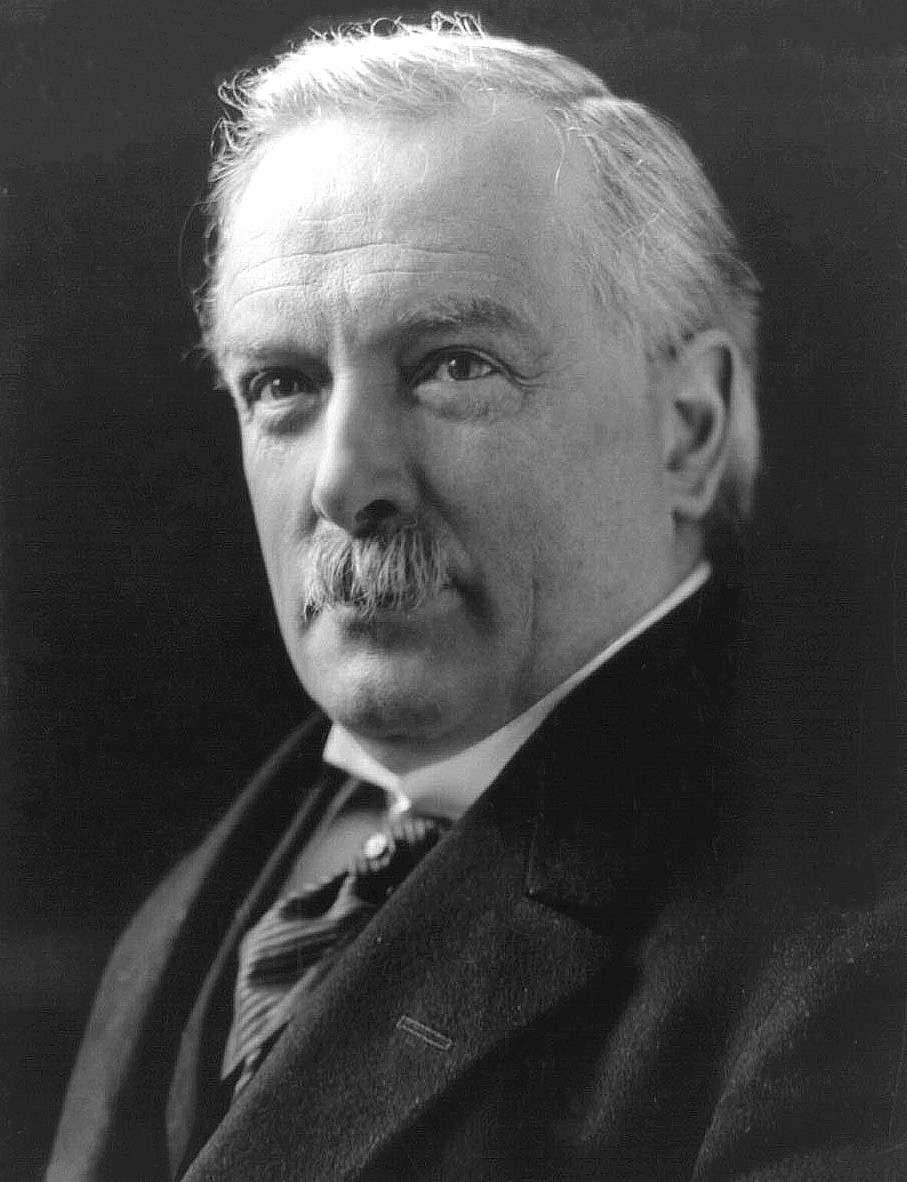
David Lloyd George
Former Prime Minister of the United KingdomWikipedia
457
MENTIONS
147
EPISODES
129
PODCASTS
Search complete. 457 mentions across 147 episodes found for "David Lloyd George".
Sep 13, 2026

David PietruszaGUEST
He's on a train crossing the border from Italy to France.
David PietruszaGUEST
And with him when he gets there is Lloyd George, the prime minister of Britain.
David PietruszaGUEST
And Lloyd George is just shocked at the language and the vulgarity, I think, even of what escaped the hatefulness that escapes Woodrow Wilson's lips when he hears that Theodore Roosevelt has passed away.
John BatchelorHOST
That is Wilson's personality as seen by others as well.
John BatchelorHOST
Colonel House, his political advisor, said the way to get close to Roosevelt is to find something you can mutually hate.

Ted LinhartNARRATOR
He knew that in nineteen fourteen, Lord Kitchener had been violently criticized, not only by civilians but also in the British regular army, because he insisted on planning for a large army and a long war instead of sending his newly raised men in driblets to the front.
Ted LinhartNARRATOR
In the midst of this, General Sir William Robertson, the chief of the British General Staff, got Lloyd George, the Prime Minister, to agree to a demand that one hundred fifty individual battalions of American infantry be sent to Europe and put in British divisions.
Ted LinhartNARRATOR
The British divisions, because of lack of men for the army, had recently been reduced from four to three battalions.
Ted LinhartNARRATOR
Putting one American battalion in each would restore them to their original strength.
Ted LinhartNARRATOR
Mr. Lloyd George sent Lord Reading, the British ambassador to the United States, who was then in Europe, to Colonel House in Paris.
Ted LinhartNARRATOR
Colonel House forwarded his request to Washington.
Ted LinhartNARRATOR
Mr. Garrison resigned as Secretary of War in February nineteen sixteen because his efforts to prepare us for war met with the disapproval of President Wilson.
6 MINS LATER
Ted LinhartNARRATOR
The last attempt was made during the Argonne battle, when it was suggested that American divisions should be distributed between British and French armies along the Western Front.

Denis GagnéNARRATOR
The public they have to satisfy is small and sophisticated, the trade unions of the larger cities, and these working men demand above all else frankness and the unpowdered truth.
Denis GagnéNARRATOR
an address by lenin is therefore as direct unsentimental and full of facts as a statement to a board of directors by an executive of an american corporation the slow strong wants of the peasants have to be heeded too but they are simple wants land and free trade and do not yet touch intricate things remote from the daily life of the farm like foreign affairs and higher economics in the end the peasants will rule russia but to-day a public opinion is the opinion of the class-conscious workingmen of the cities therefore the leaders of russia can afford to be frank in western democracies politics is the art of seeming frank while not being so only three types of politicians ever emerge in the highest places first the statement of brilliant intellectual understanding like lloyd george who always knows what he ought to do and never does it until the public also comes to understand usually some months or years later second the sentimentalist who is always able to muddle an inconvenient understanding of facts and muffle his conscience with high-sounding principles that endear him to the public heart third the kindly blockhead who discovers what ought to be done just a little later than the public these types do not exist in russia the trade unions compel the russian politician to be a stark realist talking frankly acting on the best information he can obtain and giving that information fully to his public the leaders pictured in this book will seem therefore franker and more direct than the leaders of the western world they will also seem more desperate not because it is their natural character to be desperate but because they face as desperate a problem as ever strained the human brain they have been caught from the first on the horns of the revolutionary dilemma the same intolerable breakdown of economic life which alone makes revolution possible also predestines revolution to almost certain failure that dull beast the public will move to revolution only when life has become unbearable only when the established order has broken down so completely that ruins alone remain revolution does not come before ruin and to build on ruins a new and fairer life is a task almost beyond the powers of men so much of the exhausted energy of the nation must be consumed in re-establishing the mere fundamentals of life food shelter clothing and security from fear that little remains to attack the task of remoulding life in a shape that is closer to the heart's desire But to this task the leaders of Russia have dedicated their lives, and if they succeed or if they fail, they will be remembered always for their courage in following an ideal through destruction, famine, death, and the hatred of the world.
Denis GagnéNARRATOR
Here then they are, the Russians of today, close to the Tartar and the Cossack of the plain, children of serfs and Norsemen and Mongols, close to the earth and striving for the stars.
Denis GagnéNARRATOR
Louise Bryant Lenin and his subordinates Nikolai Lenin Lenin became an active revolutionist through the spiritual motives that have moved all great reformers.
19 MINS LATER
Denis GagnéNARRATOR
There was one moment when the morale of the Red Army was exceedingly low, and when even the trusted Lettish sharpshooters guarding the Kremlin grew discouraged and sampled the wine in the Kremlin cellars to make life more interesting.
Denis GagnéNARRATOR
a let who went through these days told me an amazing story one night the old man himself came down to the barracks called the officers out felt in our pockets and finding one or two flasks of vodka smashed them on the cobblestones and went away without saying a word he only had to come once we were deeply ashamed how much truth there is in this story i do not know but it sounds so exactly like lenin that i am inclined to give it full accretance From this low ebb he built his power solidly, never forgetting to reckon on the peasants.
Denis GagnéNARRATOR
Now face to face at last with Mr. Lloyd George, Lenin is backed by a strong Red Army and a loyal staff.
Denis GagnéNARRATOR
From the moment he took office, Lenin never had a serious political rival, and the blockade bestowed on him a peculiar legendary significance, which will remain with him as long as he does not leave Russia.

Nick ShepleyHOST
Few people anticipated that from the autumn of 1914, the opposing forces would get bogged down in a costly four-year war of attrition along more or less fixed positions from the English Channel to the Swiss frontier.
Nick ShepleyHOST
As the British military commitment escalated into a mass conscript army and the Butcher's Bill of trench warfare mounted, the autonomy of Sir John French and his successor Sir Douglas Haig, came to be questioned in London, where the civilian politicians, especially David Lloyd George, after he became Prime Minister in December 1916, increasingly sought to assert control over war strategy.
Nick ShepleyHOST
For civil-military relations in Britain, the consequence of total war and the necessity of mobilisation of all the national resources was to shift the wartime balance of power away from the armed forces, especially the army, to the political leadership of the country.
Nick ShepleyHOST
The generals initially viewed themselves as the King's generals.

Malcolm Out LoudNARRATOR
His two mistresses were both conspicuously,
Edward DuttonGUEST
obviously borderlines, David Lloyd George, various others.
Edward DuttonGUEST
Then I looked at women just in the modern day in the arts, so Sylvia Plath, Sinead O'Connor, Sarah Kane, who is a British playwright, Princess Diana, so this is the modern day great man, great man's woman borderline.
Edward DuttonGUEST
So you have that.

Jillian MosleyNARRATOR
The catalyst for our present-day conflict had emerged.
Jillian MosleyNARRATOR
This motion was supported by Winston Churchill, as well as Prime Minister Lloyd George and Arthur J. Balfour, who were both fervent Christians, keen to turn biblical prophecy into reality.
Jillian MosleyNARRATOR
But some were wary of Britain's arrogant kingmaking, like former Viceroy of India, Lord Curzon.
Lord CurzonSOUNDBITE_SPEAKER
I do not recognise that the connection of the Jews with Palestine, which terminated 1,200 years ago, gives them any claim whatsoever.

Jack DickensHOST
I wondered whether you could just sketch out the landscape of the Middle East as it was back then and how it differed from the Middle East as we know it today.
Simon Sebag MontefioreGUEST
Well, I mean, the reason why I chose that scene, most people bring in these books, histories of the Middle East traditionally with sort of Sykes-Picot, Lloyd George, the fall of the Ottoman Empire.
Simon Sebag MontefioreGUEST
And I didn't because...
Simon Sebag MontefioreGUEST
The sort of reigning spirit of this book is that this is a region ruled by its people.

Philip CowleyGUEST
The debate features a series of astonishingly good speeches, of which Amory's is the one that's most often quoted.
Philip CowleyGUEST
But there's an astonishing one by Lloyd George, former prime minister as well.
Philip CowleyGUEST
And actually Churchill's winding up speech, Churchill at this point is in the government, Churchill's winding up speech, for the government is also really impressive.
Philip CowleyGUEST
And it's an example, and this is a rare example, but it does happen, of how the speeches in the Commons can occasionally change the mood.
speaker_11VOICE_ACTOR
No government can prosecute a war efficiently unless it has public and parliamentary support.
speaker_11VOICE_ACTOR
And I call on my friends to support us in the lobby tonight.
Matt ChorleyHOST
And then this was former Prime Minister Lloyd George responding with this devastating line, again voiced by an actor.
speaker_12VOICE_ACTOR
It is not a question of who are the Prime Minister's friends.

Charlie HigsonHOST
Caernarfon Castle being in northwest Wales, originally established by Edward I to subdue the Welsh.
Charlie HigsonHOST
Now, this ceremony was invented by the then Prime Minister Lloyd George, and he invented this peculiar sort of pantomime ceremony, which was part Welsh pageant, part medieval cosplay, and part sort of Ruritanian royal fantasy.
Charlie HigsonHOST
And this peculiar ceremony persisted Right up to the modern age, I remember as a schoolboy watching the investiture of the Prince of Wales, the future King Charles III, where there were still all these vestiges of this weird old ceremony that Lloyd George had invented, including a sort of knight's tent, a medieval knight's tent, which had been redesigned by Lord Snowdon for Charles's ceremony, with this weird sort of perspex box inside.
Charlie HigsonHOST
which is the only thing I really vividly remember from that ceremony.
Charlie HigsonHOST
One of the things Prince Edward had to do was to learn a few lines of Welsh, which is a pretty tricky language to get your head around if you're not a native who's been brought up speaking it.
speaker_5PANELIST
They felt that the Allies had deceived them, had abandoned all notions of honour by treating them as a conquered people when they didn't think they were.
speaker_5PANELIST
The things that had been promised to them, specifically by President Woodrow Wilson and David Lloyd George, had not been delivered.
speaker_5PANELIST
Instead, they'd been violated, their honour had been degraded.
speaker_5PANELIST
A
137 more episodes mention David Lloyd George.
Create an account to see the whole feed, search across every transcript, and follow the entities you care about.