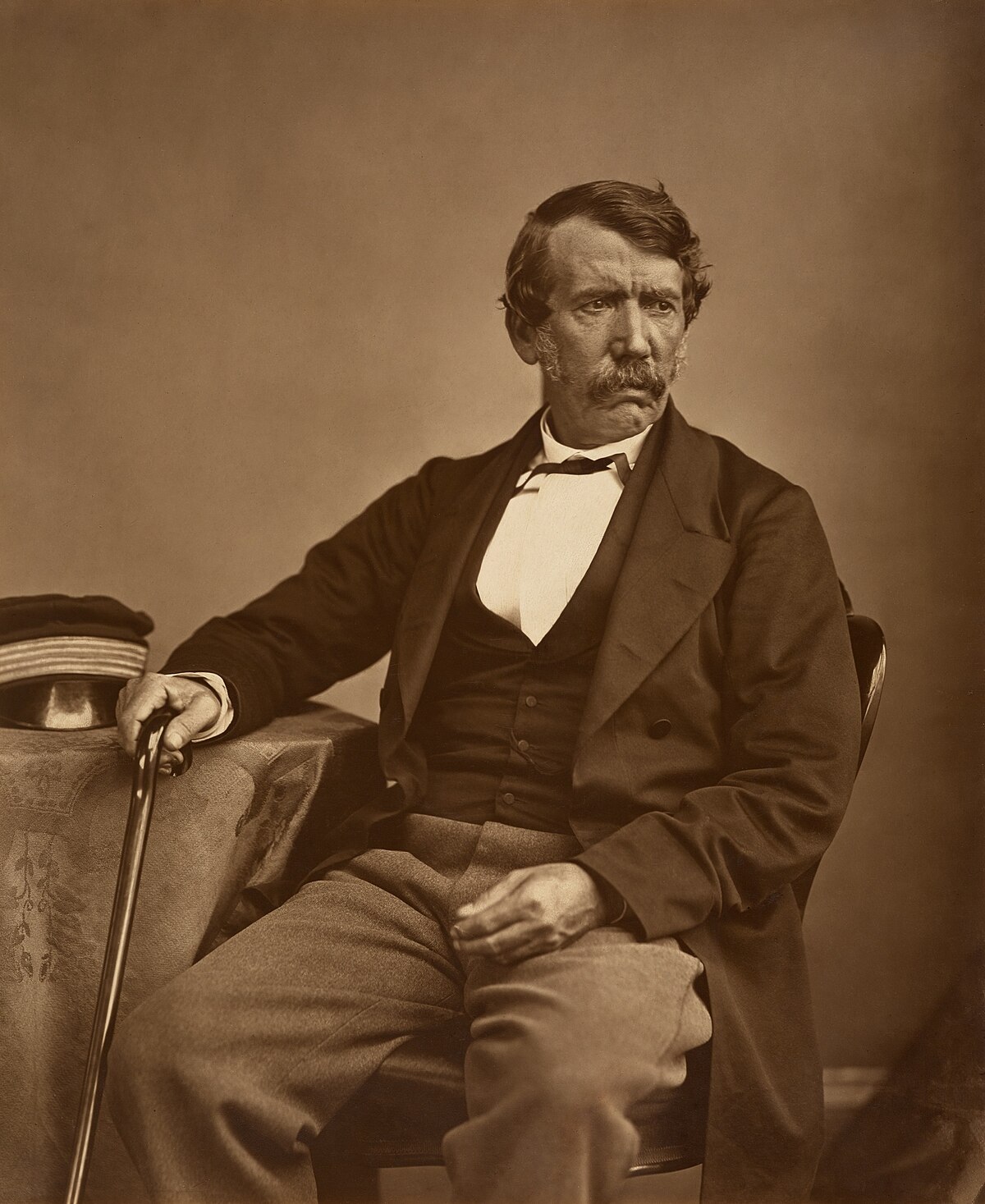
David Livingstone
Scottish doctorWikipedia
93
MENTIONS
36
EPISODES
34
PODCASTS
Search complete. 93 mentions across 36 episodes found for "David Livingstone".
Oct 27, 2026

John PiperHOST
He found the strength in Westminster Abbey.
John PiperHOST
David Livingstone's tomb is still there.
John PiperHOST
Scott entered quietly, found the tomb, and knelt in front of it to pray.
John PiperHOST
The inscription reads, Other sheep I have which are not of this fold.

Simon WhistlerHOST
Whether it's looking at countries where insulting the king is a jailable crime to the use of diplomatic bags to smuggle cocaine, it covers a wide variety of stuff.
Simon WhistlerHOST
On paper, it can be hard to say exactly why David Livingstone is ranked among the greatest explorers of Africa.
Simon WhistlerHOST
Objectively speaking, he wasn't a particularly effective missionary, and most of the areas he traveled to had already been explored by other people.
Simon WhistlerHOST
On a personal level, he got into frequent arguments with his colleagues and mostly ignored his wife and children.
Simon WhistlerHOST
Maybe it was his inspirational rags-to-riches story, starting out in a poor family working in a cotton factory and ending with a state funeral at Westminster Abbey.
Simon WhistlerHOST
Maybe it was his utmost hatred of slavery, as he made it clear again and again that everything he did in Africa had the ultimate goal of undermining the slave trade.
Simon WhistlerHOST
We'll let you decide for yourself if he was truly deserving of his place in history, as we make it our mission to explore the life of David Livingstone.
Simon WhistlerHOST
David Livingstone was born on March 19, 1813, in the small Scottish town of Blantyre in South Lanarkshire.

Paul McGuireHOST
Lots of writers, actors, artists.
Paul McGuireHOST
David Livingstone, the famous explorer.
Paul McGuireHOST
Johnny Westmuller, who was famous for playing Tarzan in the movies.
Paul McGuireHOST
George Bernard Shaw, a playwright, but a playwright with a kind of radical agenda.

speaker_0HOST
Where's Hudson? He's down in the youth, is he? Where's his namesake? He raised up Hudson Taylor for the missionary to China.
speaker_0HOST
David Livingstone went to Africa.
speaker_0HOST
Mary Schleser also.
speaker_0HOST
British and foreign Bible societies were formed.

Carl KuhlGUEST
It's Corrie Ten Boom's family risking their lives to hide Jews in their home while the Nazis occupied the Netherlands.
Carl KuhlGUEST
It's David Livingstone leaving the comforts of England and moving to Africa, not to explore, not to exploit, but because, quote, these people need Jesus.
Carl KuhlGUEST
It's William Wilberforce, because of his faith, taking on the whole British empire to end the slave trade.
Carl KuhlGUEST
And frankly, if you haven't realized, it's the story of this church.

speaker_3NARRATOR
The Wife.
speaker_3NARRATOR
Dr. Livingstone, in his travels in Africa, came one night to the house of Mozinqua, a friendly man with a pleasant-looking wife and a fine family of children, very black but calmly.
speaker_3NARRATOR
Perhaps their hospitable, kind ways made them look handsome to the lonely missionary so far from home and friends.
speaker_3NARRATOR
He was caught in a heavy rain, but he and his companions received a warm welcome and plenty of food from this friendly couple till they were able to proceed.
speaker_3NARRATOR
They had a large garden cultivated by the wife, with yams, sweet potatoes, and other vegetables growing in it, and all surrounded by a fine hedge of the banyan tree.
speaker_3NARRATOR
Under some larger trees in the middle of the yard stood the huts in which they lived, and no doubt the fine-looking little children played many happy days under their mother's care in the shade.
speaker_3NARRATOR
When Dr. Livingstone took his leave of this interesting family, his wife asked him to bring her some cloth from the white man's country.
speaker_3NARRATOR
When he returned after a long journey, he was surprised to find the pleasant home silent and deserted, the garden given up to wild weeds and the huts in ruins, and no sign of life in the spot where he last saw a large family of frolicking children.

Alan GisbersGUEST
I mean, I think it's funny.
Alan GisbersGUEST
David Livingston says that when God sent his son into the world, he sent him as a medical missionary.
speaker_2NARRATOR
Welcome to Real Faith.
speaker_2NARRATOR
Conversations about the impact faith has on our lives and the challenges we go through.
13 MINS LATER
Alan GisbersGUEST
I mean, if you believe the gospel is for everybody, then you want to go where the gospel has not been heard.
Alan GisbersGUEST
And also, medicine was part of it.
Alan GisbersGUEST
I mean, I think it's funny, David Livingston says that when God sent his son into the world, he sent him as a medical missionary.
Alan GisbersGUEST
You know, the idea that the gospel...

speaker_2NARRATOR
the water level in the narrow chasm rising to within metres of the lip on the downstream side.
speaker_2NARRATOR
David Livingstone, the Scottish missionary and explorer, became the first European to see the falls on 16 November 1855.
speaker_2NARRATOR
He paddled to the lip on a small island, now called Livingstone Island, that sits at the very edge of the drop, and he looked over.
speaker_2NARRATOR
He named the falls after Queen Victoria, and in his journal he wrote about the columns of vapour and the beauty of the scene.

Bill FedererGUEST
That's why it still exists in sudan maritime niger and so forth and eric metaxas who's a friend of ours um he has uh works with christian solidarity international that collects money to rescue christians out of slavery today and um then you have um the middle ages there were whole catholic orders that would ransom um christians out of slavery called the trinitarians and and then in the 1600s muslim pirates raided ireland and carried away a whole village uh called the uh stolen village of baltimore ireland and then they enslaved africans and tens of millions of africans and fortunately to castrate the men make immunix and sell the women in the sex trafficking And it kept going on.
Bill FedererGUEST
Even David Livingston, the missionary to the Congo, writes about seeing the slaves being shackled together and marched toward the coast.
Bill FedererGUEST
And Turkey had slaves that they would make into an army called Janissaries.
Bill FedererGUEST
And in Egypt, they called them Mamluks.
Stephen SeidelNARRATOR
what therefore we mean by the history of geographical discovery is the gradual bringing to the knowledge of the nations of civilization surrounding the mediterranean sea the vast tracts of land extending in all directions from it there are mainly two divisions of this history the discovery of the old world and that of the new including australia under the latter term though we speak of geographical discovery it is really the discovery of new tribes of men that we are thinking of it is only quite recently that men have sought for knowledge about lands apart from the men who inhabit them one might almost say that the history of geographical discovery properly so called begins with captain cook the motive of whose voyages was purely scientific curiosity but before his time men wanted to know one another for two chief reasons they wanted to conquer or they wanted to trade or perhaps we could reduce the motives to one they wanted to conquer because they wanted to trade in our own day we have seen a remarkable mixture of all three motives resulting in the european partition of africa perhaps the most remarkable event of the latter end of the nineteenth century.
Stephen SeidelNARRATOR
Speak and Burton, Livingstone and Stanley, investigated the interior from love of adventure and of knowledge.
Stephen SeidelNARRATOR
Then came the great chartered trading companies, and, finally, the governments to which these belong have assumed responsibility for the territories thus made known to the civilized world.
Stephen SeidelNARRATOR
within forty years the map of africa which was practically a blank in the interior and as will be shown was better known in sixteen eighty than in eighteen fifty has been filled up almost completely by researches due to motives of conquest of trade or of scientific curiosity in the earlier stages then the history of geographical discovery is mainly a history of conquest and what we shall have to do will be to give a short history of the ancient world from the point of view of how that world became known.
3 HRS 53 MINS LATER
Stephen SeidelNARRATOR
African exploration of the interior begins with the search for the sources of the Nile and has been mainly concluded by the determination of the course of the three other great rivers, the Niger, the Zambezi, and the Congo.
Stephen SeidelNARRATOR
It is remarkable that all four rivers have had their course determined by persons of British nationality.
Stephen SeidelNARRATOR
The names of Bruce and Grant will always be associated with the Nile, that of Mungo Park with the Niger, Dr. Livingstone with the Zambezi, and Mr. Stanley with the Congo.
Stephen SeidelNARRATOR
It is not inappropriate that, except in the case of the Congo, England should control the course of the rivers which her sons first made accessible to civilization.
26 more episodes mention David Livingstone.
Create an account to see the whole feed, search across every transcript, and follow the entities you care about.