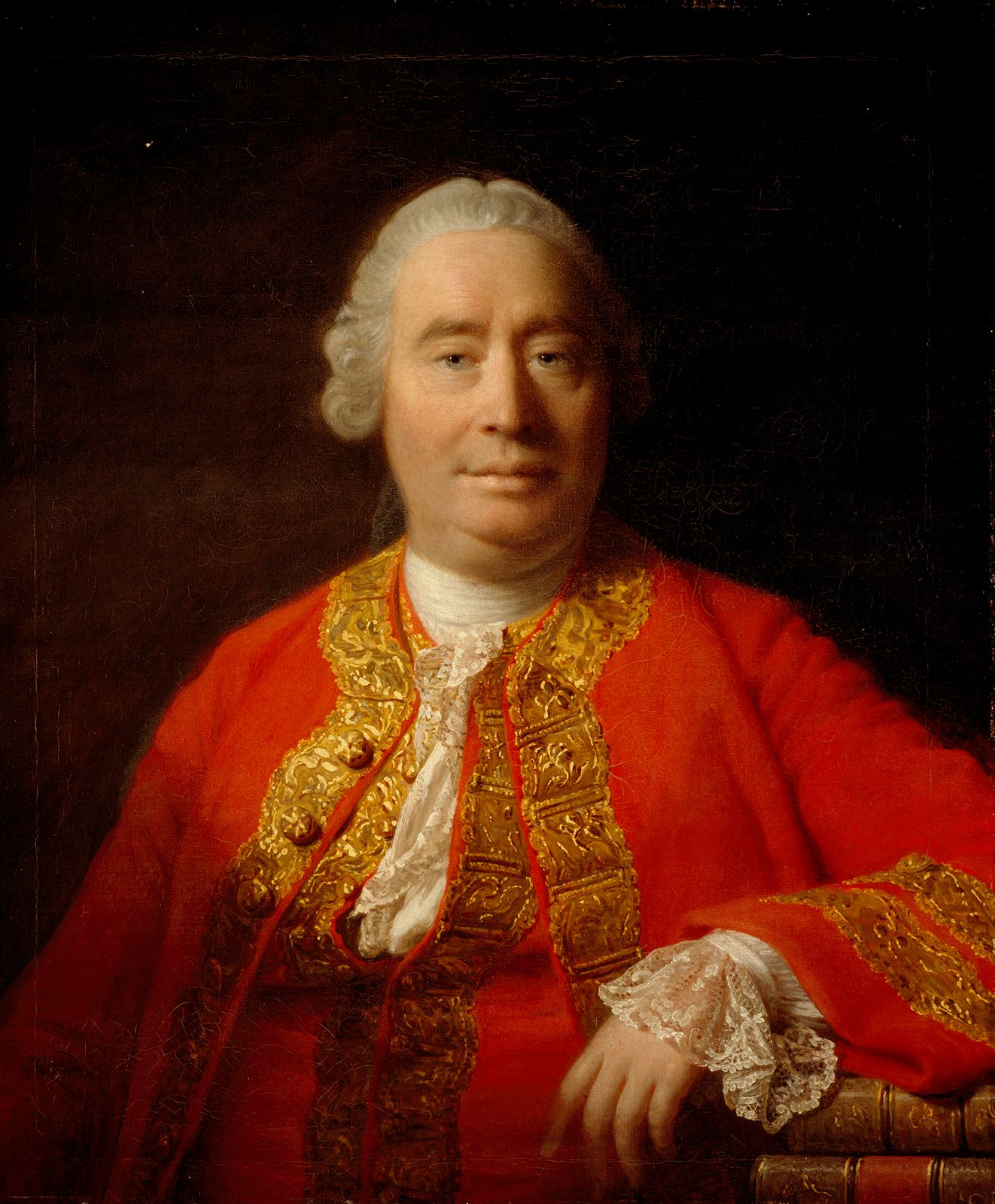
David Hume
Scottish philosopher and historianWikipedia
612
MENTIONS
172
EPISODES
149
PODCASTS
Search complete. 612 mentions across 172 episodes found for "David Hume".
Oct 28, 2026

Hetty LancasterGUEST
So we're in a tiny little section, the north section of old Colton burial ground here.
Hetty LancasterGUEST
People are far more familiar with the main section of Old Colton Burial Ground, which is to the south of Waterloo Place, and that's the one that's got the Political Masters Monument and David Hume's mausoleum and stuff like that.
Hetty LancasterGUEST
Originally, this was all one burial ground, and then once they built the new town, they needed a grander entrance route into the new town, I suppose, and so they decided to build Regent Bridge and Waterloo Place and Regent Road to have this wonderful grand entrance route onto Princes Street.
Hetty LancasterGUEST
But of course Colton Burial Ground was in the way.
Hetty LancasterGUEST
Basically, the public signed a petition and put it to the council to provide a path that afforded visitors the best views over the city and benefited the health and well-being of Edinburgh residents.
Hetty LancasterGUEST
And this is part of the path that was created.
Hetty LancasterGUEST
It's known as Hume Walk because David Hume is one of the key signatures on the petition.
Hetty LancasterGUEST
And it's actually formed the year that he died, so 1776.

Joe BartolozziHOST
Like, it's still just like, now you're just getting, now we're just talking about fucking stupid shit for no reason.
speaker_2SOUNDBITE_SPEAKER
...introduced by David Hume, questions how we can justify our belief that the future will resemble the past.
speaker_2SOUNDBITE_SPEAKER
For example, we expect the sun to rise tomorrow because it has risen every day before.
speaker_2SOUNDBITE_SPEAKER
However, Hume pointed out that there's no logical guarantee this will always happen.
speaker_2SOUNDBITE_SPEAKER
Just because something has occurred many times doesn't...
Joe BartolozziHOST
There's no logical guarantee that that will always happen.
Joe BartolozziHOST
And I know I had to read David Hume fucking last year.
Joe BartolozziHOST
But just because, yes, we are assuming that the sun will rise tomorrow because it's risen a million times prior.

Erik MatsonGUEST
I think I hadn't read the Spanish scholastics, the School of Salamanca much, but I was quite taken with some of their theoretical contributions.
Erik MatsonGUEST
I did not know, for example, that Azpilcueta first articulated the quantity theory of money before... before Baudin and the French and before David Hume.
Erik MatsonGUEST
So their theoretical insights were really important.
Erik MatsonGUEST
Lessius is another important figure.

Dana GioiaGUEST
I do not believe that.
Dana GioiaGUEST
And neither did the, you know, Immanuel Kant, who critiqued Hume in terms of, you know, bringing together Western philosophy.
Dana GioiaGUEST
There's also Oscar Wilde, who said, once again, the great statements about beauty usually have two parts.
Dana GioiaGUEST
And his is, man is hungry for beauty.
Dana GioiaGUEST
And when he said man is hungry for beauty, why? There is a void.
Dana GioiaGUEST
That's a very interesting notion, which is to say there's a hunger there because it is what is necessary to complete, in a sense, our perceptions.
Dana GioiaGUEST
You could almost take it back to David Hume and the empirical philosophers when he says, beauty is in the eye of the beholder.
Dana GioiaGUEST
If beauty is only in the eye of the beholder, there is a kind of void there.

Mabel TaylorHOST
But had an amazing memory.
Mabel TaylorHOST
And he goes to Oxford and the kind of like defining thing that happens to him there is that he is caught reading the work of David Hume, who is thought to be heretical for his ideas about religion.
Mabel TaylorHOST
And so he kind of like becomes an iconoclast via that.
Mabel TaylorHOST
Like he kind of is like, well, then I don't care what you guys have to teach me.
Mabel TaylorHOST
This book is called the invisible hand of Mariah Edgeworth.
Madeline PorsellaHOST
Isn't it the invisible hand of the market or it's a more abstract book? I think it's more abstract.
Madeline PorsellaHOST
You know what this book also didn't do to my satisfaction is like, okay, he's reading David Hume, who's an atheist, but I don't think there's really a way to interpret an invisible hand of the market in an atheistic way.
Madeline PorsellaHOST
I think it's shifting the role of God from the kind of like great designer and like maker of the watch or whatever to market forces.

Drew SparksGUEST
then you see reformers responding to these, as I've already indicated, Francis Turretin tends to side with Thomas Aquinas on this particular issue.
Drew SparksGUEST
And then over time, what ends up happening is you have someone like Immanuel Kant who comes along, and David Hume.
Drew SparksGUEST
These two individuals do a lot of damage to natural law theory as such.
Drew SparksGUEST
And then and then it kind of gets kind of gets lost at Peters out You'll see some individuals in the 1700s still trying to trying to argue for it I was reading something of the day by the time you get to the 1900s You don't really have a major evangelical theologian arguing for natural law now Is there maybe some somewhere that that does give a good classic account of natural law there may be but I'm not sure how how widespread that is And the thing that is, for me, that I think is unfortunate is when I see contemporary evangelicals imbibing explicitly the arguments of someone like David Hume against someone like Aristotle and the teleology that it brings to the table to contradict natural law.
Drew SparksGUEST
And I go, why is it we think we can imbibe explicitly David Hume and bring in a kind of skepticism, a Humean skepticism, and call it total depravity and act like, oh, this is good, this is doctrinal, this is Calvinistic.
Drew SparksGUEST
Can you give an
Tom SculthorpeHOST
example of a Humean argument against natural law?
Drew SparksGUEST
Yeah, well, Hume is very concerned about the relationship between an ought and an is.
Joe BartolozziHOST
So yeah, I don't really know if I fucking covered this idea very well.
Joe BartolozziHOST
I could go into more philosophers like Hume and Spinoza and shit, but they all fucking say the same thing in different ways.
Joe BartolozziHOST
And sometimes they go into other, like Wittgenstein goes into like, I guess a more word-based argument.
Joe BartolozziHOST
It's very hard to explain what he's trying to say.
1 HR 7 MINS LATER
Joe BartolozziHOST
It's probably going to be a long one.
Joe BartolozziHOST
To start out, this is one of the weirdest books that you can read philosophically.
Joe BartolozziHOST
It's a lot different from reading Plato or Aristotle, Friedrich Nietzsche, David Hume, or any other philosophers that are trying to convey their opinion to an audience.
Joe BartolozziHOST
Marcus Aurelius' meditations were private notes that This Roman emperor, that's who he is.

Jeffrey RosenMODERATOR
It's used by John Locke.
Jeffrey RosenMODERATOR
It's used by David Hume, who criticizes Locke's definition as too broad because Locke said that a self-evident truth is something that's axiomatic.
Jeffrey RosenMODERATOR
Like two plus two equals four.
Jeffrey RosenMODERATOR
I intuit its truth immediately.
Jeffrey RosenMODERATOR
Everything else said Hume is a matter of fact and it's open for debate.
Jeffrey RosenMODERATOR
And I may not be able to trust my senses that it actually exists.
Jeffrey RosenMODERATOR
Then you have the Scots, I've dug in deeper since we talked last, like Thomas Reed, Wilson and Jefferson's law tutor, who said, that's absurd to say that we don't know that the chair is red or that all men are created equal defies common sense.

Joe BartolozziHOST
Actually, it does.
Joe BartolozziHOST
65% like David Hume.
Joe BartolozziHOST
I hated reading Hume.
Joe BartolozziHOST
That pisses me off.

DavidHOST
This is a problem that philosophers have been wrestling with for some time.
DavidHOST
Back in the 18th century, David Hume was interested in why people took pleasure in watching tragedies.
DavidHOST
Why should representations of suffering, misery, and death entertain us when experiencing those things ourselves would be anything but enjoyable? In 1990, the American philosopher Noel Carroll attempted to address this problem in his book The Philosophy of Horror or Paradoxes of the Heart.
DavidHOST
Carroll was interested in understanding what makes horror frightening, but also why we find that experience so appealing.
162 more episodes mention David Hume.
Create an account to see the whole feed, search across every transcript, and follow the entities you care about.