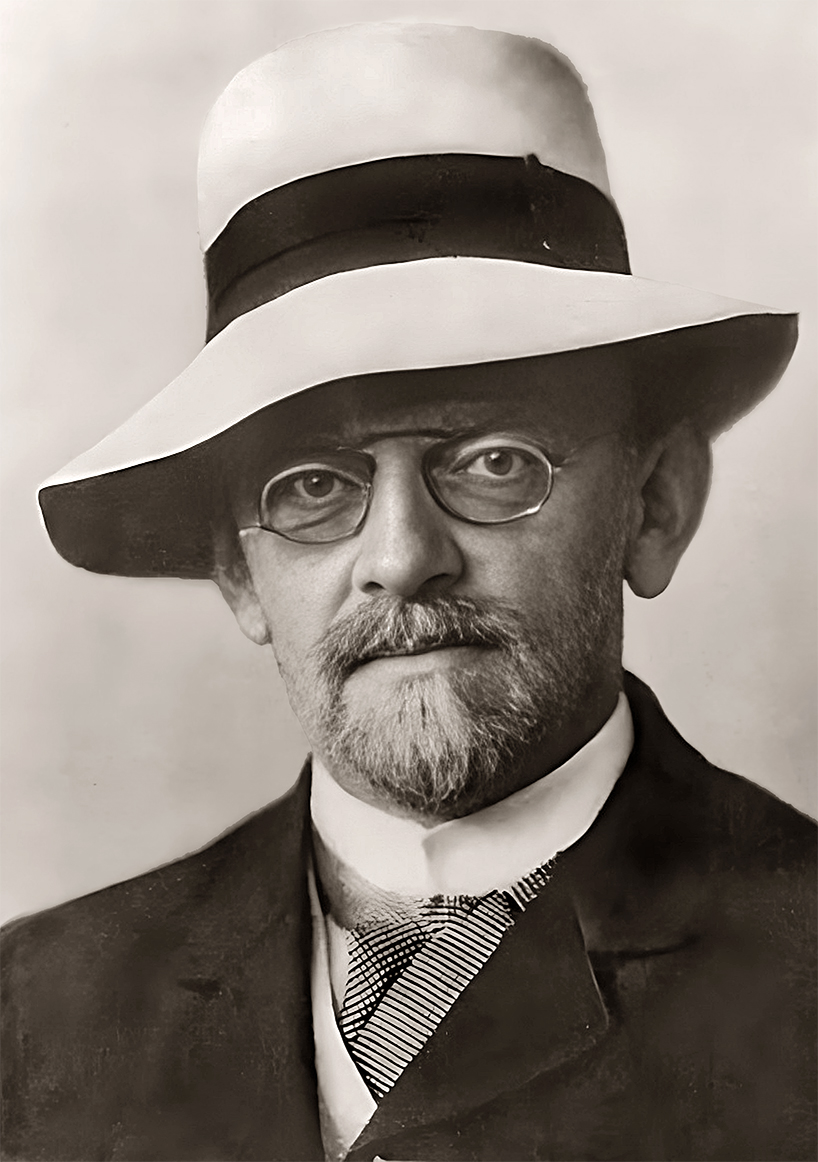
David Hilbert
German mathematician and philosopherWikipedia
96
MENTIONS
12
EPISODES
11
PODCASTS
Search complete. 96 mentions across 12 episodes found for "David Hilbert".
Sep 28, 2026

Scott AaronsonGUEST
So these are seven problems that were put forward by something called the Clay Math Institute, I think the year 2000.
Scott AaronsonGUEST
And they were inspired by a mathematician named David Hilbert, who in 1900 had put forward 23 problems that he felt could shape the course of math in the 20th century.
Scott AaronsonGUEST
And this was enormously influential.
Scott AaronsonGUEST
Hilbert's list of problems.

Matt O'DowdHOST
Where does the energy from redshifted photons go? In 1915, the expansion of the universe hadn't yet been discovered, but the failure of energy conservation was still clear from the math of general relativity.
Matt O'DowdHOST
Two of the greats of the era, David Hilbert and Felix Klein, sought the help of a young mathematician, Emmy Noether, to understand this seeming paradox.
Matt O'DowdHOST
She discovered why the law of conservation of energy broke down in general relativity.
Matt O'DowdHOST
The law was not fundamental after all.

Noah GiansiracusaGUEST
Some of them have to do with prime numbers, like I hinted at the beginning, but they come from all different topics.
Noah GiansiracusaGUEST
And every now and then there was a famous list of problems in the year 1900 that this mathematician David Hilbert assembled.
Noah GiansiracusaGUEST
And I forget even how many he listed, but a couple dozen maybe.
Noah GiansiracusaGUEST
And these really helped motivate and guide the development of mathematics for the beginning of the 20th century.
Noah GiansiracusaGUEST
So it directed our efforts.
Noah GiansiracusaGUEST
It helped us know what we should work on and what was considered important and what would illuminate the dark spots of our knowledge that we most needed addressed.
Noah GiansiracusaGUEST
Now we go another hundred years forward in the year 2000 and an institute with a lot of guidance from mathematicians, but also a lot of money from industry called the Clay Institute says, okay, we need, we're ready.
Noah GiansiracusaGUEST
It's been a hundred years since Hilbert.

GrahamHOST
Yeah, we've had 15 years to prepare for this, but in the best traditions of not doing your homework until the night before, here we are turning around two episodes in record-breaking time.
ChrisHOST
Yeah, so we first heard about this project back in the January 2013 edition of Literally, when Neil and Chris revealed they'd spent much of 2012 working on a musical project telling the life story of British scientist, mathematician and codebreaker Alan
GrahamHOST
Turing.
GrahamHOST
Now, let's just spend a little while getting to know about Alan Turing, because I admit he's not someone I knew a whole lot about before he came on my radar, thanks to Pet Shop Boys.
9 MINS LATER
ChrisHOST
And this is how ideas would form in his mind.
ChrisHOST
He was dreaming of machines.
GrahamHOST
In 1936, he published a paper in answer to a question posed by the German mathematician David Hilbert.
GrahamHOST
Can all of mathematics be proved by logic alone? In solving this problem, Turing imagined a device.

Tim PalmerGUEST
I mean, it's clear, it's clear that no interpretation, no, you know, interpretation of quantum mechanics can explain Bell's theorem in a completely satisfactory way.
Tim PalmerGUEST
So the, the, the picture I, um, or the, the line I, I took was to say, "Well, what could we do to modify quantum mechanics?" And, you know, what could be the weak points of quantum mechanics? And I was driven very much by, you know, people like David Hilbert actually, who, you know, Hilbert space is famously named after or was named by John von Neumann as the state space of quantum mechanics.
Tim PalmerGUEST
But, you know, Hilbert space is a, is a continuum space.
Tim PalmerGUEST
So, you know, it's, it's a mathematics, a vector space over the continuum field of complex numbers.

speaker_0NARRATOR
A great many mistakes were made by 17th and 18th century mathematicians because they didn't understand the importance of rigour.
speaker_0NARRATOR
It is just that in achieving rigor through magisterial projects like those of David Hilbert or the Burbaki School, mathematics became afraid of speculation and plea.
speaker_0NARRATOR
Mathematics books are devoid of humor, personality, and any indication that a human mind contemplated the results.
speaker_0NARRATOR
The texts are an endless succession of claims, proofs, and exercises.

Robert SpitzerGUEST
But here's the problem.
Robert SpitzerGUEST
If all of us in this world are like, you know, Spitzer's or all of us are like Einstein's for that matter or David Hilbert's for that matter or whoever.
Robert SpitzerGUEST
So if we're all just super geniuses, but we still have a ton of questions that we cannot answer from within our own intelligence and systematic knowledge through our intelligence.
Robert SpitzerGUEST
If that happens, well, gee whiz, can we be smart? you know, completely intelligible.
speaker_0NARRATOR
Instead, they chart an arrow pointing through a map of possible futures.
speaker_0NARRATOR
A 26 August 2026 essay in Quantum Magazine asks a surprisingly basic question about this mathematical arena known as Hilbert space.
speaker_0NARRATOR
For a century, scientists have used it to predict how matter behaves with perfect accuracy — Yet, they still cannot agree on whether this space is just a useful fiction or the actual hidden theater of reality.
speaker_0NARRATOR
Written by Charlie Wood in Quantum Magazine.
speaker_0NARRATOR
Narrated for ARVA.
speaker_0NARRATOR
In Hilbert space, all things are quantumly possible.
speaker_0NARRATOR
At the heart of quantum mechanics lie a few sacred rules for how to use the theory.
speaker_0NARRATOR
First and foremost is, roughly, that thou shalt not think about ordinary objects presently whizzing through ordinary space.

Gabrielle BirchakHOST
Hardy gave himself 25.
Gabrielle BirchakHOST
He gave Littlewood a 30, then he gave David Hilbert an 80 and Ramanujan a 100.
Gabrielle BirchakHOST
Whether those numbers were meant literally is beside the point.
Gabrielle BirchakHOST
Hardy regarded Ramanujan as possessing a kind of mathematical genius that was extraordinarily rare.

Addison AndersonNARRATOR
[music] In the 1920s, the German mathematician David Hilbert devised a famous thought experiment to show us just how hard it is to wrap our minds around the concept of infinity.
Addison AndersonNARRATOR
Imagine a hotel with an infinite number of rooms and a very hardworking night manager.
Addison AndersonNARRATOR
One night, the infinite hotel is completely full, totally booked up with an infinite number of guests.
2 more episodes mention David Hilbert.
Create an account to see the whole feed, search across every transcript, and follow the entities you care about.