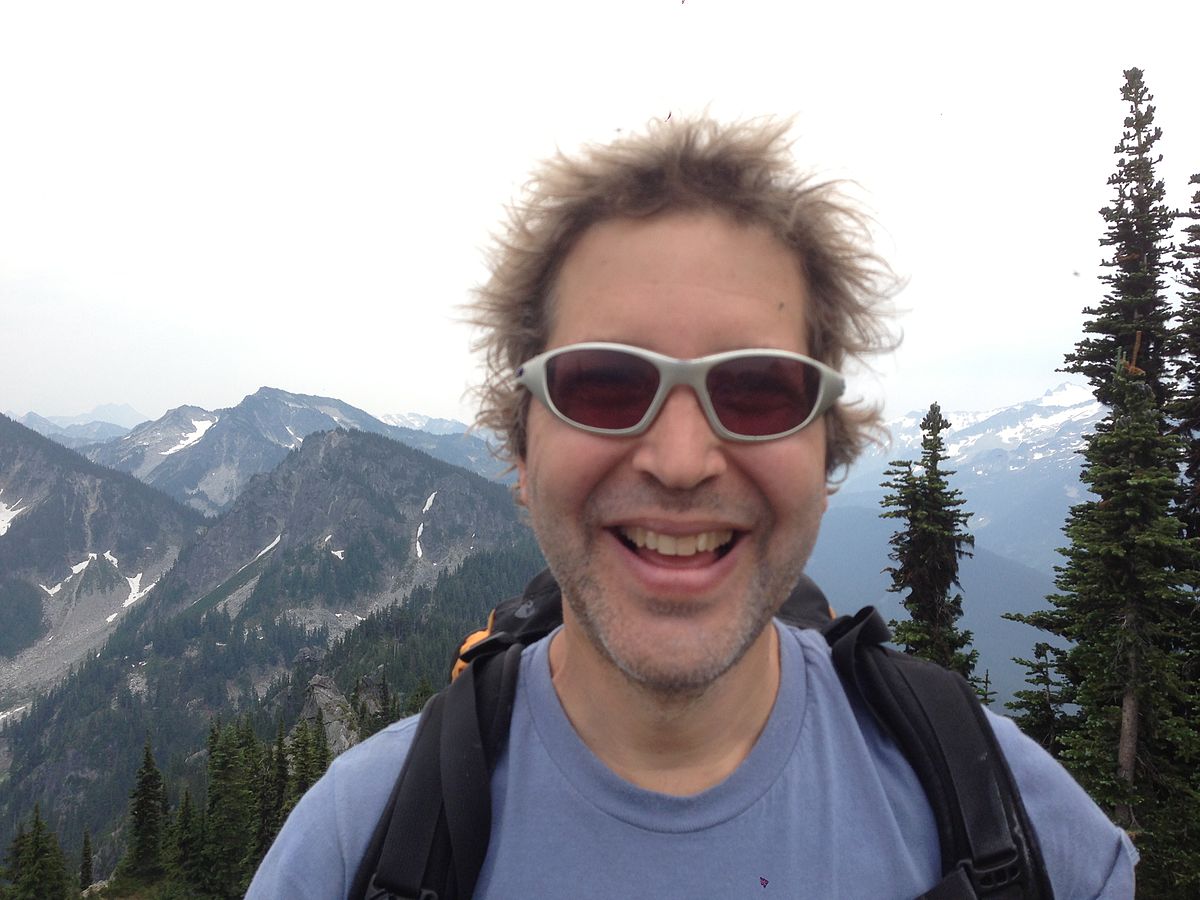
David Baker
American biochemistWikipedia
20
MENTIONS
13
EPISODES
13
PODCASTS
Search complete. 20 mentions across 13 episodes found for "David Baker".
Sep 25, 2026

Jason KellyGUEST
The question is: Where should we put the design and engineering of cells on that continuum? So will we have a CAD simulator of a cell? We have one, by the way, now for proteins.
Jason KellyGUEST
If you tell me the shape of protein you want, God bless Google and AlphaFold 3 and David Baker and the whole shebang, right? I can basically write the DNA that makes the protein the shape you want.
Jason KellyGUEST
Now, don't ask me to design you a protein that does a certain thing, Carl.
Jason KellyGUEST
That, that's a different ballgame.

AinsleyHOST
And there's a real precedent for it I should have led with earlier.
AinsleyHOST
AlphaFold's 2024 Nobel was shared with David Baker, whose lab used a similar approach to design entirely new proteins that don't exist in nature, not predicting a known shape, generating a genuinely novel one.
AinsleyHOST
That's closer to what you're describing, a capable system originating the narrow tool, or at least the design space for it, rather than a human hand building every guardrail from scratch.
AinsleyHOST
So the orchestrator model isn't pure speculation.

speaker_0NARRATOR
In terms of creativity, we have much to learn about generative AI's remarkable ability to create rhythm and rhyme in writing, and for that matter, similar patterns in music and art.
speaker_0NARRATOR
In the sciences, AI can now accurately predict three-dimensional protein structures, a result that earned David Baker, Demis Hassabis, and John Jumper the 2024 Nobel Prize in Chemistry.
speaker_0NARRATOR
This and related discoveries hold great promise across the breadth of biomedicine.
speaker_0NARRATOR
In mathematics, we have seen technology suggest new approaches to optimization and prove new theorems while finding flaws in others.

Brian GuGUEST
I, I got my undergrad in chemistry and then went on to pursue a PhD in biochemistry.
Brian GuGUEST
And actually, my PhD, uh, uh, experience is probably one of the most rewarding process, because I got to work with, uh, my, uh, professor, um, David Baker.
Brian GuGUEST
Uh, I don't know whether you know him.
Brian GuGUEST
He actually won the Nobel Prize two years ago, uh, in chemistry.

Hayley SeveranceGUEST
Discover Drug, so that's exciting.
Hayley SeveranceGUEST
And organizations like the University of Washington's Institute for Protein Design, which is run by David Baker, who won the Nobel Prize in Chemistry for this work in 2024.
Hayley SeveranceGUEST
His organization just received a grant from the Washington Research Foundation specifically to move designed enzymes from the computer to the lab, to the market.
Hayley SeveranceGUEST
So we are seeing some signs that this is moving past proof of concept.

Ruby DeLunaHOST
The plan announced yesterday is to use AI models to design artificial biological molecules, build them, then test them.
Ruby DeLunaHOST
University of Washington scientist David Baker won the 2024 Nobel Prize in Chemistry.
David BakerSOUNDBITE_SPEAKER
We are going to be discovering many more things more rapidly than we can by studying evolution.
David BakerSOUNDBITE_SPEAKER
Things ranging from cancer to autoimmune disease to neurodegenerative disease is a major target now.

speaker_3ADVERTISER
conversation.
Ayla EllisonHOST
David Baker is one of this year's Fierce 50 Innovation Honorees.
Ayla EllisonHOST
He won the Nobel Prize in Chemistry in 2024 for his work in computational protein design.
Ayla EllisonHOST
Normally, winning a Nobel Prize comes with a pretty intense victory lap.
11 MINS LATER
Ayla EllisonHOST
It can be Revolution Medicines betting everything on an undruggable cancer target.
Ayla EllisonHOST
It can be Michael Osterholm getting ready to step back after more than half a century in public health, looking at the moment in front of him and deciding, not yet.
Ayla EllisonHOST
It can be David Baker deciding what the problems his field spent decades working on are already becoming yesterday's problems.
Ayla EllisonHOST
It can be hip-hop public health helping turn stroke symptoms into something people sing.

Ayla EllisonHOST
And from there, you can move back to the people building what's next.
Ayla EllisonHOST
David Baker is one of this year's Fierce 50 Innovation Honorees.
Ayla EllisonHOST
He won the Nobel Prize in Chemistry in 2024 for his work in computational protein design.
Ayla EllisonHOST
Normally, winning a Nobel Prize comes with a pretty intense victory lap.
11 MINS LATER
Ayla EllisonHOST
It can be Revolution Medicine's betting everything on an undruggable cancer target.
Ayla EllisonHOST
It can be Michael Osterholm getting ready to step back after more than half a century in public health, looking at the moment in front of him and deciding, not yet.
Ayla EllisonHOST
It can be David Baker deciding what the problems his field spent decades working on are already becoming yesterday's problems.
Ayla EllisonHOST
It can be hip-hop public health helping turn stroke symptoms into something people sing.

Kate MichieGUEST
So the capsid's the shell that goes around the virus.
Kate MichieGUEST
So we used AlphaFold to make some predictions about what the protein would look like and that helps David's team design the constructs that they're going to express and purify.
Kate MichieGUEST
So some proteins have little flexible parts on them and that stops them from crystallising and AlphaFold can help us identify where those flexible parts are and chop them off so that we can get the structure of the majority of the protein.
Kate MichieGUEST
So we used these tools and David's team were able to get crystals quite quickly.
Kate MichieGUEST
And then they took them to the synchrotron to hit them with the radiation to get the diffraction pattern.
Kate MichieGUEST
And he got the diffraction pattern, but then he was unable to do the last step of the problem, which was solving the phase problem, which we would traditionally do by soaking in heavy metals.
Kate MichieGUEST
And so David tried soaking in heavy metals and he wasn't able to make it work.
Kate MichieGUEST
And this is a known place in crystallography where we would often have a failed progress.

Anca PetreHOST
Et en 2023, on passe à l'étape suivante.
Anca PetreHOST
Dans le laboratoire de David Baker à Seattle, un outil nommé RF Diffusion permet de concevoir des protéines entièrement nouvelles qui n'existent nulle part dans la nature.
Anca PetreHOST
Ce jour-là, l'Académie royale des sciences de Suède attribue le prix Nobel de chimie.
Anca PetreHOST
Une moitié va à David Baker pour la conception de protéines par ordinateur.
Anca PetreHOST
L'autre moitié va à Demis Hassabi et John Jumper pour la prédiction de la structure des protéines.
Anca PetreHOST
Lire et écrire, les deux, la même année, sur le même podium.
3 more episodes mention David Baker.
Create an account to see the whole feed, search across every transcript, and follow the entities you care about.