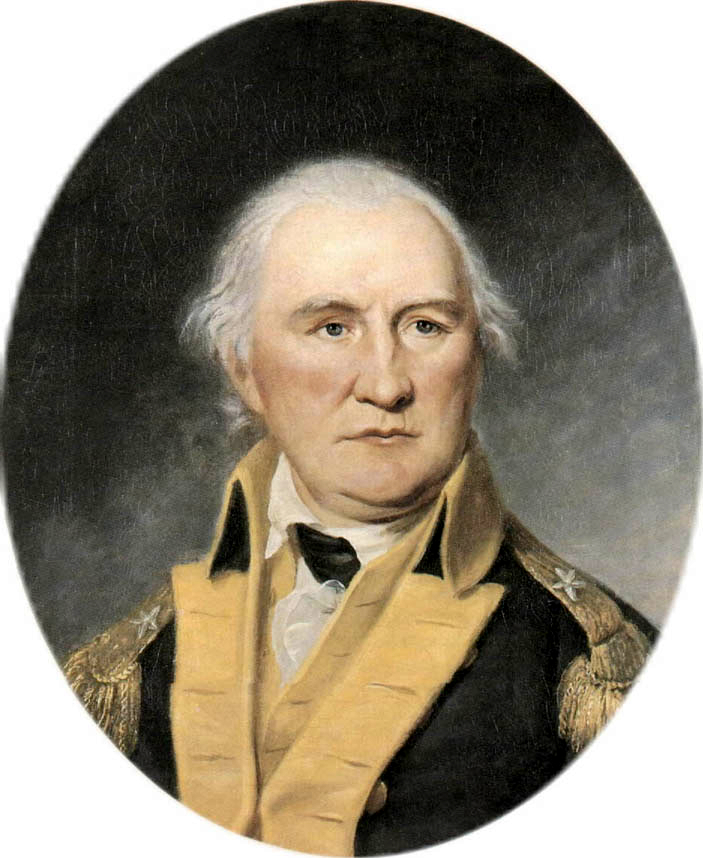
Daniel Morgan
American soldier and politicianWikipedia
21
MENTIONS
16
EPISODES
15
PODCASTS
Search complete. 21 mentions across 16 episodes found for "Daniel Morgan".
Oct 18, 2026

Michael TroyHOST
Adams noted that Hamilton wasn't even a general in the American Revolution.
Michael TroyHOST
At a cabinet meeting, he threw out other names like Horatio Gates, Benjamin Lincoln, or Daniel Morgan, all top generals in the last war.
Michael TroyHOST
These would be better candidates as a commander.
Michael TroyHOST
The cabinet shot down all of those ideas and kept insisting on Hamilton.

Amy HessHOST
Why is one of the four niches in New York's Saratoga Monument empty? The answer? The empty niche was intended for Benedict Arnold, who helped secure the American victory at Saratoga in 1777.
Amy HessHOST
The 155-foot monument honors American commanders Horatio Gates, Philip Schuyler, and Daniel Morgan, but Arnold's niche remains empty because he later betrayed the American cause and joined the British.
Amy HessHOST
And with that, we've come in for a landing on today's episode.
Amy HessHOST
Thank you so much for spending your weekend with me.
Amy HessHOST
Here is the question: Why is one of the four niches in New York's Saratoga Monument empty? The answer: The empty niche was intended for Benedict Arnold, who helped secure the American victory at Saratoga in 1777.
Amy HessHOST
The 155-foot monument honors American commanders Horatio Gates, Philip Schuyler, and Daniel Morgan.
Amy HessHOST
But Arnold's niche remains empty because he later betrayed the American cause and joined the British.
Amy HessHOST
And with that, we've come in for a landing on today's episode.

Alexander BurnsHOST
Um, you know, th-this is...
Alexander BurnsHOST
We normally say, "Whoa, you know, Daniel Morgan invented this incredibly, you know, you know, new way of fighting and, and nobody ever thought of this before." And th- I, I do think, you know, Daniel Morgan deserves some credit for using this effective policy, but, like, it's a policy that Glover starts all the way back here at Pell's Point, and the Continental Army practices it fairly regularly throughout the rest of the war.
Alexander BurnsHOST
Uh, I mean, this is the idea of, like, breaking and rallying, um, breaking and rallying behind linear obstacles.
Alexander BurnsHOST
That's how the Continental Army fights.
16 MINS LATER
Alexander BurnsHOST
We, we don't need him to inflict 200 or 1,000 ca- enemy casualties for his battle to have been a successful battle.
Alexander BurnsHOST
Um, we should be sufficiently delighted by the fact that he developed a relatively new method of engaging with, with the British forces, the idea that we're gonna stage the, uh, the, our, our troops along linear defensive obstacles, stretching in depth, and then withdraw from wall to wall, keeping up a constant fire, ke- us- just slowing the British, slowing their advance, um, getting young American troops used to the nature of fighting against very effective British and very aggressive and flexible British and Hessian opponents.
Alexander BurnsHOST
Um, and so if you're a New England boy who's absolutely crushed by what I've just said about John Glover, I hope that what you'll take away from this is John Glover pioneers the tactics that Daniel Morgan will use to win the Battle of Cowpens, rather than John Glover inflates the casualties in his reports after the battle.
Alexander BurnsHOST
Why does he do this? Basically, all 18th century commanders do this.

Shannon PringleGUEST
Yeah.
Shannon PringleGUEST
Uh, it was built between 1819 and 18- 1834, and of course it was named after General Daniel Morgan.
Shannon PringleGUEST
And the whole point of it was to serve as part of the coastal defense system, so it was intended to protect the city of Mobile and the entrance to Mobile Bay.
Shannon PringleGUEST
It was their first line of defense.

Dale KarmieHOST
It was a smaller group that was highly trained, skillful.
Dale KarmieHOST
Think of one of our previous episodes, the long range riflemen from Daniel Morgan.
Dale KarmieHOST
I don't know that, that he was a minute man, but that's the type of group where you get a group together that are trained and have a skill and are called out and to go do it.
Dale KarmieHOST
And most every town or city or area had a group of Minutemen.

Kori SchakeGUEST
He didn't have a military that could execute.
Kori SchakeGUEST
What saved him was he was a brilliant leader and he emboldened, as General Brown was talking about the culture of the American military to this day does, He emboldened these young sparklers, Alexander Hamilton, Nathaniel Green, Daniel Morgan, the Marquis de Lafayette, to go figure out how to do what needed doing.
Kori SchakeGUEST
So Washington's a great example of harnessing what the military can do well to a political agenda.
Kori SchakeGUEST
Abraham Lincoln, not afraid to fire three leaders of his military during the Civil War.

James DodsonGUEST
Three horses barely escaped, as did, by the way, there were two wagoners.
James DodsonGUEST
One was a guy named Daniel Morgan, who turned out to be the great, his hero of the Revolutionary War down in South Carolina, and a guy named Daniel Boone, who was 19 years old.
James DodsonGUEST
They were both pulling wagons, unknowns, and they cut their horses loose at the middle of the massacre and fled, got away.
James DodsonGUEST
So many of the earliest battles, the most important battles of the French and Indian War were fought from and off that road.
David D. ScheinHOST
And Francis Scott Marion is credited a lot with damaging the British to the point where they moved north up to Yorktown.
James DodsonGUEST
Yeah.
James DodsonGUEST
And Nash and Daniel Morgan developed a thing called the Flying Army, a lot like what Francis Marion was doing as they came across South Carolina, hanging people, you know, trying to trying to pacify this un-pacifiable, you know, group of people.
James DodsonGUEST
annoyed and angry Scotch-Irish.

Glenn CarleHOST
They had insufficient force, size, to subdue an entire continent.
Glenn CarleHOST
And where the British army was, it could generally, not always, impose its will where it was.
Glenn CarleHOST
But the country is 3,000 kilometers from north to south at this point.
Glenn CarleHOST
and 1,000 kilometers or more, 1,500 kilometers east to west.
6 more episodes mention Daniel Morgan.
Create an account to see the whole feed, search across every transcript, and follow the entities you care about.