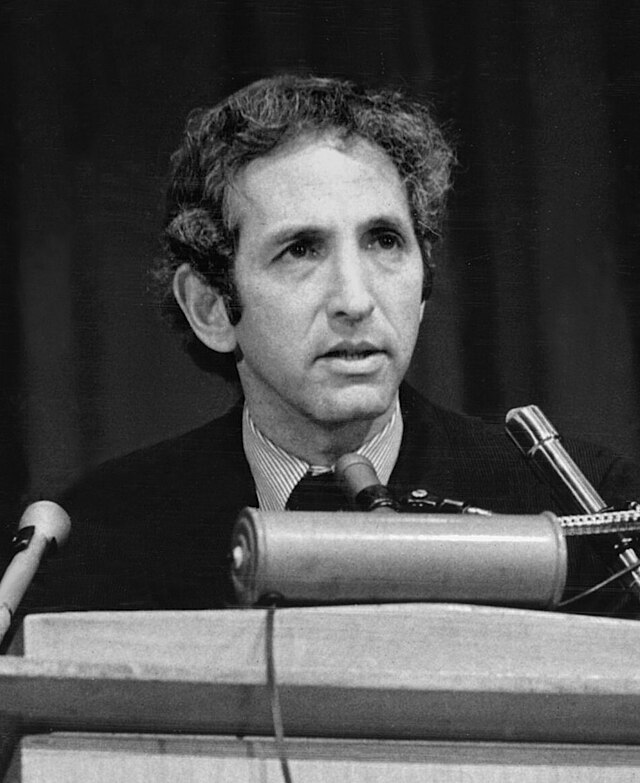
Daniel Ellsberg
American political activist and economistWikipedia
95
MENTIONS
66
EPISODES
59
PODCASTS
Search complete. 95 mentions across 66 episodes found for "Daniel Ellsberg".
Sep 21, 2026

Shane ColemanHOST
interesting.
Shane ColemanHOST
Is this the biggest kind of standoff between the media and a president since the Pentagon Papers case back in 1971 when, again, you'll correct me if I'm wrong on this, but my recollection is Nixon tried to stop the New York Times and later the Washington Post from publishing details of leaked information about the Vietnam War leaked by Daniel Ellsberg.
Niall StanageGUEST
That's right.
Niall StanageGUEST
And Nixon, of course, lost that and it was a very monumental case for press freedom that there was basically a public interest ruling in that respect.

Nick ColladoHOST
for the Democratic Party.
Nick ColladoHOST
They even went so far, Gov, as to break into Daniel Ellsberg's psychiatrist's office to steal files to know what he was saying to his psychiatrist.
Nick ColladoHOST
I mean, these guys were dirty.
Nick ColladoHOST
They did everything.

Jack MurphyHOST
That's, that's what came out of the Pentagon Papers, isn't it, Bing? That they knew they were fighting an unwinnable war.
Bing WestGUEST
Well, don't get me going with Ellsberg.
Bing WestGUEST
I think the man was a traitor.
Jack MurphyHOST
[laughs]
Bing WestGUEST
Uh, he was a traitor.
Bing WestGUEST
But that's, you know...
Bing WestGUEST
And I know Ellsberg.
Bing WestGUEST
I knew him from Rand.

Tim SandefurGUEST
I mean, we're ...
Tim SandefurGUEST
Remember, you remember in the 1970s, Daniel Ellsberg stole do- documents from the Pentagon during a time of war, and those were published in The New York Times and the Wall St- and the, and The Washington Post, and the US Supreme Court said, "That's fine." The First Amendment, uh, uh, protects the right of the newspapers to publish military documents stolen from the Pentagon in the middle of a war.
Tim SandefurGUEST
Well, if that's protected by the First Amendment, then certainly the surveillance footage of a crime occurring at a school ...
Tim SandefurGUEST
And, you know, Joe, I, I agree that I'm sympathetic with student privacy in some respects, but I s- there's no privacy right when you take a gun onto school grounds.

Kevin Perez-AllenHOST
For three months, his reporters have been working in secret on two floors of the New York Hilton Hotel.
Kevin Perez-AllenHOST
They have 7,000 pages of a top secret history of the Vietnam War written inside the Defense Department and copied without permission by a former Pentagon analyst named Daniel Ellsberg.
Kevin Perez-AllenHOST
The pages show four presidents lying to the country for 20 years about a war that's still going on.
Kevin Perez-AllenHOST
Sulzberger has read every page and he fell asleep more than once.
Kevin Perez-AllenHOST
Welcome to Control-Z Rewritten, the podcast where I take the biggest decisions in history, real 50-50 calls, and ask what happens if they go the other way.
Kevin Perez-AllenHOST
One decision, we try it the other way, and see what changes.
Kevin Perez-AllenHOST
Daniel Ellsberg is 38 years old in the fall of 1969, and the whole study is sitting in a safe in his office.
Kevin Perez-AllenHOST
He's a former Marine with a Harvard doctorate who worked in Robert McNamara's Pentagon.

Julian DoreyHOST
And the first one you mentioned is the Pentagon Papers, which I feel like is something that sometimes gets a little lost in the recounting of history.
Julian DoreyHOST
But it involved Daniel Ellsberg, who just recently passed in the past couple of years.
Julian DoreyHOST
And can you just go through exactly what happened there for people out there who are unfamiliar?
Danny SheehanGUEST
Yeah.

Lawrence FreedmanGUEST
Uh, it wasn't literary in a way, but it, it was very readable.
Lawrence FreedmanGUEST
A third book, just because it's, uh, because we've talked about it already, it's an issue that's always been close to my heart, was Daniel Ellsberg's book on, um, his time, uh, uh, as one of the whiz kids, uh, sort of an analyst at Rand in the late '50s and then consultant to the Kennedy administration, and his sort of alarm at what he's finding out about the way that SAC, as Strategic Air Command, was preparing for war and, um, the sort of lack of controls over them.
Lawrence FreedmanGUEST
And I think what, why that made an impact on me, I mean, Ellsberg's obviously this, was in his own way, a controversial figure, but I think this was a particularly, uh, reasonably genuine ...
Lawrence FreedmanGUEST
I'm sure it was a genuine memoir.

Matt BrackenGUEST
They're already looking beyond retirement.
Matt BrackenGUEST
It was Daniel Ellsberg in the Pentagon
Alex JonesHOST
Papers that they knew five years before the war was lost and just said, oh, we'll make money, so what?
Matt BrackenGUEST
Right.

C4HOST
But I was raised with the Pentagon Papers.
C4HOST
That was my childhood with Daniel Ellsberg and understanding the significance of the Washington Post and New York Times going to the Supreme Court to get that decision.
C4HOST
But that's not the reality for a lot of people in today's world, understanding that.
Brian NeimanHOST
Right.

Joe GettyHOST
I
Tim SandefurGUEST
mean, you remember in the 1970s, Daniel Ellsberg stole documents from the Pentagon during a time of war, and those were published in the New York Times and the Washington Post, and the U.S. Supreme Court said, that's fine.
Tim SandefurGUEST
The First Amendment protects the right of the newspapers to publish military documents stolen from the Pentagon in the middle of a war.
Tim SandefurGUEST
Well, if that's protected by the First Amendment, then certainly the surveillance footage of a crime occurring at a school, and, you know...
56 more episodes mention Daniel Ellsberg.
Create an account to see the whole feed, search across every transcript, and follow the entities you care about.