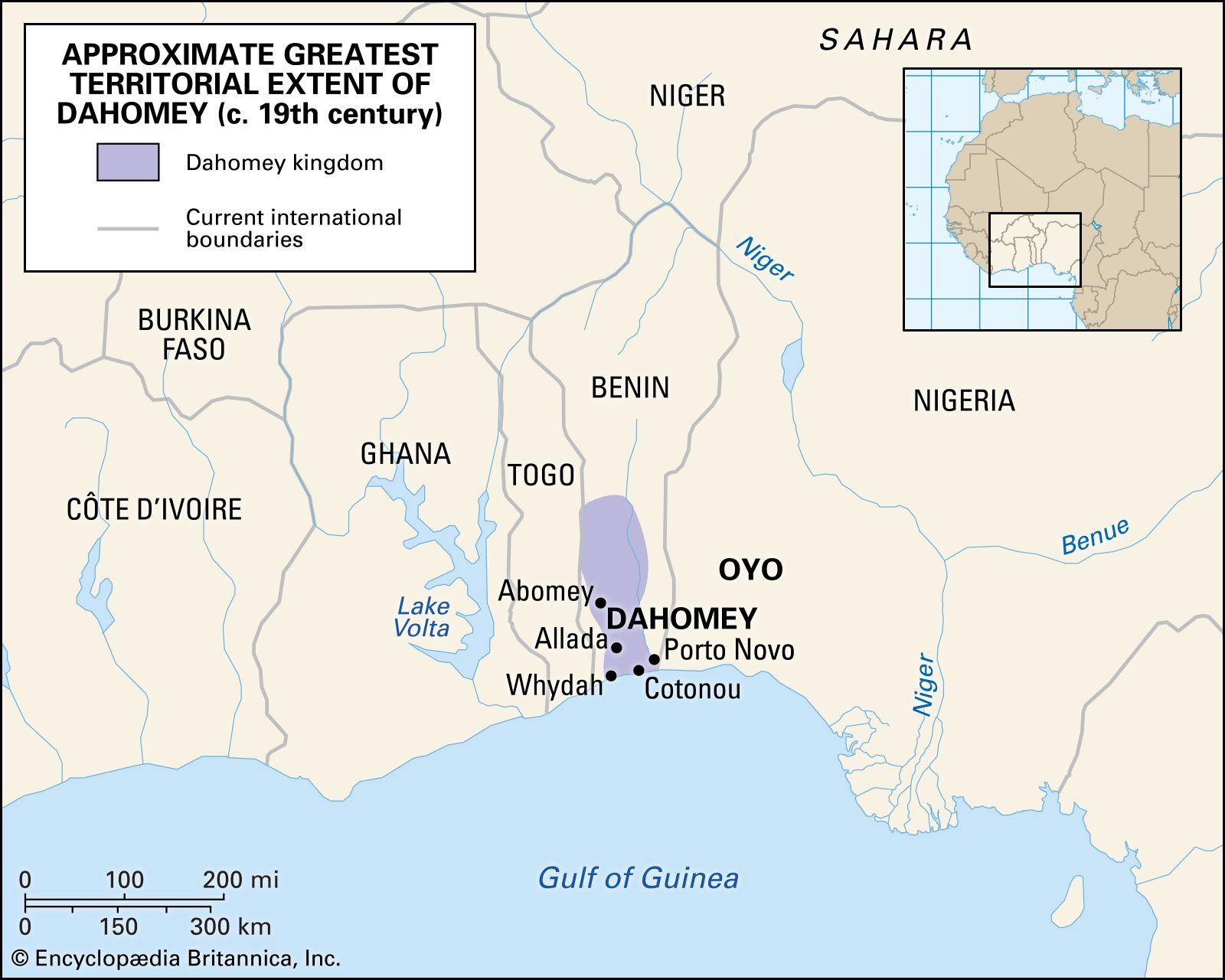
Dahomey
StateWikipedia
36
MENTIONS
26
EPISODES
26
PODCASTS
Search complete. 36 mentions across 26 episodes found for "Dahomey".
Oct 1, 2026

Dan MandisHOST
Sam, Sam's got something.
Joan JonesHOST
Yeah, I was, uh, I'm, I'm hoping they have maybe an exhibit there on the Kingdom of Dahomey.
Joan JonesHOST
Uh, rulers like King Tegbessu and King Ghezo used state military campaigns to capture people from neighboring groups in Africa, such as the Aza and the Yu, and then traded them in the Dutch slave trade in 1750.
Joan JonesHOST
The Ashanti Empire, located in modern-day Ghana, the Ashanti used expansionist warfare and domestic trade systems to supply captives to coastal European forts.

speaker_8NARRATOR
Various fortified lines were established throughout the 1700s, including the lines of Stolhofen and the lines of Neplus Ultra.
speaker_8NARRATOR
In the mid-18th century, the Dahomey Kingdom used trenches and flanking squads to resist attacks.
speaker_8NARRATOR
The Maori people in New Zealand developed sophisticated bunker and trench systems within their fortified settlements, known as pā, during the 19th century.
speaker_8NARRATOR
Observers noted that flax was used to cover fences to absorb the impact of bullets.

Matt WalshHOST
Now, what these people never talk about, because it would destroy their narrative and prevent them from ever getting handouts again, is the fact that almost everyone who ended up as a slave in the Americas was first enslaved by Africans.
Matt WalshHOST
So who exactly would be getting these reparations? The descendants of the Dahomey, who literally sailed boats in the blood of their slaves? Are we supposed to enrich those people at the expense of white people, the descendants of the men who risked their lives to end the institution of slavery? Explain to us, in plain English if you can, exactly how that makes any sense whatsoever.
Matt WalshHOST
This is from a recent editorial by a conservative politician in the UK named Daniel Hannan, who, uh, makes the point very well.
Matt WalshHOST
He says, quote, "This has gone far enough.

George BagbyGUEST
is advantageous to the Negro.
George BagbyGUEST
To attempt to abolish the hireling system with Africans, or the attempt to establish it with them, would be as wise as to endeavor to bestow a constitutional government of England on Ashanti or Dahomey.
George BagbyGUEST
These are African polities.
George BagbyGUEST
This is all very ironic in retrospect.

George BagbyGUEST
is advantageous to the Negro.
George BagbyGUEST
To attempt to abolish the hireling system with Africans, or the attempt to establish it with them, would be as wise as to endeavor to bestow a constitutional government of England on Ashanti or Dahomey.
George BagbyGUEST
These are African polities.
George BagbyGUEST
This is all very ironic in retrospect.

Mario BHOST
right so as much as i'm looking at it and i'm like oh this is i'm i'm looking at it on a bigger scale like they have less people i guess it's easier to control fewer people i don't know but i feel like that's still not an excuse i feel like there are a lot of things i took on this journey um that i want to take back home you know and just help nigerians you know understand what's help Nigerians understand, you know, that there's, there's life beyond, you know, beyond, yeah, Nigeria.
Mario BHOST
And I think for me, the highlights of all the places I went to was like, I went to, um, the Dahomey statue.
Mario BHOST
Is it the Dahomey
Fumi RichardsHOST
statue? The
Mario BHOST
Amazonian Dahomey statue.
Mario BHOST
Um, 15 woman king, beautiful.
Mario BHOST
That was in Kotonu, right? then in um yeah we saw the graffiti wall honestly if i had to really quit between togo and bene i'll do bene but for the food i'll do togo because i had something yeah i had something close to what we call awkward back at home and it was really awkward but I mean it was different in how they presented it but it was practically awkward so I had that with Poundo and honestly the experience has been amazing so far to just the icing the icing on the cake was in Togo here the beach I'm a beach person I grew up on an island so I always like looking at the sea I heard the water we went what was the name of that marcelo beach amazing stuff like french kiss really they did amazing and i think for me who's a city boy that's something i also that's an experience i want to and i have to applaud nigerians yeah everywhere yeah nigerian market traders we are like we are known we have bad pr but i think like we are the extreme of both side we're really good and we're really terrible too yeah so i think this is um you know where i'll be wrapping it um i'm hoping to travel to ghana next i think that's where i want to go to next i don't know if my

GinaHOST
In 1860, wars and raids were being staged in Africa to capture Africans and sell them to Europeans into enslavement.
GinaHOST
The Kingdom of Dahomey, in West Africa, was deeply entrenched in the trade of people, usually captured during fighting.
GinaHOST
Many unfortunates were captured and being held in the barracoons in Dahomey when some wealthy American businessmen decided that they wanted to smuggle more Africans into America because, you see, the importation of Africans into America was outlawed in 1808, and we're talking 1860.
GinaHOST
120 people were purchased.
GinaHOST
110 of them survived the journey to America and found themselves living just off the Mobile Bay in Alabama.

HewittHOST
Now, history of Baron Samedi.
HewittHOST
His origins come from Dahomey and Yaruba and the Fon people in Western Africa near what is today, present day, Benin.
HewittHOST
Much like many of the Loa, his origins are in kind of that bump out in Western Africa between Senegal and Cameroon.
HewittHOST
Maybe all the way down to Congo.

speaker_6NARRATOR
A boy belongs to his mother, a man belongs to the town, and there are things the town will only tell you once you belong to it.
speaker_6NARRATOR
To the west lay Dahomey.
speaker_6NARRATOR
Everyone knew what Dahomey was.
speaker_6NARRATOR
It was a kingdom with a standing army, disciplined and well-armed, including regiments of women soldiers who were the most feared troops on that coast.
speaker_6NARRATOR
It moved in the dry season, when the rain had stopped and the ground went hard and the rivers dropped low enough to cross.
speaker_6NARRATOR
And it moved for a reason nobody in Bonte needed explained to them.
speaker_6NARRATOR
Dahomey took people.
speaker_6NARRATOR
That was the business.

Glenn PeersGUEST
but also through imagining its own voice.
Glenn PeersGUEST
So I have tried this before, but I was given more permission, I guess, from viewing the film Dahomey, a kind of pseudo-documentary from 1924 that tells the story of the return of 24...
Glenn PeersGUEST
I think, two dozen objects to Benin from the Quai Branly in Paris.
Glenn PeersGUEST
And it is, on one level, a documentary of the physical return of those objects and placement in the museum.
16 more episodes mention Dahomey.
Create an account to see the whole feed, search across every transcript, and follow the entities you care about.