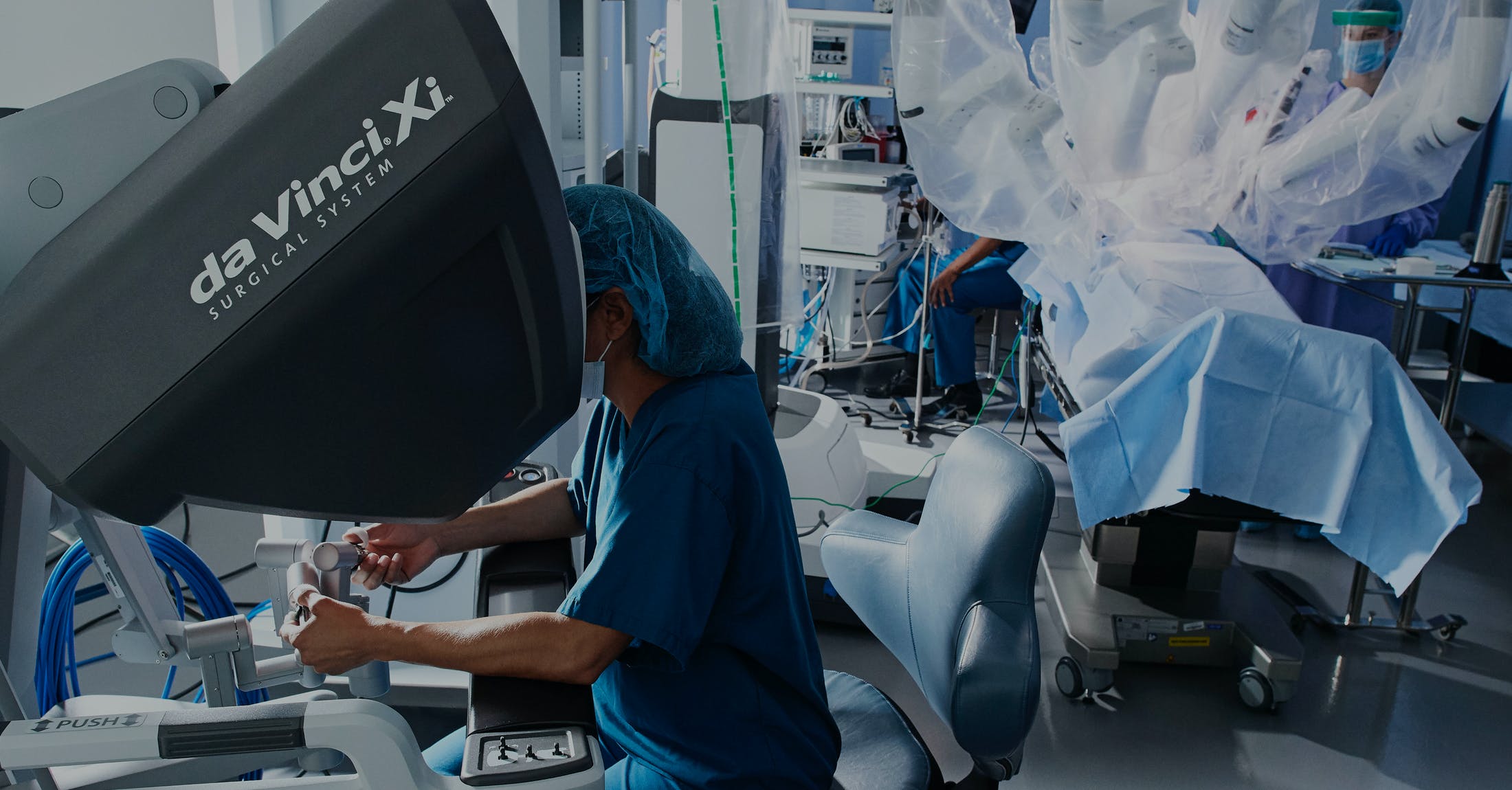
da Vinci Surgical System
31
MENTIONS
10
EPISODES
10
PODCASTS
Search complete. 31 mentions across 10 episodes found for "da Vinci Surgical System".
Sep 10, 2026

Andrew TurkGUEST
Um, there's the robotic prostatectomy, which has been a pretty common, um, treatment for, you know, the removal of prostate surgically.
Andrew TurkGUEST
Um, that's been using the da Vinci robot.
Andrew TurkGUEST
Um, and there have been advances with the robotic systems as well, um, to help with, you know, the way that surgeons operate and the way we use our hands.
Andrew TurkGUEST
Um, and a lot of times, you know- We are able to...
9 MINS LATER
Andrew TurkGUEST
We're al- also able to do UroLift, um, which involves, uh, metal implants that help spread open the prostate and create an anterior channel that allows men to urinate better.
Andrew TurkGUEST
For those men who have very, very large prostates, sometimes a simple prostatectomy is a good option for them.
Andrew TurkGUEST
Uh, simple prostatectomy is done robotically, um, uh, with a da Vinci robot.
Andrew TurkGUEST
Um, it involves small incisions, and we make an incision into the bladder, and then we go in, and we actually core the prostate out, um-

Sanjeev KumarGUEST
Yeah, trust
LitaHOST
me, I wish my da Vinci would have caught that before my vagus nerve was damaged.
Sanjeev KumarGUEST
See, there you have it right there.
LitaHOST
Yeah.
7 MINS LATER
Sanjeev KumarGUEST
I was
LitaHOST
going to ask one quick question.
LitaHOST
The da Vinci machine obviously must be one of the most expensive machines in the hospital, and I can't imagine that a hospital would have too many of them So doing all these surgeries and lining up for time on them must be a little bit chaotic.
LitaHOST
Do you foresee them coming down in price and having more and more in one hospital?

Megan AntonelliHOST
And I'll take his word for it, but it is fly over country and that level of care and what can happen.
Megan AntonelliHOST
know and he mentions like the example of someone has a acute appendicitis and has to travel two and a half hours to get to you know any kind of care you know our technology you know technology digital health isn't going to help that they're not you know i mean short of having a da vinci robot in every town you know we're not going to be able to you know manage that and i think the you know and the only and the reason those it's financially not feasible to provide that access because of the way the payment models work, right? And it's just the math doesn't math.
Megan AntonelliHOST
And until we fix that, all of these rural health care initiatives and programs, they might fix some things, but they're not going to fix the core problem of acute care that happens, you know, when you have so much distance between providers.
Megan AntonelliHOST
And I think that's something in Mexico that is all too prevalent and, you know, She decided to take it head on.

speaker_1HOST
And here in Cairns-la-Louth, I see that you're really at the forefront of innovation.
speaker_1HOST
That's why I would also like to jump onto advanced robotics, because you also have the da Vinci surgical system as one of very prominent example here in your houses.
speaker_1HOST
For listeners who may not be that familiar with it, this is one of the most advanced surgical robots worldwide that has been designed by NASA engineers and that allows surgeons to perform really minimally invasive procedures with extraordinary precision in the end.
speaker_1HOST
How has that introduction of surgical robots basically changed and hopefully enhanced outcomes for patients at your hospitals?
Jorge Short ApellánizGUEST
It's much better for and much less invasive for gynecology and for general surgery.
Jorge Short ApellánizGUEST
I know thoracic surgery, again, if you need to get something from your lungs is much less.
Jorge Short ApellánizGUEST
So mainly da Vinci robot, what it makes is people to be operated in the same time because once the doctors know how to use it, they use the same time or less.
Jorge Short ApellánizGUEST
with a less invasive system.

Kris BensonGUEST
...
Kris BensonGUEST
the, the da Vinci robot, which they've been incredibly successful.
Kris BensonGUEST
The technology has been incredible.
Chris LarsonHOST
Yeah.

John R. Porterfield Jr.GUEST
Yeah, so, um, I retired from UAB a year ago and, um, founded a private practice, uh, focused on endocrine surgery here in Birmingham.
John R. Porterfield Jr.GUEST
And, um, I've also continued Informed Surgical, which was a company that I founded with, uh, Sal Bronja, who designed the da Vinci Robot, uh, back-- Uh, he and I founded a company called Informed in twenty twenty-one that matches patients with surgeons based on their risk-adjusted outcomes.
Amanda DoubledayHOST
Great.
Amanda DoubledayHOST
All right, well, Simon, you wanna jump into a couple of cases here?

Clive BonnyGUEST
But I did subsequently have a further number of PSA tests, which came back with zero marks, and so I can be regarded as pretty much cured, although the PSA tests will continue on a six-monthly basis for the next few years.
Clive BonnyGUEST
But I was very pleased with the operation itself because it was conducted by a surgeon called da Vinci, who was a 10-foot high, five-foot wide robot who created six incisions in my midriff around my belly and conducted the operation with the doctors working with the robot successfully.
Clive BonnyGUEST
So I can certainly recommend Mr. da Vinci to any sufferers of this, anyone who's concerned about the operation.
Clive BonnyGUEST
I would also emphasize that recovery, full recovery for me was successful, both in terms of my waterworks and, uh, sex life.
Clive BonnyGUEST
People do worry about that.
Adam WalkerHOST
Yeah.
Adam WalkerHOST
That is the statistic that we should be reminded of.
Adam WalkerHOST
The experience that you had with this da Vinci robot, how many years has that been in place now? Because I wasn't aware of that until you mentioned it, until I looked into your background, and it was on your profile.

Eve McMahonHOST
And that was, you've guessed it, for milling out the femur, and they claimed far more precisely than a human could by hand, and I'm sure all the orthopods at the time were very pleased about that.
Ryan KersteinHOST
So that's some of the kind of first robots, but the machine that everyone usually pictures when they think about the early robotics is the da Vinci.
Ryan KersteinHOST
And it actually has a much stranger origin than people realize 'cause it didn't actually start in a hospital at all.
Ryan KersteinHOST
It started in the military, in the American military.
Ryan KersteinHOST
And then a young doctor and entrepreneur, Fred Moll, saw it and saw what the military hadn't, the civilian potential.
Ryan KersteinHOST
His employer passed on it at the time, so he licensed the technology himself and founded Intuitive in 1995.
Ryan KersteinHOST
It cleared FDA in 2000, and he called it da Vinci, obviously after Leonardo, whose mechanical knight around s- uh, 500 years earlier.
Eve McMahonHOST
And here's the part that always surprises people, I think.

Andrew HungGUEST
So it wasn't until medical school, I thought I was gonna be a pediatrician.
Andrew HungGUEST
Then I thought I was gonna be a cardiologist, but it was the first time stepping into the operating room with the da Vinci robot that I thought to myself, hey, I can be a surgeon.
Andrew HungGUEST
And not only that, I want to be a fantastic surgeon and robotics is really the future.
Andrew HungGUEST
And at that time, you know, half of prostatectomies were done by the robot.

OscarHOST
Because these instruments are often consumed or replaced as the procedure is performed, Intuitive has a strong recurring revenue model rather than relying on a one-time robot sales.
OscarHOST
Now, the da Vinci surgical system is primarily for minimally invasive surgery, but they also sell something called the Ion Endoluminal System to navigate the lung for minimally invasive biopsy.
OscarHOST
Currently, they're rolling out the da Vinci 5, The company mostly uses AI for imaging or navigation or training and the workflows rather than complete autonomous surgery.
OscarHOST
We discussed it for the DaVinci, for example, they have the booth and there's still a surgeon required to operate the robot.
OscarHOST
But it's still a robot.
OscarHOST
We had 11,106 installed DaVinci systems at the end of 2025.
OscarHOST
Globally, around 20 million patients have been involved in procedures with the systems.
OscarHOST
But we also discussed in one of our episodes that some people in academia and research are using actual unitary robots in combination with the booth, not the full surgical robot, and are almost able to replace some parts of the surgeries that are performed by the da Vinci usually at a much lower price point.