Cytotoxic T cell
38
MENTIONS
11
EPISODES
11
PODCASTS
Search complete. 38 mentions across 11 episodes found for "Cytotoxic T cell".
Oct 9, 2026

Tina CasconeGUEST
I put together this table really to set the stage on the, um, biological distinction across molecules and therapeutic implications.
Tina CasconeGUEST
Uh, I want you to think about different points, checkpoint coverage, cellular binding site, um, CD8, CD28, CTLA-4 networks.
Tina CasconeGUEST
We're really going through basic biology to set the stage for a clinical practice and a preserved, uh, inhibitory signaling.
Tina CasconeGUEST
And I want you to look at those in the context of PD-1 and PD-L1 VEGF-A blockade.
Tina CasconeGUEST
And so that justified the hypothesis and the data that we have around VEGF neutral-- its localization and neutralization.
Tina CasconeGUEST
This is another very important point if we think about basic biology justifying, um, therapeutic, uh, implications.
Tina CasconeGUEST
Uh, the, uh, PD-1 VEGF-A, uh, molecules do not directly disrupt the PD-L1 CD8 complexes.
Tina CasconeGUEST
Uh, in the context of PD-L1 VEGF-A, um, we might have disruption of these complexes, uh, but we do not have, uh, inherent CD8, uh, co-stimulation gain.

Tina CasconeGUEST
I put together this table really to set the stage on the biological distinction across molecules and therapeutic implications.
Tina CasconeGUEST
I want you to think about different points, checkpoint coverage, cellular binding site, CD8, CD28, CTLA-4 networks.
Tina CasconeGUEST
We're really going through basic biology to set the stage for clinical practice and preserved inhibitory signaling.
Tina CasconeGUEST
And I want you to look at those in the context of PD-1 and PD-L1 VEGF.
Tina CasconeGUEST
And so that justified the hypothesis and the data that we have around VEGF neutralization and neutralization.
Tina CasconeGUEST
This is another very important point if we think about basic biology justifying therapeutic implications.
Tina CasconeGUEST
The PD-1 VEGFA molecules do not directly disrupt the PD-L1 CD8 complexes.
Tina CasconeGUEST
In the context of PD-L1 VEGFA, we might have disruption of these complexes, but we do not have inerrant CD8 co-stimulation gain.

Tina CasconeGUEST
I put together this table really to set the stage on the, um, biological distinction across molecules and therapeutic implications.
Tina CasconeGUEST
Uh, I want you to think about different points, checkpoint coverage, cellular binding site, um, CD8, CD28, CTLA4 networks.
Tina CasconeGUEST
We're really going through basic biology to set the stage for a clinical practice and a preserved, uh, inhibitory signaling.
Tina CasconeGUEST
And I want you to look at those in the context of PD-1 and PD-L1 VEGF-A blockade.
Tina CasconeGUEST
And this is a very important point, uh, because here the checkpoint arm can influence where the molecule is retained, and so that justified the hypothesis and the data that we have around VEGF neutral-- its localization and neutralization.
Tina CasconeGUEST
This is another very important point if we think about basic biology justifying, um, therapeutic, uh, implications.
Tina CasconeGUEST
Uh, the, uh, PD-1 VEGF-A, uh, molecules do not directly disrupt the PD-L1 CD8 complexes.
Tina CasconeGUEST
Uh, in the context of PD-L1 VEGF-A, um, we might have disruption of these complexes, uh, but we do not have, uh, inherent CD8, uh, co-stimulation gain.

Tina CasconeGUEST
I put together this table really to set the stage on the biological distinction across molecules and therapeutic implications.
Tina CasconeGUEST
I want you to think about different points, checkpoint coverage, cellular binding site, CD8, CD28, CTLA-4 networks.
Tina CasconeGUEST
We're really going through basic biology to set the stage for clinical practice and preserved inhibitory signaling.
Tina CasconeGUEST
And I want you to look at those in the context of PD-1 and PD-L1 VEGF.
Tina CasconeGUEST
And so that justified the hypothesis and the data that we have around VEGF neutralization and neutralization.
Tina CasconeGUEST
This is another very important point if we think about basic biology justifying therapeutic implications.
Tina CasconeGUEST
The PD-1 VEGFA molecules do not directly disrupt the PD-L1 CD8 complexes.
Tina CasconeGUEST
In the context of PD-L1 VEGFA, we might have disruption of these complexes, but we do not have inerrant CD8 co-stimulation gain.

Tina CasconeGUEST
I put together this table really to set the stage on the, um, biological distinction across molecules and therapeutic implications.
Tina CasconeGUEST
Uh, I want you to think about different points, checkpoint coverage, cellular binding site, um, CD8, CD28, CTLA4 networks.
Tina CasconeGUEST
We're really going through basic biology to set the stage for a clinical practice and a preserved, uh, inhibitory signaling.
Tina CasconeGUEST
And I want you to look at those in the context of PD-1 and PD-L1 VEGF-A blockade.
Tina CasconeGUEST
And this is a very important point, uh, because here the checkpoint arm can influence where the molecule is retained, and so that justified the hypothesis and the data that we have around VEGF neutral-- its localization and neutralization.
Tina CasconeGUEST
This is another very important point if we think about basic biology justifying, um, therapeutic, uh, implications.
Tina CasconeGUEST
Uh, the, uh, PD-1 VEGF-A, uh, molecules do not directly disrupt the PD-L1 CD8 complexes.
Tina CasconeGUEST
Uh, in the context of PD-L1 VEGF-A, um, we might have disruption of these complexes, uh, but we do not have, uh, inherent CD8, uh, co-stimulation gain.

Tina CasconeGUEST
I put together this table really to set the stage on the, um, biological distinction across molecules and therapeutic implications.
Tina CasconeGUEST
Uh, I want you to think about different points, checkpoint coverage, cellular binding site, um, CD8, CD28, CTLA4 networks.
Tina CasconeGUEST
We're really going through basic biology to set the stage for a clinical practice and a preserved, uh, inhibitory signaling.
Tina CasconeGUEST
And I want you to look at those in the context of PD-1 and PD-L1 VEGF-A blockade.
Tina CasconeGUEST
And this is a very important point, uh, because here the checkpoint arm can influence where the molecule is retained, and so that justified the hypothesis and the data that we have around VEGF neutral-- its localization and neutralization.
Tina CasconeGUEST
This is another very important point if we think about basic biology justifying, um, therapeutic, uh, implications.
Tina CasconeGUEST
Uh, the, uh, PD-1 VEGF-A, uh, molecules do not directly disrupt the PD-L1 CD8 complexes.
Tina CasconeGUEST
Uh, in the context of PD-L1 VEGF-A, um, we might have disruption of these complexes, uh, but we do not have, uh, inherent CD8, uh, co-stimulation gain.

Molly KiltyHOST
Their job is to sort of facilitate the adaptive immune response.
Molly KiltyHOST
And then we also have cytotoxic T cells.
Molly KiltyHOST
which they themselves are toxic to cells, right? They go around and actually kill infected cells.
Molly KiltyHOST
So we have, again, humoral immunity, very focused on antibody production.
7 MINS LATER
Michael BalecaHOST
Right.
Michael BalecaHOST
And there's a very good reason why that we'll talk about in a moment because it's often a mix up.
Michael BalecaHOST
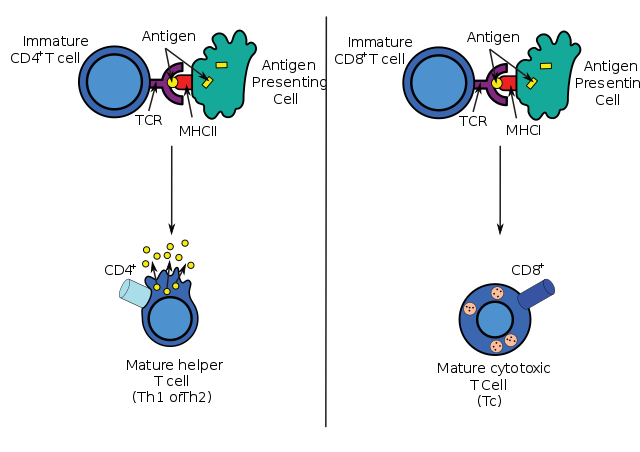
So these are cytotoxic T cells.
Michael BalecaHOST
Well, if MHC2 activates our helper T cells, what activates T? our cytotoxic T cells.

Tanya MayadasGUEST
So once the antibody engages the neutrophil, the entire pro- the entire complex gets internalized into the neutrophil.
Tanya MayadasGUEST
Through various process, we haven't figured this out exactly, it turns into ability to actually present antigen to CD4s and CD8 T cells.
Tanya MayadasGUEST
And so they're presenting the antigen, the one that we put on the end of that conjugate, to the T and B cells on the MHC Class 1 or 2.
Tanya MayadasGUEST
Uh, so, sorry, C- CD4 and CD8 T cells.
Tanya MayadasGUEST
Um, so that's where we thought we could harness this for autoimmune diseases.
Tanya MayadasGUEST
We have found, on the other hand, that these antigen-presenting cells can be bad for autoimmune disease.
8 MINS LATER
Tanya MayadasGUEST
Right
Cindy LeiferHOST
...

Lennard LeeGUEST
We give it a code for every HLA type the immune system's got.
Lennard LeeGUEST
We give it a code for every mutation it's got, and we ask it to predict now what's the CD8 response or the likelihood of a T cell reacting to it.
Lennard LeeGUEST
And if we train that over many, many patients in parallel, it can make a prediction.
Lennard LeeGUEST
And these predictions are looking really interesting because most of them validate what we already know, but some of them are new.

Emmanuel ContassotGUEST
in lesional skin, acting very early as an alarming upon epidermal injury.
Emmanuel ContassotGUEST
So now what's the role of this IF33? So we all know that, and it has been well described, that CD8-close T cells are the main killers in epidermal necrolysis.
Emmanuel ContassotGUEST
And we have shown that when we expose CD8 T cells from patients with epidermal necrolysis to IF33 in combination with interferon gamma, that is also highly released in this condition.
Emmanuel ContassotGUEST
And these CD8 T cells become more cytotoxic.
Emmanuel ContassotGUEST
They upregulate cytolytic molecules.
Emmanuel ContassotGUEST
So there is a boost of the cytotoxic response due to the presence of IL-33.
Emmanuel ContassotGUEST
So there is a kind of pathogenic loop.
Emmanuel ContassotGUEST
So damaged keratinocyte release this alarmine, and this alarmine then boosts the CD8 response.
1 more episode mentions Cytotoxic T cell.
Create an account to see the whole feed, search across every transcript, and follow the entities you care about.