Cycle of abuse
22
MENTIONS
9
EPISODES
8
PODCASTS
Search complete. 22 mentions across 9 episodes found for "Cycle of abuse".
Nov 7, 2026

KatieAUDIENCE
Yeah.
John DelonyHOST
So the cycle of abuse, it's frustratingly routine.
KatieAUDIENCE
Yeah.
John DelonyHOST
Which is it builds and it builds and it builds and then there's a big explosion.

Katherine HurtigHOST
Yeah.
Katherine HurtigHOST
What's this concept of the cycle of abuse? What does that mean? And does it always kind of follow a predictable cycle?
Ashley EnzieGUEST
Yeah.
Ashley EnzieGUEST
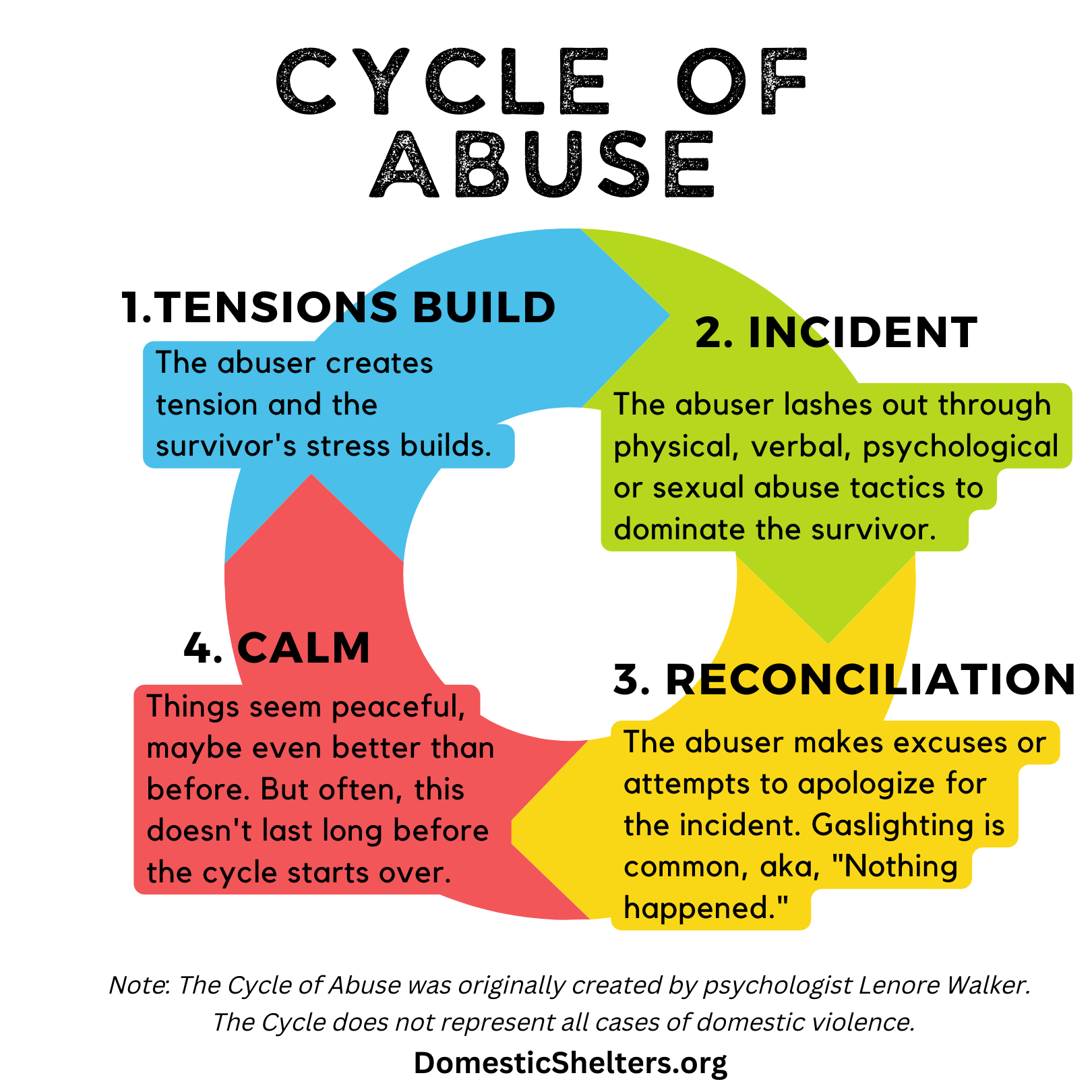
So the cycle of abuse is kind of a recurring pattern that we see in abusive relationships.
Ashley EnzieGUEST
And it kind of looks something like this.
Ashley EnzieGUEST
There is an abusive incident.
5 MINS LATER
Ashley EnzieGUEST
To know that you love a person and also you maybe feel shame for knowing that you've stayed through some things that you maybe don't want people to know about or things that you maybe thought that you would never stay through.
Ashley EnzieGUEST
And so there's a lot of, I think, conflicting emotions in that.

speaker_0HOST
The point of this episode is to teach that being in these sort of toxic relationships aren't cute.
speaker_0HOST
That being in this sort of relationship are in fact scary because you're constantly in this cycle of abuse.
speaker_0HOST
You're in this cycle of walking on eggshells then the smallest thing triggers your partner to hit you or scream at you and then after you fight they ask for forgiveness and they give you flowers to get you all happy again That cycle of up and down is not going through a hard time together.
speaker_0HOST
It's a toxic cycle, which is not just a short time, but rather the whole relationship.

DoriGUEST
And that's one side of things.
DoriGUEST
The other side is if we talk about the cycle of abuse.
DoriGUEST
So we have the power and control wheel and then the cycle of abuse cycle of abuse.
DoriGUEST
It's like every time that I worked with a victim, it was the same story every time.
DoriGUEST
Like the relationship is really good.

Christine Marie CocchiolaHOST
There are too many things that I would have to list out about everything that you have accomplished in your career.
Christine Marie CocchiolaHOST
But a lot of people know what the cycle of abuse is, right? And they also know what the batter woman syndrome is, right? So those are two really important things that really began to shift how we looked at domestic abuse in general.
Christine Marie CocchiolaHOST
And so I'm so glad you're here.
Christine Marie CocchiolaHOST
And thank you so much.
Christine Marie CocchiolaHOST
A lot of people...
Christine Marie CocchiolaHOST
You've
Christine Marie CocchiolaHOST
been around for so long that a lot of people don't even really know that much about you personally, right? They know the cycle of abuse.
Christine Marie CocchiolaHOST
They know what you've done, but they don't

Courtney BullardHOST
In addition, towards the end of our conversation, Betsy and I discuss domestic violence and dating violence, which is particularly timely as October is Domestic Violence Awareness Month.
Courtney BullardHOST
It's an important reminder of the role our institutions and school districts play in recognizing and responding to domestic DV and also supporting those impacted as well as a small primer on the cycle of abuse and the issues and challenges we see in DV cases.
Courtney BullardHOST
Whether you listened when this first aired four years ago or this is your first time hearing it, I think you'll find the conversation particularly relevant given the issues receiving attention today.
Courtney BullardHOST
So without further ado, here's my conversation with Betsy.
37 MINS LATER
Courtney BullardHOST
I've learned a lot from you because of what you learned as being a DV prosecutor.
Courtney BullardHOST
Anything you can share with us that would be helpful, I know it's a whole class, but on statistics, on things that would be helpful for Title IX coordinators to understand, and especially investigators and decision makers, because these are such complex cases.
Betsy SmithGUEST
Yeah, so our coordinators and professionals should be really prepared to address these situations with complainants or individuals who have experienced the sexual harassment to recant or initially report something and then say, never mind, I don't want you to do anything about it because they're in this repetitive cycle of abuse.
Betsy SmithGUEST
We're even seeing it at the late elementary school, early middle school, and all through high school ages that the behavior or the patterns of behavior are continuing.

Jessica KnightHOST
But what your body already knows, even when your mind is still hoping, is that- It keeps going back to where it once was.
Jessica KnightHOST
So one small thing sets it off again, and the repair is not a foundation, it's just a pause in the cycle of abuse.
Jessica KnightHOST
I used to map out the cycle of abuse.
Jessica KnightHOST
I would write down what happened, what I said, what the response was, how it escalated, when calm came, how long it lasted, when it started again.
Jessica KnightHOST
And honestly, as exhausting as all that just sounded, doing that was one of the most clarifying things I did because the pattern on paper looked nothing like what it felt when I was in the middle of it.
speaker_0HOST
One song that comes to mind is Amor Que Mata by Grupo Extra.
speaker_0HOST
This song can't be any more explicit on their topic, especially when they said, This whole verse is a cycle of abuse.
speaker_0HOST
If you don't know what that is, it goes like this.
speaker_0HOST
Step one, the tension.
speaker_0HOST
But when you least expect it, you're back to step one and it goes in circles.
speaker_0HOST
Cupra Extra explores why people stay in this cycle with the lyric, y pensando que algún día va a cambiar.
speaker_0HOST
That hope that they will change keeps survivors in this cycle of abuse.
speaker_0HOST
However, it's not the only reason.

speaker_12SOUNDBITE_SPEAKER
Fred was abused by his mother and his father.
speaker_12SOUNDBITE_SPEAKER
So you've got this cycle of abuse.
speaker_12SOUNDBITE_SPEAKER
And unfortunately, it's come out in subsequent generations.
speaker_12SOUNDBITE_SPEAKER
So Fred's son, Steven, has been convicted of sexual offenses.