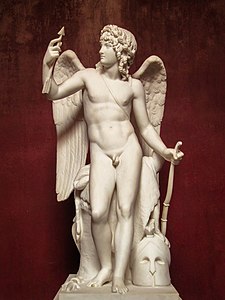
Cupid
GodWikipedia
141
MENTIONS
14
EPISODES
14
PODCASTS
Search complete. 141 mentions across 14 episodes found for "Cupid".
Sep 15, 2026

Greg GiordanoNARRATOR
Apollo, read by Greg Giordano.
Michael FaissNARRATOR
Cupid, read by Michael Faiss.
Alan MapstoneNARRATOR
Peneus, read by Alan Mapstone.
Agnes Robert BaerNARRATOR
Venus, read by Agnes Robert Baer.
speaker_3NARRATOR
Daphne.
speaker_3NARRATOR
Scene one.
speaker_3NARRATOR
Cupid is playing with his bow and arrows on Parnassus.
speaker_3NARRATOR
Apollo bids him leave such weapons for stronger hands.

Hannah CornwellGUEST
So James, I believe you might be referring to, uh, a figure or possibly two figures at Augustus' foot.
Hannah CornwellGUEST
Uh, and what we can see is we have a small figure, winged figure, a male figure, so, um, a, a, a, a putto, a sort of a cupid, and it probably is Cupid or Eros, riding on a dolphin.
Hannah CornwellGUEST
And this has normally been interpreted as, as Eros, as Cupid, the divine son of Aphrodite, Venus, who is, as you pointed out, uh, the mother of Aeneas and the mother of the entire Julian family through that line, as we know from, uh, Virgil's Aeneid and, and other poems and literature.
Hannah CornwellGUEST
Uh, so this does seem to be...
Hannah CornwellGUEST
Uh, going back to your earlier point, uh, about Augustus not having any issues and his having some sort of divine, potentially divine aspect.
Hannah CornwellGUEST
Uh, the fact that we have this dolphin and, and Cupid, who is sort of almost tugging on his [laughs] his, uh, tunic skirt, is a further way perhaps of indicating his divine associations, his divine lineage.
Hannah CornwellGUEST
I have also read at least one scholar arguing that because on the breastplate you have the heavens and the earth, we have Cupid riding a dolphin, which is the sea.
Hannah CornwellGUEST
And in a lot of Augustan rhetoric, we have the idea of peace achieved by land and sea.

Alan MapstoneNARRATOR
Red by DC.
Alan MapstoneNARRATOR
Cupid.
Shrimp FishVOICE_ACTOR
Red by shrimp fish.
Alan MapstoneNARRATOR
Juno.
42 MINS LATER
Alan MapstoneNARRATOR
Act 3.
Alan MapstoneNARRATOR
Scene 1.
Alan MapstoneNARRATOR
Enter Cupid.
Shrimp FishVOICE_ACTOR
now cupid cause the carthaginian queen to be enamoured of thy brother's looks convey this golden arrow in thy sleeve lest she imagine thou art venus's son and when she strokes thee softly on the head then shall i touch her breast and conquer her

Terry GlaspeyGUEST
Yeah.
Terry GlaspeyGUEST
And it works in the mythology of Cupid and Psyche in with kind of contemplation about the connection between faith and reason and all that.
Terry GlaspeyGUEST
It's probably one of his most difficult books as far as being challenging, but it's so worth it to
BrookeHOST
me.
21 MINS LATER
Terry GlaspeyGUEST
And it actually was a beautiful sister and an ugly sister.
Terry GlaspeyGUEST
It's very much that theme.
Terry GlaspeyGUEST
The beautiful sister ends up in a relationship with a god, with the god Cupid.
BrookeHOST
Okay.

Lawrence GinangeliHOST
Not a lot of Christ and Mary's going on here.
Lawrence GinangeliHOST
The frescoes we're going to be discussing are predominantly by Raphael, are his Galatea one of his masterworks, I believe, and the Loggia of Cupid and Psyche.
Lawrence GinangeliHOST
I want to be clear that these are highly collaborative efforts.
Lawrence GinangeliHOST
So the Loggia of Cupid and Psyche, for example, was certainly designed by Raphael, and he probably executed some of the painting.
Lawrence GinangeliHOST
However, a lot of it was done by his workshop, who was essentially painting his design.
Lawrence GinangeliHOST
Those were painted later on, though, in 1518.
9 MINS LATER
Lawrence GinangeliHOST
rendered quite differently, it seems that a combination of literary sources and contemporary artists had a hand in conceiving Galatea.
Lawrence GinangeliHOST
And as Galatea rides forward on her sea chariot, it is not the tragic moment of her lover's death that has been depicted, and thus could be read in that parallel between Agostino and Francesca, something we will see throughout the entire decoration of the villa.

Kevin GreenNARRATOR
This LibriVox recording is in the public domain.
Kevin GreenNARRATOR
Chapter twelve, The Story of Cupid and Psyche.
Kevin GreenNARRATOR
Cupid, god of love, was the son of Mars and Venus, and though he was always the happiest of children, his mother was distressed because he never grew up, but remained, year after year, a chubby, dimpled child.
Kevin GreenNARRATOR
When she consulted Themis, the goddess of justice, to find out why Cupid was never any older, she was told that love cannot grow without passion.
Kevin GreenNARRATOR
This explanation was at first very mystifying, but later, when Anteros was born, Venus understood the meaning of the strange words.
Kevin GreenNARRATOR
Cupid then developed into a tall, slender youth, who did not revert to his childish form, except in his brother's absence, when he again became a rosy, mischievous child.
Kevin GreenNARRATOR
Though grown larger in stature, the god of love still kept his gauzy wings, and always carried a bow and a quiver full of arrows.
Kevin GreenNARRATOR
No mortal ever saw him, though many knew when he had come and gone.

Greg GiordanoVOICE_ACTOR
Apollo, read by Greg Giordano.
Greg GiordanoVOICE_ACTOR
Cupid, read by Michael Fays.
Alan MapstoneVOICE_ACTOR
Peneus, read by Alan Mapstone.
Agnes Robert-BairVOICE_ACTOR
Venus, read by Agnes Robert-Bear.
InkelNARRATOR
Daphne.
InkelNARRATOR
Scene 1.
InkelNARRATOR
Cupid is playing with his bow and arrows on Parnassus.
InkelNARRATOR
Apollo bids him leave such weapons for stronger hands.

speaker_5SOUNDBITE_SPEAKER
Te iba a extrañar, pero no iba a ser yo.
speaker_5SOUNDBITE_SPEAKER
Cupido esperábamos de los dos.
speaker_5SOUNDBITE_SPEAKER
Todo fue con amor, así que no me debes nada.
speaker_5SOUNDBITE_SPEAKER
Me quedo con lo bueno, porque lo malo fue que no pudimos ser nada.
12 MINS LATER
OzunaSOUNDBITE_SPEAKER
Yo soy tu mala, tú eres mi bandido.
OzunaSOUNDBITE_SPEAKER
Quiero que me hables sucio al oído.
OzunaSOUNDBITE_SPEAKER
No me hables de amor, tampoco de Cupido.
OzunaSOUNDBITE_SPEAKER
Dame bien duro y escucha mis gemidos.

Alexia CostadinaHOST
But it's a story most people know.
Alexia CostadinaHOST
The story that Apollo, struck by Cupid's arrow, becomes massively infatuated with the nymph Daphne.
Alexia CostadinaHOST
And he pursues her relentlessly.
Alexia CostadinaHOST
despite her clear refusal and then because she's refusing him quite clearly she's transformed into a laurel tree at the moment of being caught escaping him by ceasing to be a human the only escape from him is to become this tree apollo completely undeterred even by this adopts that laurel as his sacred plant and it's worn from then on as a symbol of his devotion to her This is one of the most famous Greek myths in popular imagination, if you like.
Alexia CostadinaHOST
Don't get me wrong, there are scattered references connecting Apollo to Laurel and to the nymphs generally.
Alexia CostadinaHOST
And Daphne appears marginally and later in different Greek sources.
Alexia CostadinaHOST
But the real developed, you know, chase and transformation narrative that we all know, the part with Cupid's arrow as that inciting cause, and also that specific... emotional pursuit and refusal is really an ovidian literary construction it's not well attested earlier greek myth it doesn't have a long independent history so why might ovid build a story this way well partly because it fits his transformation theme absolutely perfectly a person becoming a plant is exactly the kind of metamorphosis his whole poem is organized around but partly because the laurels' genuine, well-attested connection to Apollo in actual Greek religious practice needed some kind of origin story.
Alexia CostadinaHOST
In Greek religious practice, the laurel wreaths at Delphi and the laurel in Pythinian ritual are obviously completely linked to Apollo.

Greg GiordanoVOICE_ACTOR
Apollo, read by Greg Giordano
Michael FaissVOICE_ACTOR
Cupid, read by Michael Faiss
Alan MapstoneVOICE_ACTOR
Peneus, read by Alan Mapstone
Agnes Robert-BearVOICE_ACTOR
Venus, read by Agnes Robert Baer
InkelNARRATOR
Daphne.
InkelNARRATOR
Scene one.
InkelNARRATOR
Cupid is playing with his bow and arrows on Parnassus.
InkelNARRATOR
Apollo bids him leave such weapons for stronger hands
4 more episodes mention Cupid.
Create an account to see the whole feed, search across every transcript, and follow the entities you care about.