cuneiform
Syllabic writing systemWikipedia
29
MENTIONS
9
EPISODES
9
PODCASTS
Search complete. 29 mentions across 9 episodes found for "cuneiform".
Sep 13, 2026

Eric H. ClineGUEST
Now, there's no way that happened.
Eric H. ClineGUEST
There's absolutely no way, because Akkadian and Cuneiform had really only been deciphered 30 years earlier.
Eric H. ClineGUEST
There was a big contest in 1857 where they gave names four different scholars, a newly discovered inscription and said, what's it say? And all four of them put their translations into envelopes, turned them into the secretary, and they were about 90, 95% identical.
Eric H. ClineGUEST
So they, in 1857, okay, we can now read Akkadian and we can do Cuneiform.
Eric H. ClineGUEST
So that's only 30 years earlier.
Eric H. ClineGUEST
Now, Budge is an Egyptologist.
16 MINS LATER
Eric H. ClineGUEST
So, great question.
Eric H. ClineGUEST
Basically, if we go back to Winkler and Abel for a moment, what they were doing was open access.

FinnHOST
How did people go from grunting like cavemen to talking, texting, and writing entire books?
MiraHOST
Well, grab your time-traveling dictionary because today we are exploring the amazing history of languages.
FinnHOST
Wait.
FinnHOST
Did you know there are over 7,000 languages spoken in the world right now?
MiraHOST
I did, and we are going to find out how that happened, starting from the very first words spoken around ancient campfires.
FinnHOST
So who was the first person to actually talk? Was it a caveman named Bob?
MiraHOST
Because humans didn't stay in one place.
MiraHOST
Around 60,000 years ago, groups of humans started migrating out of Africa.

Aidan MattisHOST
So...
Aidan MattisHOST
And if I remember, I always thought of Cuneiform as a Sumerian language, whereas you were talking about, I believe, Hittite.
Aidan MattisHOST
Hittite, yes.
Arum NatzorkhangGUEST
So Cuneiform was a writing system that was used to write a whole bunch of languages.
Arum NatzorkhangGUEST
The first of them being Sumerian.
Arum NatzorkhangGUEST
And then the most used among them, believe it or not, Sumerian was not the most well-attested cuneiform language.

speaker_4HOST
Initially, the records show it was a purely administrative tool.
speaker_4HOST
Cuneiform was developed by accountants to track grain inventories, livestock, and debt.
speaker_3HOST
So just ancient accounting?
speaker_4HOST
It was the ancient equivalent of an Excel spreadsheet.

DianeHOST
The Louvre, which now holds the stele, describes Shamash as presenting Hammurabi with the insignia of royal authority, not literally handing him a written law code, though that tends to be the popular image people have in their heads.
DianeHOST
Below the relief in CUNY form is a collection of 282 numbered legal provisions that cover everything from property disputes to personal injury.
DianeHOST
Law 196 really does say that if a man destroys the eye of another man of comparable social status, his eye is to be destroyed.
DianeHOST
Whatever else we decide to make of the penalty, its logic is correspondence.

Margaret PooleHOST
I'm a writer with an interest in ancient mythology.
Margaret PooleHOST
Together with Radio 1 RPH's Wamba Lakodes, I visited the ANU Classics Museum to speak with Dr Marco Vitas about this cuneiform tablet.
Marko VitasGUEST
Cuneiform was one of the earliest writing systems in, really, the history of the world.
Marko VitasGUEST
It was first invented to record a language called Sumerian.
Marko VitasGUEST
And after that, the script was just like, you know, other scripts we use today, was used to record other languages, like Akkadian, like...
6 MINS LATER
Margaret PooleHOST
Instead of using pictures to describe an object, cuneiform scribes began using pictographs to represent sounds.
Margaret PooleHOST
This enabled them to record abstract concepts and the spoken word.
Margaret PooleHOST
Cuneiform represented a monumental leap in human communication.

Scott AlexanderHOST
Back to the text.
Scott AlexanderHOST
A drawing of an arrow, here's a cuneiform arrow, pronounced ti in Sumerian, began to stand for the syllable ti in any context, including unrelated words like life, also pronounced ti, or enamtila, house of creation.
Scott AlexanderHOST
Cuneiform became a horrendous hodgepodge, with some signs representing whole words, others syllables, and others changing with context or altering the meaning of other signs.
Scott AlexanderHOST
Scribes had to be trained from childhood to master it.
Scott AlexanderHOST
By 2500 BC, cuneiform could finally express the same meaning as spoken language.
Scott AlexanderHOST
Even after this, the vast majority of documents we have are receipts and contracts, and it took a while for nuanced texts like religious rituals or literature to catch on.
Scott AlexanderHOST
Unfortunately, just as its writing system matured, Sumerian as a spoken language was going out of style.
Scott AlexanderHOST
When Sargon of Akkad conquered Mesopotamia in the 2330s BC, he made Akkadian, a predecessor of modern Arabic and Hebrew, the prestige language and lingua franca, and Cuneiform became even more Byzantine to accommodate the new tongue.

HEYZGUEST
Yeah.
ChrissyHOST
Your Cuneiform tablet.
HEYZGUEST
Yeah.
HEYZGUEST
I will pay someone like 50 bucks to ask me a music question.

Heather M. ByeNARRATOR
The cuneiform character in itself is neither picturesque nor decorative.
Heather M. ByeNARRATOR
It does not offer that delightful assemblage of birds and snakes, of men and quadrupeds, of heads and limbs, of tools, weapons, stars, trees, and boats, which succeed each other in perplexing order on the Egyptian monuments, to give permanence to the glory of Pharaoh and the greatness of his gods.
Heather M. ByeNARRATOR
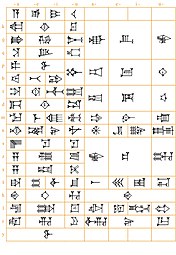
Cuneiform writing is essentially composed of thin, short lines, placed in juxtaposition or crossing each other in a somewhat clumsy fashion.
Heather M. ByeNARRATOR
It has the appearance of numbers of nails scattered about haphazard, and its angular configuration and its stiff and spiny appearance gives the inscriptions a dull and forbidding aspect, which no artifice of the engraver can overcome.
Heather M. ByeNARRATOR
End of section 31.