Cuban Missile Crisis
WarWikipedia
682
MENTIONS
511
EPISODES
380
PODCASTS
Search complete. 682 mentions across 511 episodes found for "Cuban Missile Crisis".
Oct 27, 2026

Gene DecodeGUEST
But those are covers for ACROM, human organs, children, human trafficking, as well as the Chinese had started putting nuclear missiles into Venezuela.
Gene DecodeGUEST
So we have the Cuban Missile Crisis.
Gene DecodeGUEST
This is a similar thing, but it's being done kind of below the eyesight of the average person.
Gene DecodeGUEST
So a lot is going on in the area of Venezuela.

Isaac WoodHOST
I can only imagine the diesel bills racking up for farmers this harvest season.
Isaac WoodHOST
Today, we're covering the $8 billion aid package going to farmers, then a rewind to the Cuban Missile Crisis, and finally, a creative way to test soil health.
Isaac WoodHOST
But first, I'm going to pass it over to Senior Editor Will Quebec for today's Quick Hits.
Will KabackHOST
Thanks, Isaac.
26 MINS LATER
Will KabackHOST
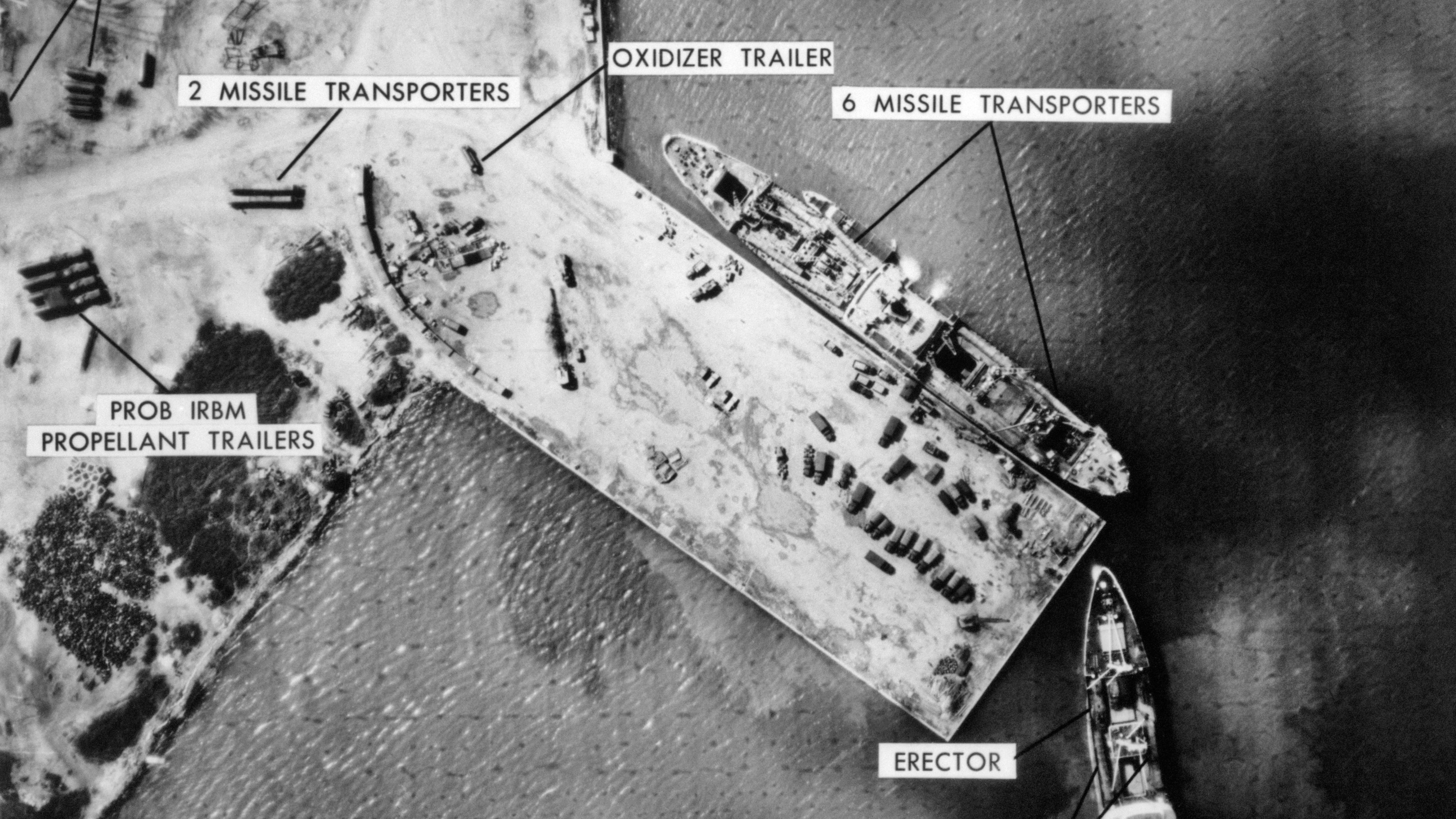
On October 14th, 1962, pictures taken by a US U-2 aircraft showed sites for medium and intermediate range ballistic nuclear missiles under construction in Cuba.
Will KabackHOST
The photographs were cause for major alarm in President John F. Kennedy's administration as they followed the failed Bay of Pigs invasion and Kennedy's warnings to Cuba and the Soviet Union against placing weapons on the island.
Will KabackHOST
The discovery marked the beginning of the Cuban Missile Crisis.
Will KabackHOST
Some of Kennedy's advisors wanted the U.S. to carry out strikes against the missile sites and invade the island nation, while others urged a more diplomatic approach.

David ReynoldsNARRATOR
Since the Second World War, the superpower standoff between Democratic West and Communist East created the constant threat of all-out nuclear war.
David ReynoldsNARRATOR
Tensions peaked in 1962 in the Cuban Missile Crisis, which left Americans with a new sense of vulnerability and the whole world teetering on the brink of Armageddon.
David ReynoldsNARRATOR
Nixon developed a plan to end the global standoff.
David ReynoldsNARRATOR
To do this required detente, a relaxation of tension with Russia.
28 MINS LATER
David ReynoldsNARRATOR
He signed a series of agreements with the Soviets, above all on arms control.
David ReynoldsNARRATOR
So in three dramatic months in 1972, Nixon had overturned a quarter century of Cold War history, becoming the first US president to visit the two capitals of communism.
David ReynoldsNARRATOR
Just ten years after the Cuban Missile Crisis, when nuclear war seemed inevitable, Nixon's policy of détente, relaxing superpower tension, offered hope for an end to the Vietnam War and the prospect of a new, more peaceful world.
David ReynoldsNARRATOR
The global chess game paid off.

Bob WoodleyHOST
After declaring independence from the Soviet Union, the area became Uzbekistan, which it remains today.
Bob WoodleyHOST
This week in 1962, Major Rudolph Anderson of the United States Air Force becomes the only direct human casualty of the Cuban Missile Crisis when his U-2 reconnaissance plane is shot down in Cuba by a Soviet-supplied SA-2 guideline surface-to-air missile.
Bob WoodleyHOST
Back then, Cuba relied on its relationship with the Soviet Union to maintain the communist Castro regime.
Bob WoodleyHOST
The Soviets were happy to help as long as they could put missiles on the island pointed right at the United States.
Bob WoodleyHOST
Now the Soviet Union no longer exists, Russia has better things to worry about, and Venezuela is no longer run by a communist dictator.
Bob WoodleyHOST
China is willing to step up, but Cuba has become more isolated through economic pressure brought by the Trump administration than it ever could by Kennedy's ship blockade.
Bob WoodleyHOST
But in order to end the Cuban Missile Crisis, Kennedy promised Moscow the United States wouldn't attack Cuba.
Bob WoodleyHOST
So far, we have kept that promise.

Rich RobertsHOST
so there we have it 100 years ago with roger luther in other history it was in 1682 philadelphia the city of brotherly love was founded and back in the way before the revolutionary war started one of the early cities of the new colonies and the city of amsterdam was founded in 1275 that's over there in the netherlands let's see the first New York City subway line opened back in 1904 Wow and then in 1954 some 50 years later walt disney's first tv show disneyland presented on abc i remember when i first started watching it they were on nbc and let's see um it was back in 2004 the curse of the bambino that's uh babe ruth ended as the boston red sox swept the game to win um the world series their first major league baseball championship in 86 years and uh We've got some news on the sports front right here after the history concerning the ongoing World Series right now.
Rich RobertsHOST
In other history, it was in 1962 on this day during the Cuban Missile Crisis, a U-2 reconnaissance aircraft was shot down while flying over Cuba.
Rich RobertsHOST
killing the pilot US Air Force Major Rudolph Anderson jr. and thank you for your service to your country and let's see and let's see what else we got the Red Sox won the World Series and I guess that's it for history and in sports concerning the World Series Milwaukee Brewers yesterday they kicked the Tampa Bay Rays ass 10-1 and they lead the series 3-0.
Rich RobertsHOST
They play again today at 8 p.m. and I think it's going to be a sweep here.

Micah FrazierHOST
1954, Benjamin O. Davis Jr. becomes the first black general in the U.S. Air Force.
Micah FrazierHOST
1962, Major Rudolph Anderson from the Air Force becomes the first and only direct human casualty of the Cuban Missile Crisis.
Micah FrazierHOST
1988, Ronald Reagan suspends construction on the new U.S. Embassy in Moscow after inspectors found listening devices.
Micah FrazierHOST
1997, Microsoft argues against the U.S. government that the internet should be free from government interference.

Kenny KatayamaHOST
I wanted to briefly talk about Arkhipov Day and Vasily Arkhipov.
Kenny KatayamaHOST
In 1962, October 27, Vasily Arkhipov, vice admiral on a nuclear submarine, refused orders to fire a nuclear missile during the Cuban Missile Crisis.
Kenny KatayamaHOST
And many historians and folks at the time report that we very much would have gone into like a nuclear war at that time if that warhead had been fired, probably eradicating most of life on Earth.
Kenny KatayamaHOST
So first of all, I want to thank Arkhipov for refusing that order.

speaker_1HOST
On this date in 1904, New York City's subway opened, with Mayor George McClellan taking the controls for its inaugural run.
speaker_1HOST
In 1962, the United States and the Soviet Union stepped back from the brink of nuclear war as the Cuban Missile Crisis began to come to an end.
speaker_1HOST
And in 1994, the US Justice Department announced that the nation's state and federal prison population had surpassed one million for the first time.
speaker_0HOST
Yesterday's Morning Chuckle asked, how do you identify a bald eagle? The answer, all his feathers are combed over to one side.

Albert MohlerSOUNDBITE_SPEAKER
I grew up in Florida.
Albert MohlerSOUNDBITE_SPEAKER
Look no further than the Cuban Missile Crisis for a reminder of how important communication can be.
Albert MohlerSOUNDBITE_SPEAKER
I recognize that AM radio is no longer as popular as it once was, but AM radio remains important.
Albert MohlerSOUNDBITE_SPEAKER
Our digital transmissions are, technologically speaking, fragile.

MaryHOST
A later rocket in the series, the Saturn V, was used in the Apollo spacecraft program from the 1960s and early 1970s that put astronauts on the moon.
MaryHOST
In 1962, during the Cuban Missile Crisis, a U-2 reconnaissance aircraft was shot down while flying over Cuba, killing the pilot, U.S. Air Force Major Rudolph Anderson, Jr., In 1995, a sniper killed one soldier and wounded 18 others during an outdoor physical training session in Fort Bragg, North Carolina.
MaryHOST
In 1998, powerful Hurricane Mitch cut through the western Caribbean, pummeling coastal Honduras and Belize.
MaryHOST
The storm caused at least 10,000 deaths in Central America and before eventually making U.S. landfall in southwest Florida as a tropical storm.
501 more episodes mention Cuban Missile Crisis.
Create an account to see the whole feed, search across every transcript, and follow the entities you care about.