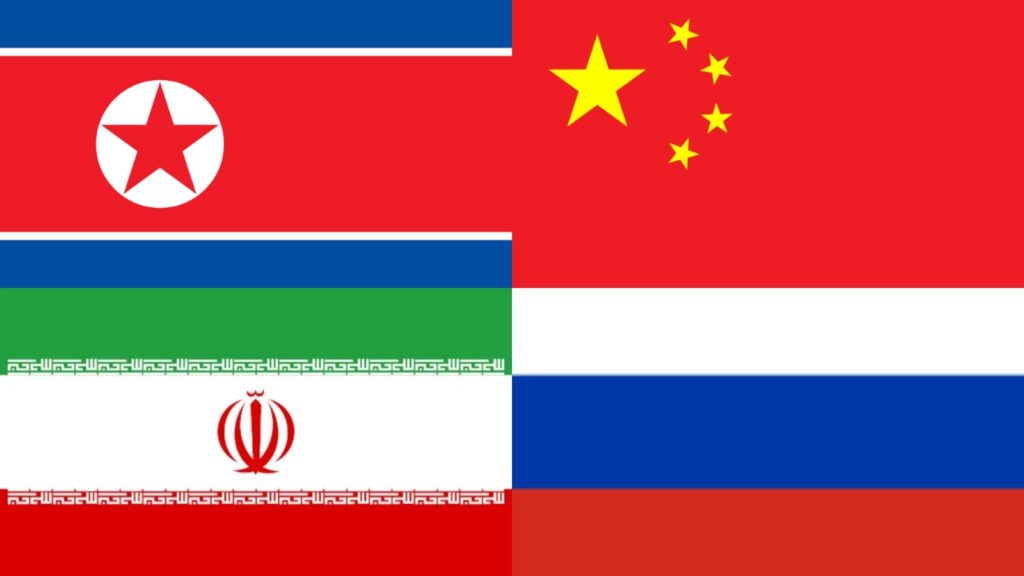
CRINK
23
MENTIONS
11
EPISODES
11
PODCASTS
Search complete. 23 mentions across 11 episodes found for "CRINK".
Oct 2, 2026

Raymond ArroyoHOST
I mean, Russia, China, North Korea, uh, linking, by the way, I- Iran in the background.
Raymond ArroyoHOST
Is that the true alliance now, or axis, if you will? And is Beijing the senior partner?
Gordon ChangGUEST
Oh, Beijing is clearly the senior partner, um, and we're seeing in the CRINKS, China, Russia, Ind- uh, Iran, North Korea, their, their very close bonds now.
Gordon ChangGUEST
For instance, North Korea once had only one formal military alliance.
Gordon ChangGUEST
That was with China.

Peter HartcherGUEST
China, of course, uh, is arming, uh, and assisting Iran and Russia with dual use technologies, with intelligence, with dr- the whole thing.
Peter HartcherGUEST
Xi Jinping is the man behind the arming, uh, and, and assistance to the so-called CRINKs, um, alliance, which is China, Russia, Iran, North Korea.
Peter HartcherGUEST
Xi Jinping is the leader of that alliance, de facto alliance.
Peter HartcherGUEST
It's not a formal one.

Michael AllenHOST
Um, we always talk about the cooperation between Russia, China, Iran, and North Korea.
Michael AllenHOST
People call it everything from the axis of upheaval, um, all sorts of terms.
Michael AllenHOST
W- w- are we making too much of this? Are they just sort of doing what we do all the time, which is sell arms to each other and occasionally sh- share intelligence? Is it something that we've already got China at the very top of our national security worry list.
Michael AllenHOST
Is the axis of upheaval a real thing, and it, should it be something that we talk about more?
Ann E. KowalewskiGUEST
This is a great question, Michael.
Ann E. KowalewskiGUEST
I actually do think that it is a little unique because it's not just...

Michael AllenHOST
We always talk about the cooperation between Russia, China, Iran, Iran.
Michael AllenHOST
And North Korea, people call it everything from the axis of upheaval, all sorts of terms.
Michael AllenHOST
Are we making too much of this? Are they just sort of doing what we do all the time, which is tell arms to each other and occasionally share intelligence? Is it something that – we've already got China at the very top of our national security worry list, right? Is the axis of upheaval a real thing? And should it be something that we talk about more?
Ann E. KowalewskiGUEST
This is a great question, Michael.
Ann E. KowalewskiGUEST
I actually do think that it is a little unique because it's not just...

Nathan KikerHOST
Let's turn to America's adversaries.
Nathan KikerHOST
We increasingly hear about an axis of autocracies involving China, Russia, Iran, North Korea.
Nathan KikerHOST
You've written about this yourself.
Nathan KikerHOST
How real is that coordination? Are they just states with their own agenda who sometimes talk to each other, or are they actively coordinating with a shared view of America and their own goals in the world?
James M. LindsayGUEST
I think we have to be very careful here because the reality is sort of midway between the two sort of polls you laid out, Nathan.
James M. LindsayGUEST
First...
James M. LindsayGUEST
The axis of autocracies is not something akin to NATO with the secretariat and the Chinese ambassador shows up with the Russian ambassador and the Korean ambassador and the Iranian ambassador, and they plot how to coordinate their policies.
James M. LindsayGUEST
But it's also not the case that it's just four countries that all harbor an animus toward the United States.

Rory DuncanHOST
Yeah.
Christina RichmondHOST
Part of the CRINKS gang.
Rory DuncanHOST
Oh, the CRINKS.
Christina RichmondHOST
And in our news...
Christina RichmondHOST
Yes, the CRINKS.
Christina RichmondHOST
We have that in our news newsletter today as well.
Christina RichmondHOST
Uh, so what are the CRINKS, Rory?
Rory DuncanHOST
Oh, so this is the combined forces of darkness, which are, in this regard from a cyber perspective, China, Russia, Iran, and North Korea.

Hal KempferHOST
For China, Russia, Iran, and North Korea, this is this alliance of these four countries, very interconnected, very mutually supporting in every way, and how events in various regions, events in Europe, events in the Middle East, are really changing things pretty rapidly and could have some strategic impact on this informal grouping of these four countries.
Hal KempferHOST
Now, For those of you who have not heard that acronym before, my understanding is that the geopolitical term CRINK for C-R-I-N-K, for China, Russia, Iran, and North Korea, was first coined back in around 2017 by a guy named Mark Anderson, who was a founder of the Strategic News Service.
Hal KempferHOST
Later in 2023 at the Halifax International Security Forum, a guy named Peter Van Praagh pushed it out there.
Hal KempferHOST
I think that's about the time I started hearing about it.

Freddy GrayHOST
That was Edward Howell, who is a lecturer at Oxford University in International Relations, and he's a specialist on China and China's relationship with North Korea.
Freddy GrayHOST
And he also has a new book out, which is called The New Axis of Upheaval.
Freddy GrayHOST
Do have a look out for that.
Freddy GrayHOST
It's a very, very important subject indeed.

Sanghun SeokGUEST
In the past, I had a slightly different view about the usefulness of the terminology trink, because traditionally, North Korea has been oscillating between Moscow and Beijing, and by naming them as a solid group, there is a danger that- It might consolidate them even more and make us blind about internal dynamics that might lead to divergence between those authoritarian states.
Sanghun SeokGUEST
But as of now, uh, due to institutionalization of that relationship as evidenced by continued high-level exchanges and continued cooperation, not only in military domains, but also in economic sectors, CRINKS looks stronger than it used to be.
Sanghun SeokGUEST
To the contrary, our challenge is that we are not as united or coordinated maybe compared to what CRINKS is.
Sanghun SeokGUEST
Although we often discuss and talk about the convergence of the securities in the Indo-Pacific and the European theater, and it is true that North Korean troops are fighting alongside Russia in Ukraine, and South Korea has become an important defense partner in Europe.
Sanghun SeokGUEST
But at the same time, I'm not really sure whether this greater interconnection really means, uh, real strategic convergence.

Hanna NotteGUEST
But, you know, so much for the BRICS alliance.
Hanna NotteGUEST
I think you know that we've had a lot of talk in Washington, in Western capitals over the last few years of another alliance that Russia has allegedly forged, the Axis of Upheaval, or some call it the CRINC, so Russia's partnership with China, Iran and the DPRK.
Hanna NotteGUEST
Unarguably, these countries have been very important supporters of Russia, supporting its economy and its defense enterprise.
Hanna NotteGUEST
And there's these deepening connections between Russia and these three partners.
1 more episode mentions CRINK.
Create an account to see the whole feed, search across every transcript, and follow the entities you care about.