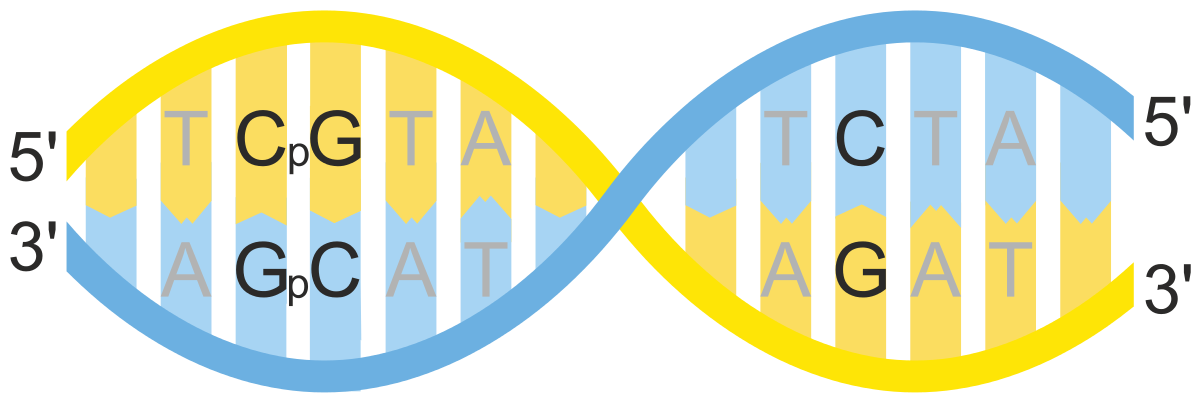
CpG site
26
MENTIONS
10
EPISODES
7
PODCASTS
Search complete. 26 mentions across 10 episodes found for "CpG site".
Oct 26, 2026

speaker_1UNKNOWN
The first is DNA methylation.
speaker_1UNKNOWN
This is where methyl groups, tiny chemical tags, attach directly to cytosine bases in the DNA, usually at specific regions called CPG islands near the promoter of a gene.
Manaan KarrayHOST
Okay.
speaker_1UNKNOWN
When a promoter region becomes highly methylated, it acts like a physical roadblock.

Daniel J. GuerraHOST
And it's common.
Daniel J. GuerraHOST
So methylation of specific cytosine residues just on CPG islands of that dinucleotide, an enhancer and promoter, which is just there, where it was first discovered, that itself is variable.
Daniel J. GuerraHOST
And yet it is not pathological.
Daniel J. GuerraHOST
It doesn't necessarily at all involve a pathological event, such as a tumor or a susceptibility to infection or an hyperimmune response.

Kathy SpindlerHOST
So the therapies for this chronic hepatitis B infection must, one, deal with two forms of the viral DNA, DNA in infected cells, covalently closed circular DNA and integrated DNA.
Kathy SpindlerHOST
And, uh, then HBV gene expression is regulated by chemical modifications, which is the addition of methyl groups to CpG rich regions in the viral genome.
Kathy SpindlerHOST
So, uh, there are these, uh, CG dinucleotides, and they can cluster into what are called i-islands.
Kathy SpindlerHOST
And those regions, when methylated, affect the levels of viral DNA replication and the serum antigen levels that come from the virus, uh, in the infected patients.
Kathy SpindlerHOST
So the, um, this first EE that they're gonna study, they call EE4000.
Kathy SpindlerHOST
And so they test the gRNA2 and EE4000 in cells, and what they're looking for is silencing, that is reduced transcription of the viral antigen genes due to, um, this, uh, methylation.
Kathy SpindlerHOST
So, uh, they, uh, see that, and so [chuckles] the result is they see a correlation of methylation of the dinucleotide CpG islands and the silencing.
Kathy SpindlerHOST
So I wrote in my notes, "Yay." [chuckles] That's what they're looking for.
Daniel J. GuerraHOST
So when you overexpress Enfield-3, you increase that methylation.
Daniel J. GuerraHOST
In fact, it's six unique CPG island sites, all in that conserved non-coding sequence two region.
Daniel J. GuerraHOST
So that mechanism underlies a basic phenomenon that basically can be translated this way.
Daniel J. GuerraHOST
Enfield-3.

Andrew AdeyGUEST
It-- So it's CH methylation or non-canonical methylation.
Andrew AdeyGUEST
So typical DNA methylation in mammalian cells is in the CG context, so some people say CpG or CG, where it's a cytosine followed by guanine.
Andrew AdeyGUEST
Those bases are the ones that are methylated, so you might have these CG islands and regulatory elements that are often, you know, what, what's used to control the methylation state.
Andrew AdeyGUEST
It's, it's at these CG sites.
Daniel J. GuerraHOST
Nevertheless, We are now deep, at least, into finally discussing just neurodegeneration.
Daniel J. GuerraHOST
We've already discussed how microglia are polarizable, and that polarizability has to do with alterations in transcription factor expression, which means there's going to be an effect on gene expression specifically and that is linked to the epigenetic alteration of gene expression, such things as acetylation of histones, and methylation or demethylation of cytosine residues in specific CPG islands that we find in genes in, for example, promoter enhancer regions of those genes that would otherwise control hyperinflammation or promote hyperinflammation, the kind of genes we were just talking about in the GWAS type studies.
Daniel J. GuerraHOST
Now we can get down to also to simply What kind of carbon source is being used in the brain? And is carbon source and carbon oxidation, particularly glucose versus fatty acid or amino acid, play a role in promoting or suppressing neurodegeneration? So now we're down not just into intermediary metabolism, we're into bioenergenics.
Daniel J. GuerraHOST
How is ATP produced in the brain? What is being oxidized to reduce NAD to NADH so that NADH, including FADH, FADH2, that is, can be reoxidized.

Graham MorganHOST
And in DNA methylation, these tiny chemical tags physically attach themselves to the DNA strand, specifically at regions that are rich in cytosine and guanine.
Dana MahoneyHOST
The CPG islands.
Graham MorganHOST
Yeah.
Graham MorganHOST
CPG islands.
Graham MorganHOST
So when a methyl group attaches to a promoter region of a gene, it physically obstructs transcription factors.
Dana MahoneyHOST
It blocks the cellular machinery from reading it.
Dana MahoneyHOST
It doesn't just scan a few known aging pathways.
Dana MahoneyHOST
It utilizes this process called bisulfite conversion to differentiate unmethylated cytosines from methylated ones.

David BearssHOST
So, so there's, uh, 5-methylcytosine is, is a mark that we can measure, and that mark, um, has specific consequences associated with, with respect to genes that are regulated.
David BearssHOST
Um, a lot of genes have what we call CpG islands, which are, uh, CG, so cytosine, guanosine, um, uh, residues that are right next to each other, and those CpG islands are, are sites of methylation.
David BearssHOST
So they can be methylated, and they, those are usually associated with regulation, so turning genes on and off.
David BearssHOST
And so if you have more methyl groups, usually that's associated with transcriptional repression, and less methyl groups means more expression of the gene.
Daniel J. GuerraHOST
Now, that involves increasing and maintaining genomic integrity But what must occur is a chromatin re-tailoring, which will necessarily involve a great deal of epigenetic mechanistic induction.
Daniel J. GuerraHOST
That is covalent modification of nucleotides such as cytosines in specific CPG islands in the DNA.
Daniel J. GuerraHOST
adenosines in either DNA or RNA, and then the entire histone protein complex, further modified by covalent modification of either methylation, acetylation, ubiquitinylation, succinylation, and indeed many other covalent modifications on specific lysine residues, arginine residues, sometimes serine, even cysteine residues on those histone proteins.
Daniel J. GuerraHOST
which make up the nucleosomes, which essentially is the chromatin protein fraction that we then call the genome.
1 more episode mentions CpG site.
Create an account to see the whole feed, search across every transcript, and follow the entities you care about.