Cover crop
100
MENTIONS
10
EPISODES
7
PODCASTS
Search complete. 100 mentions across 10 episodes found for "Cover crop".
Sep 18, 2026

Henry HochstetlerGUEST
And so they're kind of testing some things, but they don't, like he said, every time in the past, they've tried to wait until the crops are off because they don't want to smash the crops.
Henry HochstetlerGUEST
Um, And he said, by the time everything, you know, the crops were off, it was too late to establish the cover crop.
Henry HochstetlerGUEST
And so he's like, there's really not been a way to do it to where the cover crop's solid by the time winter
MikeHOST
comes.
MikeHOST
What seed were you spreading? Clover.
Henry HochstetlerGUEST
I told him as soon as they harvest the beans, I want to know because I want to go back and see.
MikeHOST
Yeah.
MikeHOST
That was the same way with the corn, the stuff I did, you know, cover crop on corn.

Noah NewmanHOST
We waited for burndown as long as possible.
Noah NewmanHOST
And you can join the discussion at notillfarmer.com. Let's send it over to McCain Vogel now for today's Cover Crop Connection.
Noah NewmanHOST
McCain.
McCain VogelCORRESPONDENT
Thanks Noah.
McCain VogelCORRESPONDENT
We're still combing through all the great content that we captured at Farm Progress Show this year, and this week we're looking at a clip from Cody Hornaday, a technical agronomist with Koch Agronomic Services, as he explains a few tips that no-tillers and cover croppers should keep in mind for unlocking phosphorus in their soils.
Cody HornadaySOUNDBITE_SPEAKER
One of the things I wanted to show you real quick right out of the gate, both the products we're really highlighting here today focus primarily on early season advantages.
Cody HornadaySOUNDBITE_SPEAKER
And so naturally this time of year, some of the differences get a little harder to see.
Cody HornadaySOUNDBITE_SPEAKER
So just freeing up more phosphorus that wouldn't have otherwise been available to your crop.

Francesca BroomeHOST
But before we hear from Alistair and Steven Aldous on fungicides, tillage, and harvesting, I spent some time with George to discuss the latest thinking on cover crop use, particularly given the likelihood of more dry springs in the years ahead.
Francesca BroomeHOST
[upbeat music] I'm very pleased to be joined by Georgina Barrett.
Francesca BroomeHOST
We're here talking about cover crops.
Francesca BroomeHOST
It's the right time of year, and hopefully growers that are interested in putting cover crops in have had a chance to have a look at some of our literature that we have on the website.
Francesca BroomeHOST
But as we have the, the font of all knowledge in front of me here, let's make a start.
Francesca BroomeHOST
So, George, what are the implications of all this dry weather? Should we have cover crops or not?
Georgina BarrettGUEST
That's such a good question, and one we keep getting asked at the moment.
Georgina BarrettGUEST
So it's difficult prioritizing on farm.

Keith BernsHOST
[laughs]
Kevin ElmyGUEST
And, and so at the first meeting, I gave her a copy of my cover crop, uh, cover cropping book, and, uh, she cordially thanked me, and I said, "Well, no, thank you for all you, what you do." The...
Kevin ElmyGUEST
In that second meeting, she was waving this book in front of everybody and saying, "Every time he says Western Canada, think Western Australia.
Kevin ElmyGUEST
Every time he says overwintering, think over summering."
42 MINS LATER
Kevin ElmyGUEST
Uh, Reason Press is, uh, the, the, the printer that I worked with, but it's on Amazon.
Kevin ElmyGUEST
Um, if they wanna get ahold of me I can, I can get 'em copies.
Kevin ElmyGUEST
Um, yeah, it's, uh, the, the, the, the cover cropping book that, uh, you guys did, another really good resource.
Kevin ElmyGUEST
Uh, so if you can get ahold of Keith and get his book also.

TannerHOST
We're almost about as far north as they really take off.
TannerHOST
I mean, it doesn't seem like there's a lot of our listeners much further north than we are that do a lot with cover crop.
Eric ScherderGUEST
If you do, you've got to start so early in the season, then if we're not careful, especially in corn, you can start getting more, you get growth down in the leaves.
Eric ScherderGUEST
You start, all of a sudden now we get stuff, we can get some ear molds, different things like that.
TannerHOST
They're really a double crop.
TannerHOST
We're very fortunate with our feedlot to be able to utilize the forage out of some of those.
TannerHOST
And the ground that we already have cover crops seeded on is gonna get chopped.
TannerHOST
So it's gonna be some of the first fields completely taken off.

Todd GleasonHOST
We have a couple of news items as we head into the Labor Day weekend.
Todd GleasonHOST
First, a survey shows continued growth in cover crop use.
Todd GleasonHOST
The 2026 National Cover Crop Report indicates growing interest in cover crops among farmers.
Todd GleasonHOST
The survey found cover crop users planted an average of nearly 398 acres in 2026, and and expect to exceed 400 acres next year.
Todd GleasonHOST
Nearly half of the respondents reported more than 10 years of experience using cover crops.
Todd GleasonHOST
The survey conducted by the Conservation Technology Information Center, USDA Sustainable Agriculture Research and Education Program, and the American Seed Trade Association included responses from 657 farmers, across 46 states and Puerto Rico.
Todd GleasonHOST
Researchers noted that cover crop use is often flexible rather than continuous, with many farmers adjusting acreage based on economics, weather, labor, availability, and crop rotations.
Todd GleasonHOST
More than 73 percent of farmers who have never used cover crops say they would consider trying them.

speaker_0HOST
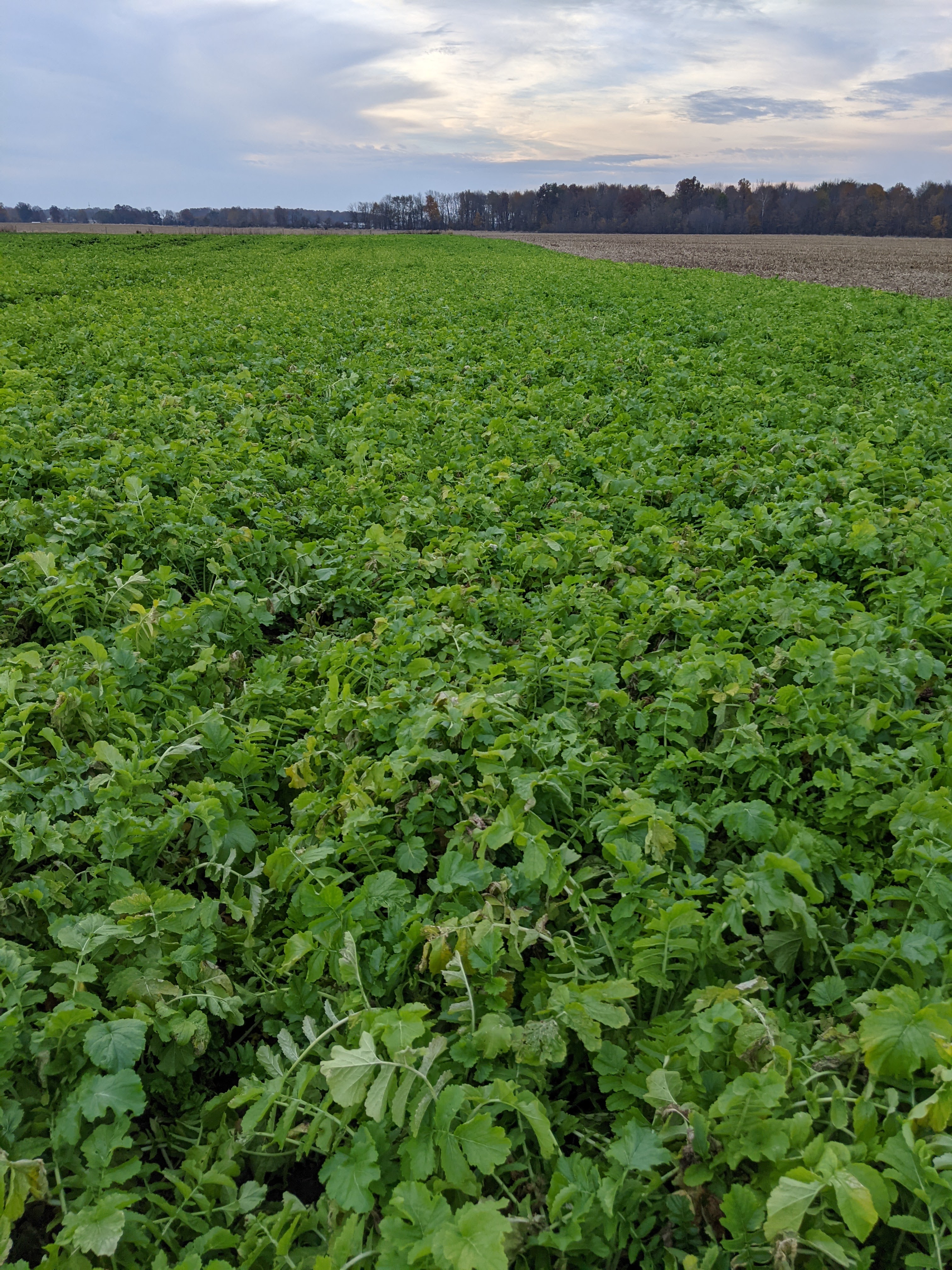
I'm standing in the shade at the edge of the field by the river.
speaker_0HOST
I'm just going for a walk tonight and I'm really curious about this cover crop.
speaker_0HOST
And you can tell from the house that it's up and it's really nice to see it up close.
speaker_0HOST
I guess oats or barley, I'm not sure which, probably the barley.
speaker_0HOST
It's a, it looks really uniform.
speaker_0HOST
Like I always wonder, Oh, is this going to be streaky or what's this going to be like? But, um, as it just, it's a hundred percent, it just looks really great, super even, and it's really dense.
speaker_0HOST
It's going to be a high biomass cover crop for sure.
speaker_0HOST
So that's really nice to see.
speaker_0HOST
I had five bags, five 50-pound bags from last year of just straight oats and barley, like 80% or 80 pounds per acre of barley and 20 pounds per acre of oats.
speaker_0HOST
And then I've got 45 bags here of blended cover crop seed, and that's, uh, gonna be put on...
speaker_0HOST
I g- I've, I've got it at 16 and a half acres.
speaker_0HOST
It's around 17 acres, I'd say.
6 MINS LATER
speaker_0HOST
So that's good.
speaker_0HOST
Crisis averted.
speaker_0HOST
What's the price on this? This cover crop seed is $1,358 I think it was.
speaker_0HOST
So it's a big deal to make sure it gets on properly and that in addition I guess the tillage, the diesel and all the maintenance and stuff that goes along with the tillage.
Todd GleasonHOST
Episode 84 was just released.
Todd GleasonHOST
It is the third in a three-part series called Cover Crop Conversations.
Todd GleasonHOST
and we'll hear again from three farmers.
Todd GleasonHOST
This time, they'll provide advice about the hard lessons they've learned over the decades, and more importantly, the practical things someone knew, or even experienced for that matter, can and likely should deploy.
Todd GleasonHOST
Adam Dahmer farms in deep southern Illinois, not so far from the Ohio River.
Todd GleasonHOST
Brent Fowler's farm sits halfway between the Illinois and the Mississippi rivers in McDonough County, and Greg Thorne farms in the driftless region of the northwestern corner of the Prairie State in Joe Davies County.
Todd GleasonHOST
Today, we'll hear their final thoughts on using cover crops, as explored in the webinar, and some down-to-earth practical management advice.
Todd GleasonHOST
We'll start with seeding a cover crop.
speaker_0HOST
Like there's, um, poplar trees up there and they're, they're really something else for, um, propagating, uh, with the roots underground and just expanding their, their, um, uh, area, uh, by growing sap or like new trees, um, from roots, uh, along the fence line.
speaker_0HOST
So anyway, I had tons of, tons of roots with the chisel plow and, and some of them were maybe, say like two inches in diameter so pretty significant and they kind of bunged up the chisel plow and and i started raking so i'd have to stop and dump and clear out all this uh all these roots it took me i don't know to do that section it took me probably 45 minutes to do two passes it was a pain in the butt but hadn't been done in a long time so those two things have to be fixed up before i do anything else and also there's some ash trees maybe five of them along by the river that are dead and i want to cut them and chop them up for firewood before uh before i put a cover crop in that field um next step in there is going to be the disc again To level and knock down the clods of dirt that the chisel plow brought up.
speaker_0HOST
And then I think I'm just going to broadcast the cover crop.
speaker_0HOST
And I ordered one from Courtney's and it's ready to go.
speaker_0HOST
It's actually in bags, 46, 50-pound bags.