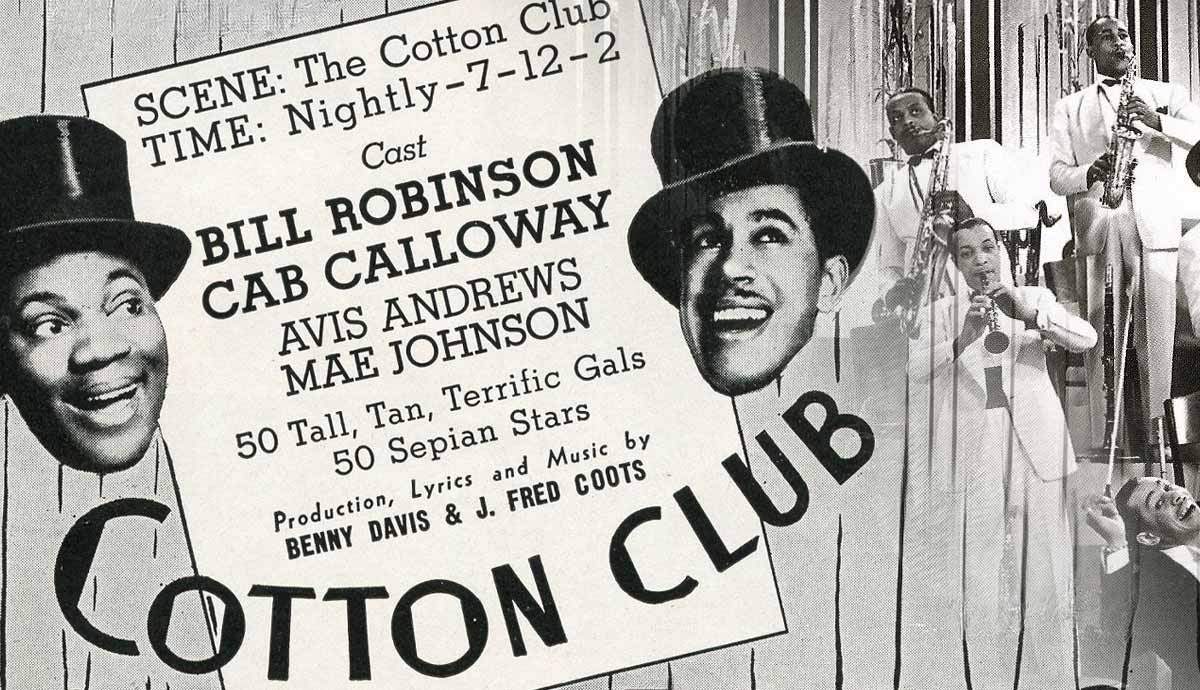
Cotton Club
NightclubWikipedia
101
MENTIONS
39
EPISODES
8
PODCASTS
Search complete. 101 mentions across 39 episodes found for "Cotton Club".
Oct 23, 2026
A 50-Year-Old Party Could Be Your Best Movie Night
R
16:52Richard CrouseGUEST
We're going to go to Harlem.
R
16:54Richard CrouseGUEST
We're going to go back a few years, though, back to the Cotton Club.
R
16:59Richard CrouseGUEST
which was at 142nd Street and Lenox Avenue.
R
17:04Richard CrouseGUEST
And it was the club I think that most people closely associate with Harlem because of the movie.
R
17:21Richard CrouseGUEST
And because they were open during prohibition, they had a lot of kind of sneaky drinks that they would serve that were illegal at the time, but sort of equally delicious.
R
17:33Richard CrouseGUEST
So I found a few of them, one called a Harlem Cocktail.
R
17:36Richard CrouseGUEST
And this one is obviously named after the neighborhood and it's strongly linked to the Cotton Club.
R
17:45Richard CrouseGUEST
It was a Prohibition era cocktail.
Cricket Magazine: Cricket ages 9-14 - Friday, 10/23/26
T
18:14Tara SalazarNARRATOR
Dancing as a social activity was wildly popular in 1930s Harlem, and you could always find the best dancers and the best musicians at the Savoy Ballroom.
T
18:24Tara SalazarNARRATOR
Unlike Harlem's famous Cotton Club, which featured Black entertainers performing before all-white audiences, the Savoy was one of the first integrated public places in the country.
T
18:34Tara SalazarNARRATOR
In 1937, a famous battle of the bands took place.
T
18:38Tara SalazarNARRATOR
It featured bandleader and clarinetist Benny Goodman with his drummer Gene Krupa versus bandleader and drummer Chick Webb.
Swing King Chick Webb Brought Ella Fitzgerald to the World: Let It Roll From the Beginning... 4.7
N
22:43Nate WilcoxHOST
The underground dance scene was quite integrated, but around World War One, the Jim Crow edicts came down and segregated everything.
N
22:50Nate WilcoxHOST
So this is breaking down that imposition of segregation and even, you know, yeah, the famous Cotton Club.
N
22:57Nate WilcoxHOST
But one thing that really blew me away was the capacity of this club.
N
23:02Nate WilcoxHOST
Four thousand people at a time.
P
Unknown podcast
Harlem Renaissance
Oct 18 · 2 Mentions
S
30:05speaker_1NARRATOR
This included writers and performers like Langston Hughes and Ethel Waters.
S
30:10speaker_1NARRATOR
In the music scene of Harlem, venues like the Cotton Club and Rockland Palace often hosted drag shows alongside other performances.
S
30:20speaker_1NARRATOR
Performers such as Gladys Bentley and Bessie Smith were part of this movement, helping to introduce these cultural expressions to a wider audience.
S
30:29speaker_1NARRATOR
While the contributions of women were sometimes overlooked in the past, modern critics have worked to recognize the importance of their work.
S
34:02speaker_1NARRATOR
Musicians also experienced a mix of positive and negative outcomes.
S
34:07speaker_1NARRATOR
Nightclubs and cabarets in Harlem provided a stage for performers and a place for residents to dance.
S
34:15speaker_1NARRATOR
But some of the most famous locations, like the Cotton Club, were restricted to white audiences only.
S
34:22speaker_1NARRATOR
The black musicians who played there often became very successful in the mainstream music scene.
Chamber Music Pittsburgh - Valerie Coleman and Friends
J
3:01Jim CunninghamHOST
... on this program.
J
3:02Jim CunninghamHOST
Uh, we've got the William Grant Still Summerland and, uh, Valerie's pieces, Portraits of Langston, The Cotton Club, Juba.
J
3:11Jim CunninghamHOST
What are you gonna choose here to, to tell us about, okay?
M
3:15Mariam AdamGUEST
When Imani Winds in this early incarnation with the three of us as founders, we played Summerland.
14 MINS LATER
M
17:29Monica EllisGUEST
So all of those wonderful, wonderful organizations that, uh, have still, are still making great music and, and, um, you know, representing Pittsburgh really well.
J
17:39Jim CunninghamHOST
One last thing.
J
17:40Jim CunninghamHOST
Gotta ask, uh, Valerie about, uh, the Cotton Club Juba.
J
17:43Jim CunninghamHOST
Now, I've never seen the Juba-
10.15.26
R
14:01Rebecca ShoreHOST
Everyone was afraid of him because he had a psychotic streak, and he was a killer, says Raines.
R
14:07Rebecca ShoreHOST
Madden owned the famous Cotton Club in Harlem and muscled his way into part ownership of a variety of other nightclubs.
R
14:15Rebecca ShoreHOST
In 1935, seeking a quieter way of life, he relocated to Hot Springs, which he'd visited a few times.
R
14:23Rebecca ShoreHOST
Leaving his rowdy ways behind him, he married the postmaster's daughter and settled into a comfortable life.
P
Unknown podcast
Monk's Minton's House: How One Piano Transformed Jazz
Oct 13 · 3 Mentions
S
5:43speaker_1UNKNOWN
Alright folks, after dissecting how Monk reshaped the piano roll, let's pivot to a different kind of jazz revolution.
S
5:51speaker_1UNKNOWN
I want to talk about Cab Calloway, that flamboyant vocalist who turned the Cotton Club into an arena for cultural negotiation.
S
6:00speaker_1UNKNOWN
He wasn't just a singer, he was a brand architect and a political actor in the 1930s Harlem scene.
S
6:08speaker_1UNKNOWN
His career gives us a lens on how race, spectacle, and commerce collided when defining what jazz could become.
S
7:43speaker_1UNKNOWN
It also introduced the first widely used call and response structure in popular music, engaging listeners as participants.
S
7:52speaker_1UNKNOWN
This success forced record labels to rethink marketing strategies toward African American audiences.
S
7:59speaker_1UNKNOWN
The Cotton Club was a paradoxical venue.
S
8:02speaker_1UNKNOWN
It showcased black talent while reserving the dance floor for white patrons.
P
Unknown podcast
Armstrong’s West End Blues Cadenza: Myth, Market, and Musical Legacy
Oct 13 · 3 Mentions
S
6:46speaker_1UNKNOWN
That influx set the stage for a new kind of collective improvisation that would redefine what jazz sounded like.
S
6:53speaker_1UNKNOWN
Venues like the Cotton Club and Savoy Ballroom were the epicenters of this transformation, but they had a paradoxical relationship with race.
S
7:04speaker_1UNKNOWN
The Cotton Club, for example, was an all-white club that showcased black talent to white audiences.
S
7:12speaker_1UNKNOWN
while the Savoy welcomed a mixed crowd in a dance hall that turned into a laboratory for swing.
S
7:19speaker_1UNKNOWN
Musicians had to read the room and adjust their arrangements on the fly, turning every set into a negotiation between artistic vision and audience expectation.
S
9:36speaker_1UNKNOWN
Yet racial realities never fully disappeared.
S
9:40speaker_1UNKNOWN
Black musicians faced segregation in hotels, on tour, and even within their own clubs.
S
9:47speaker_1UNKNOWN
The Cotton Club's policy of white patrons forced performers to adopt a polished, clean style that could pass for mainstream entertainment while still retaining African-American grit.
P
Unknown podcast
Habanera & Tresillo: The Rhythm That Shaped Jazz
Oct 13 · 2 Mentions
S
12:43speaker_0UNKNOWN
What makes Johnson's story resonate is that he wasn't just playing notes.
S
12:48speaker_0UNKNOWN
He was negotiating space in clubs like Cotton Club and on radio waves that were still being coaxed into the mainstream.
S
12:56speaker_0UNKNOWN
The early 1920s saw him record The Charleston for Brunswick, a tune that became an anthem of the roaring 20s, but also a battleground where record companies began to see jazz as marketable commodity rather than niche art.
S
13:11speaker_0UNKNOWN
But it wasn't just about dollars.
S
14:04speaker_0UNKNOWN
In the club scene, Johnson pioneered what became known as stride.
S
14:09speaker_0UNKNOWN
a left-hand technique that walked bass lines while the right hand launched melodic leaps.
S
14:14speaker_0UNKNOWN
That approach mirrored African polyrhythms and also allowed him to improvise within a framework that could be understood by dancers at the Cotton Club or patrons in Harlem's Savoy Ballroom.
S
14:26speaker_0UNKNOWN
But perhaps his most enduring legacy is how he turned the piano into a vehicle for cultural dialogue, bridging gaps between black and white communities through music.
P
Unknown podcast
From Church Basements to Bent Horns: The Foundations of Jazz
Oct 13 · 1 Mention
S
8:14speaker_1UNKNOWN
Yet the economic reality forced them to play in venues where they could earn a living.
S
8:20speaker_1UNKNOWN
Ellington's Cotton Club gigs were lucrative, but came with the price of performing for a segregated audience.
S
8:26speaker_1UNKNOWN
Musically, the problem was clear.
S
8:29speaker_1UNKNOWN
78 RPM records and radio broadcasts demanded concise arrangements that still allowed room for improvisation.
29 more episodes mention Cotton Club.
Create an account to see the whole feed, search across every transcript, and follow the entities you care about.