Cotard delusion
Mental disorderWikipedia
10
MENTIONS
3
EPISODES
3
PODCASTS
Search complete. 10 mentions across 3 episodes found for "Cotard delusion".
Oct 12, 2026

Christine Cliatt-BrownGUEST
Visit facepain.org. [upbeat music] This is Christine Cliatt-Brown from the University of Utah.
Christine Cliatt-BrownGUEST
Today in our series on delusional misidentification syndromes, we're going to explore Cotard syndrome.
Christine Cliatt-BrownGUEST
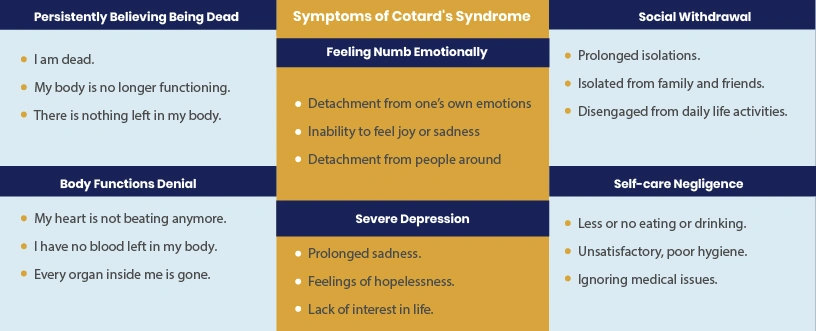
Cotard syndrome is a nihilistic delusion in which patients believe that they are dead, dying, rotting, no longer exist, are missing internal organs, or have lost their blood, soul, or body.
Christine Cliatt-BrownGUEST
This presentation can vary from severe depressive nihilism to bizarre fixed somatic beliefs, but the core feature is this profound denial of self, life, or bodily existence.
Christine Cliatt-BrownGUEST
The syndrome is named for Jules Cotard, a French neurologist and psychiatrist who described what he called le délire de négation in the late 19th century.
Christine Cliatt-BrownGUEST
His original patient claimed she had no brain, no nerves, no chest, no stomach, and no need to eat because she was already dead.
Christine Cliatt-BrownGUEST
Cotard syndrome is often discussed in psychiatry, especially in the setting of severe depression with psychotic features.
Christine Cliatt-BrownGUEST
But neurologists should know that it also appears in a range of neurologic disorders.

Austin LimGUEST
Mm-hmm.
Jonathan EvisonHOST
You, you talk about something called the Cotard delusion, which leads patients to believe they are dead, um, and th-- even going to such extremes as burying themselves alive.
Jonathan EvisonHOST
Is this a real thing?
Austin LimGUEST
Yeah, exceedingly rare psychotic delusion.
Austin LimGUEST
I am royalty.
Austin LimGUEST
Everyone should bow down to me," things like that.
Austin LimGUEST
Um, some of the more rare forms of these delusions, which can happen in schizophrenia or they can happen on their own following some kind of injury, the Cotard delusion, right, where a person believes they are dead, and these are very, very rare cases.
Austin LimGUEST
There are instances of people saying, um, "I, I set my alarm Early in the morning, I slept past it and I panicked.

Austin LeeHOST
I can't think of many things more horrific than that.
Austin LeeHOST
But for this one, we're covering the very rare Cotard's syndrome, also known as the Walking Dead or the Walking Corpse Syndrome, and more broadly, Cotard called it the delusions of negation or nihilistic delusions.
Austin LeeHOST
And he described this as a state that is neither life nor death.
Austin LeeHOST
He called it being dead alive, which we'll get more into 'cause that sounds contradictory, but it'll make more sense as we dig into this.
26 MINS LATER
Austin LeeHOST
He also mentioned that he didn't feel human and that his life felt like a dream, and he had actually died by suicide.
Austin LeeHOST
But this is an armchair diagnosis from fans and writers after the fact, so we don't really know if he truly did suffer from Cotard syndrome.
Austin LeeHOST
This walking corpse syndrome has also been retroactively connected to disturbing high-profile cases like Richard Chase.
Austin LeeHOST
He was never formally diagnosed, but a retrospective analysis of his case suggests that he may have had it.