cosmic microwave background
135
MENTIONS
25
EPISODES
15
PODCASTS
Search complete. 135 mentions across 25 episodes found for "cosmic microwave background".
Oct 29, 2026

Matt O'DowdHOST
This episode is supported by 23andMe.
Matt O'DowdHOST
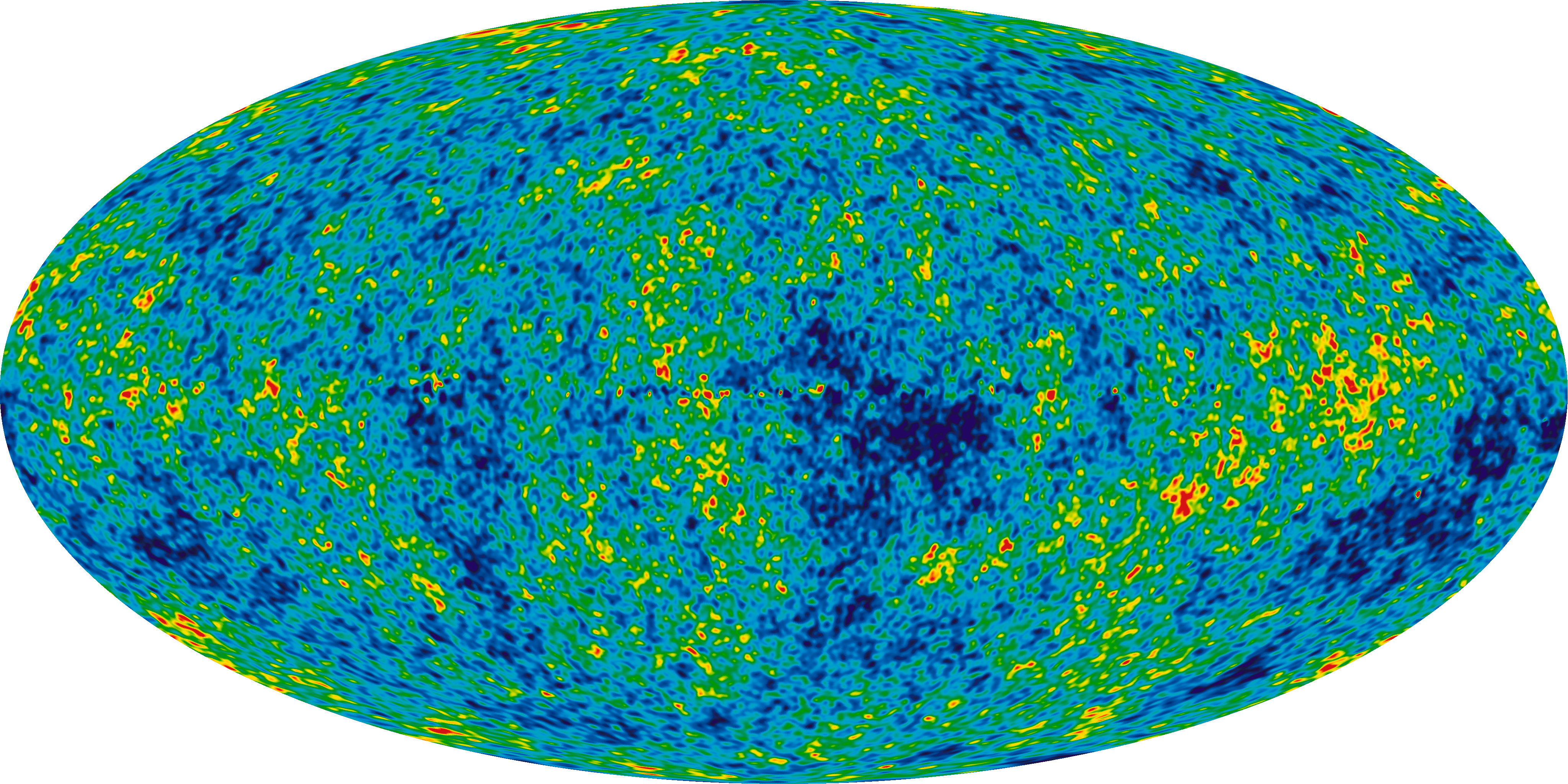
If you study a map of the Cosmic Microwave Background, or CMB, you may notice a large deep blue splotch on the lower right.
Matt O'DowdHOST
This is the cold spot.
Matt O'DowdHOST
Is this feature a statistical fluke, the signature of vast supervoids, or even the imprint of another universe? Is that giant cold spot in the cosmic microwave background really evidence of a collision with another universe? That's what all the media hype is saying, which means it's time for another space time journal club to sort it out.
Matt O'DowdHOST
Today we're going to talk about a fascinating new publication by Mackenzie et al.
Matt O'DowdHOST
2017 titled Evidence Against a Super Void Causing the CMB Cold Spot.
Matt O'DowdHOST
First, the name.
Matt O'DowdHOST
Evidence against a supervoid.
Matt O'DowdHOST
In the last episode, we did a Space Time Journal Club on a new paper investigating whether the cold spot in the cosmic microwave background was due to supervoids or a collision with another universe.
Matt O'DowdHOST
Let's discuss.
Matt O'DowdHOST
A few people point out that there are lots of cold spots in the CMB map and that some look larger than the actual cold spot.
Matt O'DowdHOST
Well, first, let me point out that the cold spot wasn't identified by the, ooh, that bit looks a bit bluer than the rest method.
Matt O'DowdHOST
Detailed statistical analysis of the entire Planck CMB map pointed to that region as being a significant outlier.
Matt O'DowdHOST
It's the size of the consistently low temperature region that's unusual.
Matt O'DowdHOST
There are smaller, cooler regions that are consistent with random fluctuations.

PeterHOST
It was an event so big that we can detect the echo of all this energy all around us even 14 billion years later.
PeterHOST
It's called the Cosmic Microwave Background, the CMB.
PeterHOST
But it's not actually a leftover of the Big Bang.
PeterHOST
The CMB is the imprint of an event 380,000 years after the Big Bang.
27 MINS LATER
PeterHOST
It would have nowhere to go.
PeterHOST
Temperatures would rise as the pressure increased.
PeterHOST
Same cosmic microwave background energy, but a much smaller box.
PeterHOST
The heat would go up.

David KippingHOST
After all, when you walk down the carriage of a 50mph train, are you moving at 3mph or 53mph? Both are right, it just depends what you're comparing to.
David KippingHOST
But one example might at first seem to defy this, the Cosmic Microwave Background or the CMB.
David KippingHOST
This is the radiation that was produced by the hot primordial soup of the early universe just 380,000 years after the big bang.
David KippingHOST
That time corresponds to the epoch when the universe became transparent to light for the first time.
David KippingHOST
Because before that it was largely ionized, creating a kind of thick fog that prevented light from traversing space.
David KippingHOST
The CMB radiation is all around us.
David KippingHOST
We are bathed in its light.
David KippingHOST
It comes from every direction.
David KippingHOST
After all, the entire universe was filled with this ionized plasma.
David KippingHOST
This light is known as the Cosmic Microwave Background or CMB and it encodes the temperature of the universe at this time.
David KippingHOST
Any patch of the CMB more than two degrees away from another patch is simply too far away to have had time for light to have traveled between them, at least given the age of the universe at the time, just 380,000 years old.
David KippingHOST
So if we see a particular pattern or ripple repeated in the CMB that is separated by more than two degrees, well, that implies that space somehow wraps around on itself.

Michelle CollinsHOST
And so you normally, by assuming this sort of, we assume in this, you have a flat lambda cold dark matter model, and then you get a value for H naught for that model.
Michelle CollinsHOST
If you were to change the model, you would get a slightly different value of H naught, but the CMB supports this sort of flat lambda CDM cosmology.
Michelle CollinsHOST
So they use that.
Michelle CollinsHOST
Now the problem is that these two values are now measured very precisely, but they don't agree at a fairly high significance level.
8 MINS LATER
Payel DasHOST
actually it'd be nice to really see, could we ever constrain a kind of shape for it?
Michelle CollinsHOST
But this is, I guess, a way of checking the systematics on that local universe.
Michelle CollinsHOST
So, you know, then we have to say, okay, well, there's a reason that the CMB is not the same as the local universe.
Michelle CollinsHOST
And it isn't because the local universe measurement is wrong.

Dave FarinaHOST
More data has to be gathered.
Dave FarinaHOST
And once the CMB was understood, it was pretty resound like, like, yeah, okay, this looks to be this very, very, um, very, very precisely matches the expectation out of this, uh, out of this, uh, big bang cosmological model.
Dave FarinaHOST
We would expect to see, uh, this, this, uh, this artifact and it would be stretched to precisely this, uh, this temperature.
Dave FarinaHOST
So, uh, and the, the, uh, the, the, the, uh, the, and it's a tropic, uh, uh, aspect of it too.
Dave FarinaHOST
So they need this story.
Dave FarinaHOST
And they need the story so bad... that they try to tell the story from within the history of science, but they're lying every time when they do that.
Dave FarinaHOST
Once they got to CMB, okay, Big Bang cosmology is very, very clear.
Dave FarinaHOST
And again, none of it substantiates any of their propaganda.
Dave FarinaHOST
This can help us learn about the structure and composition of the universe.
Dave FarinaHOST
There is also a cosmic neutrino background, analogous to the cosmic microwave background, which would give us information about a much earlier universe than the CMB.
Dave FarinaHOST
An experiment called Ptolemy is building a demonstrator to prove that an experiment could look for this.
Dave FarinaHOST
It is extremely hard to detect, but would revolutionize cosmology in the same way that the CMB did.
Dave FarinaHOST
There are also theories about sterile neutrinos, which are hypothetical neutrinos that don't feel the weak force, yet they mix with the three active flavors and add extra oscillation frequencies.
Dave FarinaHOST
Certain anomalies have been spotted in reactor and accelerator experiments that possibly point towards extra sterile neutrino flavors, as well as some theoretical motivations that let them act as dark matter or CP-violating components of the early universe.
Matt O'DowdHOST
And yet, there is one frame of reference that in some ways is a little more preferred, or at least special, than all of the others.
Matt O'DowdHOST
It's the frame of reference of the cosmic microwave background radiation, the CMB.
Matt O'DowdHOST
The CMB is the leftover heat glow from the hot, dense early universe.
Matt O'DowdHOST
In all directions, it appears to be the same temperature, around 2.7 Kelvin, and hence, the same microwave wavelength.
Matt O'DowdHOST
Actually, when we look at the CMB from our moving platform of planet Earth, we don't see a perfectly even temperature.
Matt O'DowdHOST
This motion is due to the sun's orbit around the Milky Way and the Milky Way falling to the great attractor.
Matt O'DowdHOST
More on that last one soon.
Matt O'DowdHOST
That motion causes the CMB to be Doppler shifted.
15 more episodes mention cosmic microwave background.
Create an account to see the whole feed, search across every transcript, and follow the entities you care about.