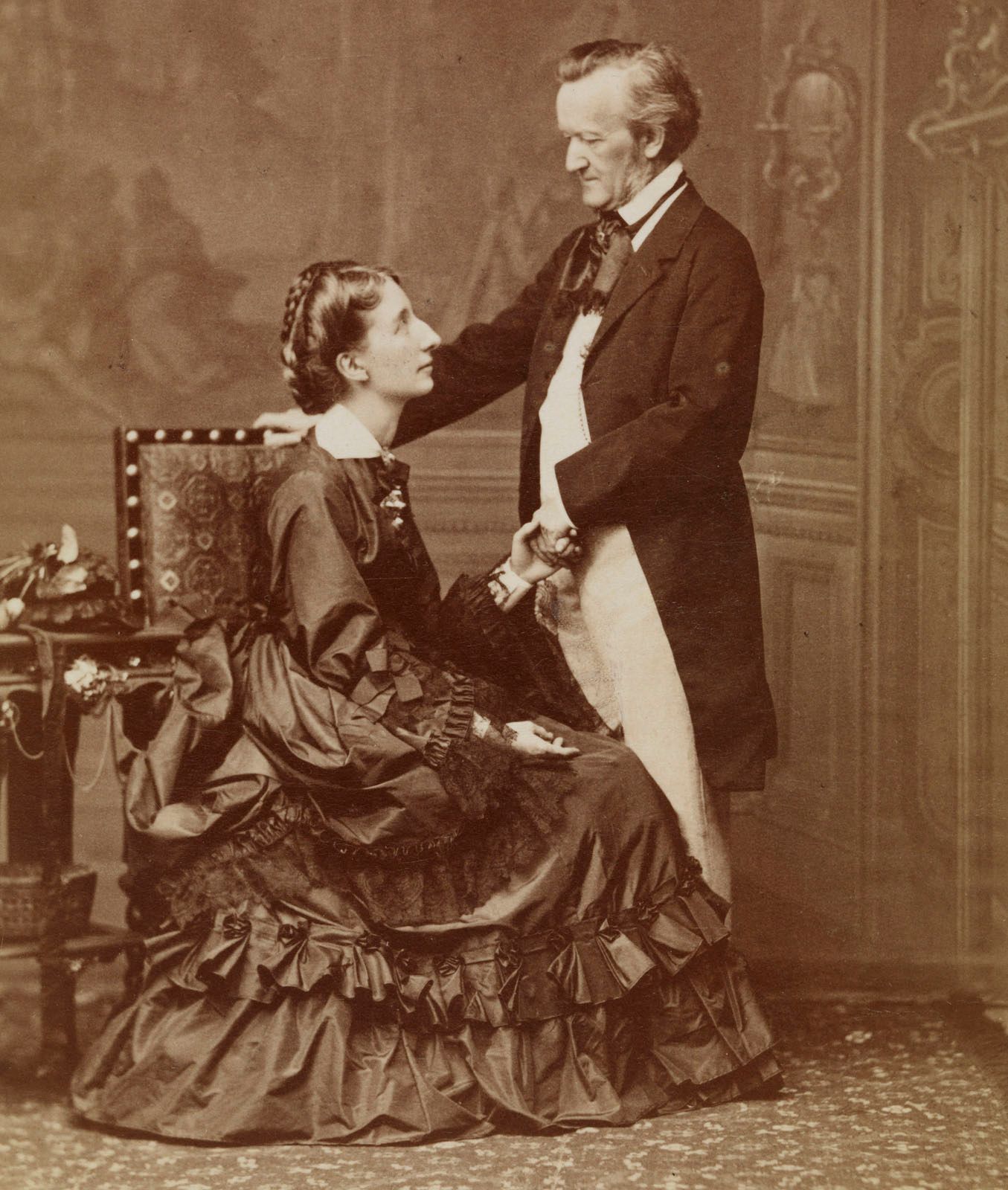
Cosima Wagner
German composerWikipedia
79
MENTIONS
6
EPISODES
6
PODCASTS
Search complete. 79 mentions across 6 episodes found for "Cosima Wagner".
Oct 28, 2026

speaker_1NARRATOR
It had harbored Goethe and Schiller and been sanctified in the young musician's sight by the labors of Liszt.
speaker_1NARRATOR
his munich friend the tenor heinrich zeller who had coached wagner rolls with him had settled there and a young soprano pauline de anha the daughter of a bavarian general with strong musical enthusiasm soon followed him in proper course she was to become richard strauss's wife a high-spirited outspoken lady never disposed to mince words a source of innumerable yarns and witticisms and who saw to it that her celebrated husband carefully towed the mark pauline strauss was in every way a chapter by herself and when not very long after his death she followed him to the grave it seemed only a benign provision of fate that she should not too long survive him strauss almost instantly infused a new blood into the artistic life of weimar where he settled in eighteen eighty nine and remained till eighteen ninety four the worthy old court kapellmeister edward lassen was sensible enough to allow his energetic new associate complete freedom of action true the artistic means at his disposal were relatively modest and at first they might well have given the ambitious newcomer pause the orchestra then contained only six first violins there was a painfully superannuated little chorus and most of the leading singers had seen better days but the conductor from munich was disturbed by none of these apparent handicaps in bayreuth he had already learned the proper way of producing wagner and even when the means were limited he tolerated no concessions all wagnerian performances had to be done without cuts or at least with a minimum of curtailments a wisecrack began to go the rounds what is richard strauss doing to which the reply was strauss is opening cuts the mouldy old settings were replaced by new ones and once when there was insufficient funds to buy new stage appointments strauss approached the grand duke with the plea that he might lay out of his own pocket a thousand marks to freshen the settings to the credit of the ruler it should be told that he refused the offer and disbursed the sum himself but strauss's reforms were far from ending there he once confessed that in his comprehensive job he was not only conductor but coach scene painter stage manager and tailor in short a thorough-going he threw himself heart and soul into the job so much so that in spite of a small stage and limited means he produced in the presence of none other than cosima wagner a lohengrin that deeply gripped her he had symphonic concerts as well as operas to occupy him at one of the former he transported his hearers with the world premiere of his don juan the date deserves to be noted november eleventh eighteen eighty nine that same year he had composed another tone poem death and transfiguration and on june twenty one eighteen eighty nine he permitted an audience in nearby eisenach to hear it the work is programme music if you will but the idea that it originally set out to illustrate the poem about the man dying in a necessitous little room and after his death struggles translated to supernal glories is wrong moreover the long-accepted notion that the music is based on lines by alexander ritter is fallacious for in the first place the composer did not aim to illustrate his friend's word picture and in the second ritter wrote the poem only after becoming acquainted with the score this is what explains a certain incongruity between ritter's verses and the tones which in reality were never conceived in slavish illustration of them hanslick wrong as usual was to write misleadingly once again a previously printed poem makes it certain that the listener cannot go awry for the music follows this poetic programme step by step quite as in a ballet scenario and he spoke of the score as a gruesome combat of dissonances in which the wood-wind howls in runs of chromatic thirds while the brass growls and all the strings rage by this time accustomed to such critical nonsense the composer did not suffer himself to be troubled what disturbed him much more was that his old champion von beulau gave indications of no longer seeing eye to eye with him at beulau's suggestion strauss had revised and newly instrumented macbeth but the piece was to continue a step-child soon he was increasing his output of songs and enriching leader singers with such treasures as rua maenzela cecilie heimliche auforderung and morgan while only a few short years ahead lay traum durch die dämmerung nachtsgesang and schlagende herzen to delight nearly two generations of recitalists strauss had always been blessed with a robust health unlike wagner for instance he never suffered from exacerbated nerves and violent extremes of unbalanced mood but at the period of which we speak he did experience one of his rare periods of illness what between his guest engagements his rehearsals the strain of composing attending to details of publication and myriad other obligations of a travelling conductor and virtuoso he came down in may eighteen ninety one with a menacing grip which sent him to bed and threatened serious complications he was resigned to anything even if he did confess dying would not be in itself so bad but first i should like to be able to conduct he recovered and had his wish in eighteen ninety two but in the summer he was sick once more this time with pneumonia now it looked as if one lung were seriously threatened he was granted the vacation he requested from november eighteen ninety two to july of the succeeding year taking some works and sketches he started on the advice of his physicians for the south the convalescent with a finished opera libretto in his baggage went to repair his health in italy greece and egypt in egypt he recovered completely in the anhalter railway station berlin he was to see for the last time the mortally sick von bulow likewise journeying to egypt in a last effort to repair his shattered constitution poor bulow was not to survive the trip the wiry frame of strauss helped him over any threat of tuberculosis and not only defied any peril to his lungs but seemed actually to renew his creative powers the libretto which occupied his attention was that of his opera guntram the first and least known of his productions for the lyric stage Guthrum is without question a stiefkind among Richard Strauss's operas.
speaker_1NARRATOR
The average Strauss enthusiast's acquaintance with its music may be said to be confined to the brief phrase from it cited in the section called The Hero's Works of Peace in the tone poem Ein Heldenleben.
speaker_1NARRATOR
Nevertheless, the opera cost the composer six long years of his time.
17 MINS LATER
speaker_1NARRATOR
Nevertheless, Wilhelm II remarked to Hülsen, I am sorry that Strauss composed this Salome.
speaker_1NARRATOR
I like him, but he is going to do himself terrible harm with it.
speaker_1NARRATOR
at the dress rehearsal the famous high b flat of the double basses so filled count seebeck with the fear of an outbreak of hilarity that he prevailed upon the player of the english horn to mitigate the effect somewhat by means of a sustained b flat on that instrument strauss's own father hearing his son play a portion of the opera on the piano exclaimed a short time before his death my god this nervous music it is as if beetles were crawling about in one's clothing and Cosima Wagner declared after listening to the closing scene, This is madness! The clergy, too, was up in arms, and the first performance at the Vienna State Opera in October 1918 took place only after an agitated exchange of letters with Archbishop Piffel.
speaker_1NARRATOR
The Orchestra of Salome, in all numbers 112 players, Strauss, however, eventually arranged the opera for fewer players, and Villechoux tells of the composer having conducted it in Innsbruck with an orchestra of only fifty-six players, winds in twos, but highly efficient solo instrumentalists.

NessHOST
She becomes quite touching.
NessHOST
She stands naked before him." The woman, Kasama, who Nietzsche has one-itis for, makes herself vulnerable to Wagner in a way that makes her even more attractive to Nietzsche because Contra, the modern feminist, boss babe, girl power tripe, vulnerability and tenderness are two of the most attractive, non-physical characteristics women can possess.
NessHOST
And so Kasama makes herself vulnerable to Wagner in a way that makes her even more attractive to Nietzsche, and yet she despises Nietzsche while throwing herself at Wagner's mercy.
NessHOST
And Nietzsche is criticizing Wagner for all of this.
NessHOST
It's so gamma-coded, it is like I said before, it's almost comical, almost beyond parody.
NessHOST
And yet Nietzsche isn't evidencing any hatred for the game.
NessHOST
He is hating the player for being good at the game.
NessHOST
He's getting mad at Wagner for Kasama being attracted to Wagner and not to Nietzsche.

Charles OwenGUEST
And this turned, as so many have, to the spiritual comfort and rigour of J.S. Bach's music.
Charles OwenGUEST
in 1862 when he lost his daughter, Blandine, very young.
Charles OwenGUEST
He was totally bereft.
Charles OwenGUEST
He had three children.
Damian ThompsonHOST
of course, Bach was a Protestant and Liszt was a Catholic.
Damian ThompsonHOST
And this was a period still in the 19th century when the gulf between Catholics and Protestants was very considerable, particularly in German-speaking countries.
Damian ThompsonHOST
And yet, well, perhaps it's an illustration of it, but when Liszt's daughter, Cosima, married for the second time Richard Wagner, Wagner made her convert to Lutheranism.
Damian ThompsonHOST
And

Martha WellerNARRATOR
He had died some hours before.
Martha WellerNARRATOR
He was buried in London, but when later Wagner became director of music at Dresden, he obtained permission for Weber's remains to be brought back to Dresden, and the singers who had so often sung under Weber's direction sang over his grave.
Martha WellerNARRATOR
To Wagner and the other great musicians who came after him, Weber has always seemed an embodiment of what is best in the spirit of Germany of his time.
Martha WellerNARRATOR
When he lived, Italian opera was still the most admired, and there was very little German opera.
Martha WellerNARRATOR
Weber knew that in Italian opera, the secret was in the actual singing and in the wonderful and complicated arias which needed great vocal execution and skill.
29 MINS LATER
Martha WellerNARRATOR
Chapter 19, Berlioz.
Martha WellerNARRATOR
Beethoven died in 1827, and it was during the last part of his life, the beginning of the 19th century, that a number of musicians were growing up who are all now famous.
Martha WellerNARRATOR
Berlioz, Chopin, Mendelssohn, Schumann, Liszt, and Wagner were all born within 10 years of each other, and each is now well known to all lovers of music.

David WalesNARRATOR
The lofty walls are hung with portraits.
David WalesNARRATOR
Here his mother, there his wife Cosima, his patron King Ludwig, his friend Liszt, his idol Beethoven, Schiller and Goethe and Schopenhauer, and others endeared to him by intellect or friendship.
David WalesNARRATOR
A splendid Steinway grand piano occupies one corner of the room, and mention must not be omitted of a magnificent dog which lies stretched in sympathetic silence at his master's feet.
David WalesNARRATOR
For Wagner, whether he walks or writes or rests, is never unaccompanied by a dog, and he insists that his beloved Peps helped him to compose Tannhäuser by howling most vociferously with his eyes peering deep into his master's whenever the music went against the grain with him.
18 MINS LATER
David WalesNARRATOR
But now the morning has reached the hour of twelve, and the composer's long isolation is ended.
David WalesNARRATOR
His wife comes in, taking it for granted that he has worked long enough, and sits down to tell him the news of the day, to read his letters aloud to him, to listen to his enthusiastic projects, and write at his dictation some of the enormous multiplicity of letters which must be dispatched.
David WalesNARRATOR
Cosima Wagner, the daughter of Liszt, is a perfect wife for the eccentric musician, whose first marriage was in all respects unhappy.
David WalesNARRATOR
She almost worships her husband, and delights to serve and wait upon his smallest wishes.