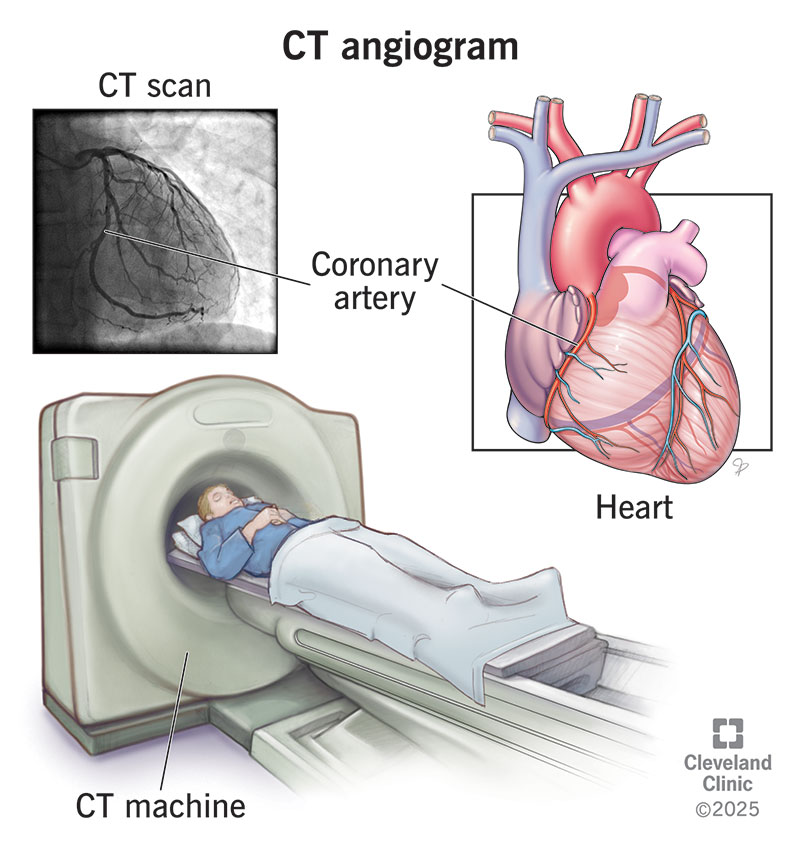
Coronary CT angiography
Diagnostic assessmentWikipedia
94
MENTIONS
27
EPISODES
23
PODCASTS
Search complete. 94 mentions across 27 episodes found for "Coronary CT angiography".
Sep 14, 2026

Anthony G. JayGUEST
So you have to take things more serious and so I kind of, I kinda separate it by the, by the CAC scan.
Anthony G. JayGUEST
And the problem with the angiograms, you know, the CCTA scans, the soft plaque measurements, they're ridiculously variable when doctors are interpreting them.
Brian LenzkesHOST
Yeah.
Anthony G. JayGUEST
If you give-- They did a study where they gave, uh, several professional CCTA readers, they gave different doctors the same exact scan, and they got 30% variability between the doctors.
Brian LenzkesHOST
Yeah.
Anthony G. JayGUEST
So, like, sometimes they tell you you have 50% plaque, but then you only have 20% plaque, or you have 80% plaque.
Anthony G. JayGUEST
So I-
Brian LenzkesHOST
Yeah, so man, 'cause-

Dinesh KalraGUEST
And so if you have this sense that somebody has a very strong family history of very high LP little A, you know, that's, that's a place where you can consider it.
Dinesh KalraGUEST
They don't recommend it across the board, but it's selective use and may be considered, recognizing that as of today, doing a coronary CT and seeing plaque has not been shown to affect downstream outcomes.
Dinesh KalraGUEST
It's the same concept.
Dinesh KalraGUEST
If you see a lot of plaque, we know that patients will take therapy, you're more impelled to prescribe aggressive therapy, but that link between doing a CT and reducing MIs is yet unproven.

Lily JohnstonHOST
Right.
Lily JohnstonHOST
I mean, and that's, that's a key feature of all the regression trials that have been done since the early 2000s, right? Whether it's intravascular ultrasound, IVUS, whether it's CCTA or other technologies, we are always seeing some regression, regression even in a control group, right? Even in an untreated or a minimally treated group who's not at whatever goal, usually a lipid goal, we see regression, and that's partly measurement, partly it may be biology or control of other risk factors, right? We, we acknowledge that.
Dave FeldmanGUEST
But just to put a bow in this, as you saw in the Cholesterol Code documentary, we were interviewing doctors, not just like Brett Sher, but for example, Dr. William Cromwell, who I was posing that question, "If we see regression, regression in this cohort, particularly confirmed regression, would that be a big deal?" And I think it absolutely is a big deal because it wouldn't be expected given how high the LDL and ApoB levels are.
Lily JohnstonHOST
Maybe.
Lily JohnstonHOST
I mean, originally, yes.
Lily JohnstonHOST
I mean, that's how the original validation was done.
Lily JohnstonHOST
It's important to make note that the original validation for CCTA and the AI tools was done largely in a clinical cohort, right? So people who had- More plaque volume because they had chest pain, because they had a heart attack, right? They- this was done mostly in patients who were getting IVUS, meaning an invasive angiographic procedure where they're inside the blood vessels in the heart.
Lily JohnstonHOST
You don't do that for somebody who doesn't need a cath.

Cynthia ThurlowHOST
And a 2025 Lancet Commission is rethinking coronary artery disease early detection should focus on non-calcified plaque, the soft stuff, meaning calcium scoring isn't the ideal early detection tool, and it performs especially poorly under the age of 40.
Cynthia ThurlowHOST
So this is why I think when we're really looking to screen, we have to be thinking about coronary CT angiography or CCTA, which images both calcified and non-calcified plaque.
Cynthia ThurlowHOST
It shows the severity of narrowing and high-risk plaque features.
Cynthia ThurlowHOST
Its accuracy for detecting obstructive disease is 81.1% versus 68.8% for a calcium score alone, and it isn't thrown off by a heavy calcium burden.
Cynthia ThurlowHOST
The strongest outcomes come from Scott Hart's 10-year follow-up.
Cynthia ThurlowHOST
It looked at the CCTA, which is the coronary angiography-guided care, lowered coronary death or non-fatal heart attack from 8.2% to 6.6%, non-fatal heart attack 6.0% to 4.3%, and major cardiac events from 10.3% to 8.3%.
Cynthia ThurlowHOST
That benefit wasn't from doing more procedures.
Cynthia ThurlowHOST
This is what's significant.

Anthony JayGUEST
Most people don't realize that.
Anthony JayGUEST
But the tool that you can use to measure soft plaque is called CCTA.
Anthony JayGUEST
So the first one starts with a C, the second one starts with a C. CAC is the hard plaque, CCTA, it's called angiograms.
Anthony JayGUEST
Again, just think of it as CCTA or angiogram.
Anthony JayGUEST
I'll use the terms interchangeably because they're interchangeable.
Anthony JayGUEST
So an angiogram has five times more radiation than a CAC.
Anthony JayGUEST
It's not that big of a deal.
Anthony JayGUEST
And you can compare those.

Abeer BerryGUEST
It's called the REACT Trial, where they did a study just looking-- It was a, it was a-- people who don't have underlying heart disease, but they looked at cor- 17,000 people in Europe, right? Technically, they have better diets than we do.
Abeer BerryGUEST
Coronary CTA, so they're looking at the arteries through their CAT scan of their heart.
Abeer BerryGUEST
They looked at ultrasounds of the arteries of the groin, and they looked at carotid ultrasound arteries, and they found that 58% of these people had underlying plaque formation, atherosclerosis.
Abeer BerryGUEST
And the more interesting part was 10% of the population that was between the age of 17 to 29 had plaque buildup.
5 MINS LATER
Abeer BerryGUEST
And ultimately, atherosclerosis, plaque formation, you know, it can start within the arterial wall lining.
Abeer BerryGUEST
Uh, I had a patient once who was a smoker, had high cholesterol, didn't want to take his medications, had a cor- He had some chest pain.
Abeer BerryGUEST
He ended up with a coronary CTA.
Abeer BerryGUEST
So a coronary CTA goes past the calcium score.

Felix MahfoudGUEST
That also provides clinically relevant information to patients, I guess.
Felix MahfoudGUEST
And lastly, I think another important study that has been presented is the use of coronary CT in patients presenting with chest pain where an acute coronary syndrome has been ruled out.
Felix MahfoudGUEST
More than 3,000 patients included in this study.
Felix MahfoudGUEST
And the addition of a CT to guide secondary prevention did not result in an improvement in outcome, so I think that's an important statement, too.

Sarah KleinerHOST
Oh, yeah
Anthony JayGUEST
... cholesterol-- His total was over 700 for the past seven years, and he did a CAC scan of his arteries, a scan to see if he has plaque in his arteries, and he did a CCTA scan.
Anthony JayGUEST
Both-- He did both types of scans, and both of them show zero plaque in his arteries-
Sarah KleinerHOST
Wow
Sarah KleinerHOST
Yeah.
Anthony JayGUEST
And there's no interpretation from the doctors.
Anthony JayGUEST
I do not like the CCTA scan, the one that's-- measures hard and soft plaque, and it's because there's huge variability between the different scans.
Anthony JayGUEST
Like, here's the problem.

Jaime HopeGUEST
And what I love about perimenopause and menopause, because it's a known time that your cardiovascular health decreases because we're losing that protection.
Jaime HopeGUEST
It's a time to get a set point, just like you would get a mammogram, get your cardiac scan, get your CCTA and know your soft plaque versus hard plaque in your heart.
Jaime HopeGUEST
So then you know what intervention is specific.
Jaime HopeGUEST
What your intervention would be will be different than my intervention.
Jaime HopeGUEST
Stress tests and just the calcium scoring scan, they give you some information, but not enough.
Jaime HopeGUEST
You can still ride around on a horse to get to work every day, but you can get there faster in a car.
Jaime HopeGUEST
So as the technology improves, why not give yourself the most information? And quite frankly, something like a CCTA, which is a specific type of CAT scan that looks...
Jaime HopeGUEST
It actually...

James ThompsonGUEST
But I want people to know that you can still have disease before it shows up as calcium.
James ThompsonGUEST
And I think the best way to understand this is to understand where CT, the other test, the cardiac or coronary CTA, became a class A1 indication in chest pain guidelines.
James ThompsonGUEST
How did that happen? Well, we first saw CT show up in guidelines in Europe, in England, right, in the UK.
James ThompsonGUEST
So they have NICE guidelines.
James ThompsonGUEST
Correct.
James ThompsonGUEST
Yes.
James ThompsonGUEST
So a CTA or a cardiac or coronary CTA, different from a calcium score, will identify all plaque on or inside the vessel, because this plaque even forms before it starts to even narrow the vessel.
James ThompsonGUEST
So that plaque comes in basically two forms.
17 more episodes mention Coronary CT angiography.
Create an account to see the whole feed, search across every transcript, and follow the entities you care about.