Copernican heliocentrism
79
MENTIONS
24
EPISODES
21
PODCASTS
Search complete. 79 mentions across 24 episodes found for "Copernican heliocentrism".
Nov 4, 2026

Blaise Agüera y ArcasGUEST
It's a trauma.
Blaise Agüera y ArcasGUEST
This has been called a Copernican trauma.
Blaise Agüera y ArcasGUEST
And as you've cited a couple of really good ones, like Freud talked about this as well.
Blaise Agüera y ArcasGUEST
I think he was kind of a schmuck, but he got that one right.

speaker_5NARRATOR
such ideas sound to us grotesque but imagine no tracts made for us by scientific ancestors and what aspects would we single out from nature to understand things by not till the beginning of the seventeenth century did the more insipid kinds of regularity in things abstract men's attention away from the properties originally picked out Few of us realize how short the career of what we know as science has been.
speaker_5NARRATOR
350 years ago, hardly anyone believed in the Copernican planetary theory.
speaker_5NARRATOR
Optical combinations were not discovered.
speaker_5NARRATOR
The circulation of the blood, the weight of air, the conduction of heat, the laws of motion were unknown.
speaker_15NARRATOR
Yet, as the popular mind gradually accepts and adapts itself to the novel conception, we generally find that its influence is even more far-reaching than was at first anticipated.
speaker_15NARRATOR
In the case of the Copernican theory, it took about two centuries for the controversy to pass through the three stages, and the mind of the public to become readjusted to the new conception of the earth's revolution.
speaker_15NARRATOR
In the case of the Darwinian theory of evolution, the process was accomplished in about fifty years.
speaker_15NARRATOR
The Einstein theory is more subversive of ordinary ideas than either of the others.

Tim MendhamGUEST
This is actually seen as being something of the move towards Copernicus.
Tim MendhamGUEST
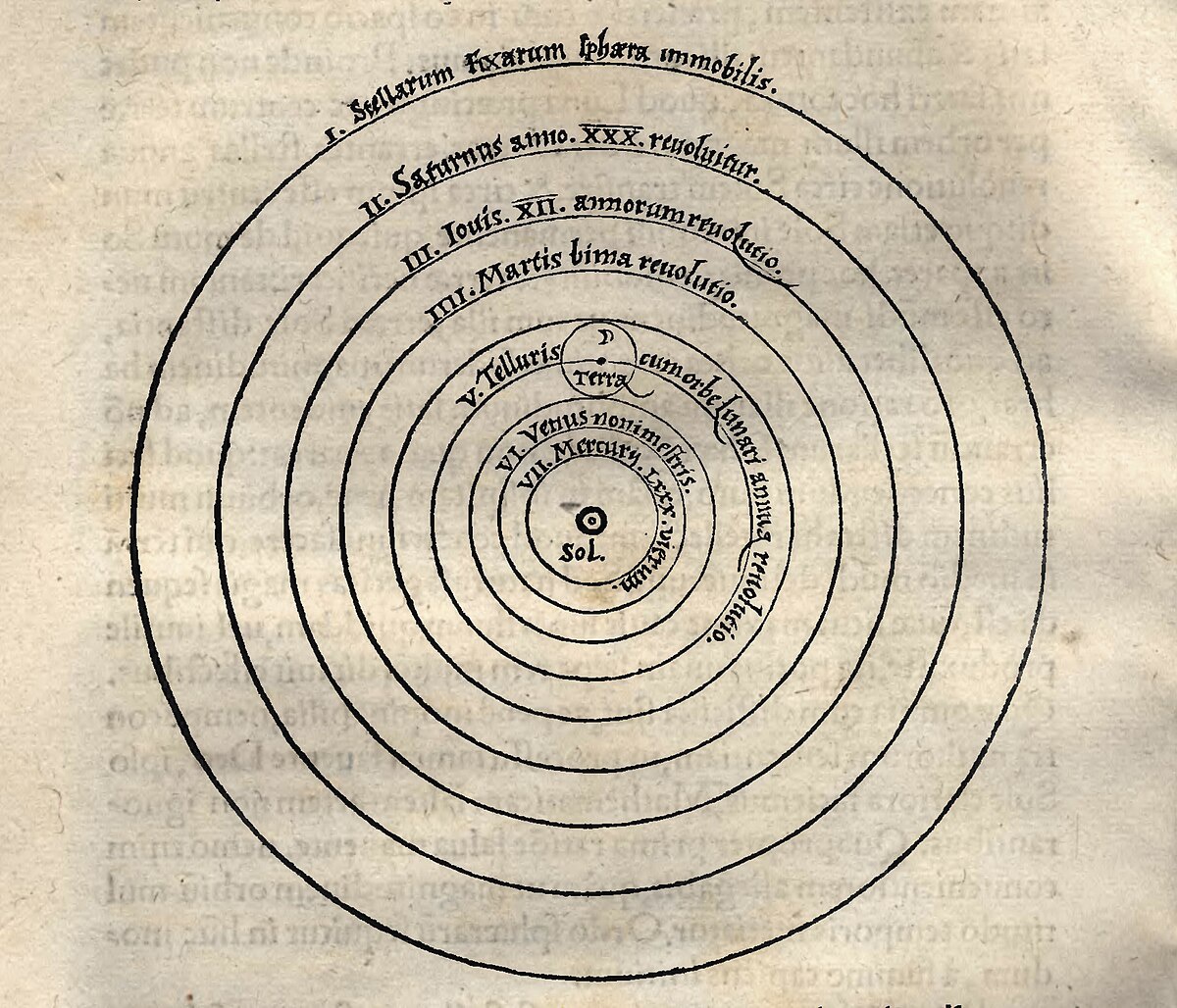
This is often because of the change of the view about astronomy in this time from a geocentric, Ptolemaic view of the solar system that the Earth is in the middle and everything else revolves around the Earth, to the Copernican view, which he wasn't the first, etc., but others had suggested it, but he was perhaps the most famous, suggesting that, no, the Earth is not in the middle, the Sun is, and all the planets, all these bodies, planets meaning wanderers, because they go back and forth in the sky, the night sky, revolve around the Sun.
Tim MendhamGUEST
And they obviously knew about, was it Mercury, Venus, Earth, Mars, Jupiter and Saturn.
Tim MendhamGUEST
They were known.

Adam KirschGUEST
All of that shattered the idea that there's something special about the Earth, something special about humanity, that we are unique.
Adam KirschGUEST
And it gave rise to this new way of thinking, which can be called the mediocrity principle, or sometimes people call it Copernicanism, because Nicholas Copernicus was the astronomer who first discovered that the Earth revolves around the sun, not the other way around.
Adam KirschGUEST
And both of those are just ways of saying there's nothing special about Earth.
Adam KirschGUEST
So in our solar system for a long time, lots of scientific thinking people, the most advanced progressive people in the 17th, 18th, 19th centuries, they all assumed that if we could ever go to other planets, we would find other living species on those planets.

Marianne SpiegelNARRATOR
It remained only as a geometrical conception, whereon we find it convenient to indicate the places of the stars.
Marianne SpiegelNARRATOR
Once the Copernican doctrine had been fully set forth, it was impossible for anyone who had both the inclination and the capacity to understand it to withhold acceptance of its truth.
Marianne SpiegelNARRATOR
The doctrine of a stationary earth had gone forever.
Marianne SpiegelNARRATOR
Copernicus, having established a theory of celestial movements which deliberately set aside the stability of the earth, it seemed natural that he should inquire whether the doctrine of a moving earth might not remove the difficulties presented in other celestial phenomena.
Marianne SpiegelNARRATOR
We have already remarked that Mars, though generally advancing from west to east among the stars, occasionally pauses, retraces his steps for a while, again pauses, and then resumes his ordinary onward progress.
Marianne SpiegelNARRATOR
Copernicus showed clearly how this effect was produced by the real motion of the Earth combined with the real motion of Mars.
Marianne SpiegelNARRATOR
In the adjoining figure, we represent a portion of the circular tracks in which the Earth and Mars move in accordance with the Copernican doctrine.
Marianne SpiegelNARRATOR
I show particularly the case where the Earth comes directly between the planet and the sun because it is on such occasions that the retrograde movement, for so this backward movement of Mars is termed, is at its highest.

Paul FryHOST
It makes better poetry, and whereas we all know that that the universe is of a certain kind.
Paul FryHOST
We can't even call it Copernican anymore.
Paul FryHOST
Poetry has this odd preference for Ptolemaic astronomy.
Paul FryHOST
In other words, everything about poetry is atavistic.

Darryl CooperGUEST
Doesn't he talk about, I can't remember if this was from Kuhn himself or if it's just something that, uh, I thought of while reading it or, or read when I was reading about him.
Darryl CooperGUEST
Um, he specifically, uh, with like the, the Ptolemaic versus Copernican, um, a strong astronomical mental models, uh, or paradigms rather, um, uh, As data starts to accumulate, that kind of lets people know there's something wrong with the Ptolemaic model, like there's some problem here because we can't account for all of these things that we're beginning to be able to measure and that we're seeing.
Darryl CooperGUEST
There's going to be quite a period of time where first, just because you have that accumulation of data that doesn't fit, you don't have a better model to replace the old one with.
Darryl CooperGUEST
And then even once you do, there was a period of time after the Copernican model was sort of it was out there for everybody that the Ptolemaic model was still able to actually help people navigate more accurately for quite some time than the Copernican model, like a lot of different things that it's still explained better because the Copernican model wasn't fleshed out yet.
Darryl CooperGUEST
And so that's like a big part of the resistance to change as well.
Darryl CooperGUEST
Like you really do have to, you see this, you know, to come back to the military aspect.
Darryl CooperGUEST
And, you know, if you didn't have a Internet connection or a television, you could very plausibly not even know we were at war.
Darryl CooperGUEST
You know, there's very, very, very little direct consequence that sort of stimulates that learning process.

Darryl CooperGUEST
Doesn't he talk about, I can't remember if this was from Kuhn himself or if it's just something that, uh, I thought of while reading it or, or read when I was reading about him.
Darryl CooperGUEST
Um, he specifically, uh, with like the, the Ptolemaic versus Copernican, um, a strong astronomical mental models, uh, or paradigms rather, um, uh, as data starts to accumulate, that kind of lets people know there's something wrong with the Ptolemaic model, like there's some problem here because we can't account for all of these things that we're beginning to be able to measure and that we're seeing.
Darryl CooperGUEST
there's going to be quite a period of time where first, just because you have that accumulation of data that doesn't fit, you don't have a better model to replace the old one with.
Darryl CooperGUEST
And then even once you do, like there was a period of time after the Copernican model was sort of, it was out there for everybody that the Ptolemaic model was still able to actually help people navigate more accurately for quite some time than the Copernican model, like a lot of different things that it's still explained better because the Copernican model wasn't fleshed out yet.
Darryl CooperGUEST
And so that's like a big part of the resistance to change as well.
Darryl CooperGUEST
Like you really do have to, you see this, you know, to come back to the military aspect.
Darryl CooperGUEST
And, you know, if you didn't have a Internet connection or a television, you could very plausibly not even know we were at war.
Darryl CooperGUEST
You know, there's very, very, very little direct consequence that sort of stimulates that learning process.

William StickeversGUEST
You have all these different groups, right? And they're also created in the image of God.
William StickeversGUEST
So we're going to have a 50 centering and then a 60 centering like we had during the Copernican and Darwinian revolution.
William StickeversGUEST
That man was no longer created.
William StickeversGUEST
He was like the animals.
14 more episodes mention Copernican heliocentrism.
Create an account to see the whole feed, search across every transcript, and follow the entities you care about.