Copenhagen interpretation
44
MENTIONS
16
EPISODES
16
PODCASTS
Search complete. 44 mentions across 16 episodes found for "Copenhagen interpretation".
Sep 21, 2026

speaker_1HOST
I prefer to call it the ghost in the equations.
speaker_1HOST
It has been sitting like a live grenade in the center of quantum mechanics since Niels Bohr and Werner Heisenberg first argued about the Copenhagen Interpretation in 1927.
speaker_0HOST
I've heard the term Schrodinger equation thrown around a lot.
speaker_0HOST
That is the fundamental math that describes how these quantum probability waves move through space, right?

Charles LiuGUEST
But before something is measured, we actually don't have a mathematical certainty that that's what it is.
Charles LiuGUEST
And so the extension into this many worlds interpretation, which is the opposite of that, uh, everything becomes concrete interpretation, that's called the Copenhagen.
Charles LiuGUEST
You mentioned the Copenhagen interpretation, right, Chuck? The, this multiverse-
Neil deGrasse TysonHOST
You said many worlds.
Charles LiuGUEST
This-

Steve StrogatzHOST
I'm not so sure it's totally been put to bed, though.
Steve StrogatzHOST
What you're talking about is what used to be called the Copenhagen interpretation, right?
Jonathan HalliwellGUEST
Yeah.
Steve StrogatzHOST
From Niels Bohr and his school.
Steve StrogatzHOST
It's out there still.
Jonathan HalliwellGUEST
It's still an issue.
Jonathan HalliwellGUEST
I think the Copenhagen interpretation and the many worlds interpretation are still out there.
Jonathan HalliwellGUEST
I think decoherent histories is maybe an alternative to both.

speaker_0HOST
You have these brilliant minds, uh, Werner Heisenberg, Pascual Jordan, John von Neumann.
speaker_1HOST
And they were desperately trying to pin down the math of the Copenhagen interpretation.
speaker_1HOST
Heisenberg had this idea of representing physical observables like momentum or position as matrices.
speaker_0HOST
Because in quantum mechanics, things aren't just a single solid number anymore.

Julian DoreyHOST
Mm.
Alex O'ConnorGUEST
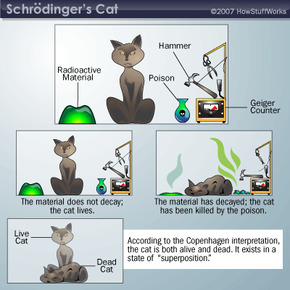
That doesn't make any sense." So that's what Schrödinger's cat is supposed to, is supposed to demonstrate, and the interpretation of quantum mechanics that this relies upon is called the Copenhagen interpretation.
Alex O'ConnorGUEST
And as I said to David Deutsch, and apparently he said that he's been using this ever since.
Alex O'ConnorGUEST
I said, "You can't spell the Copenhagen interpretation without cope."
Julian DoreyHOST
[laughs]
Alex O'ConnorGUEST
Which apparently he's picked up on and started using, so I'm quite proud of that one.

speaker_1HOST
But Niels Bohr, one of the brilliant founding fathers of quantum mechanics, looked at the double slit experiment and basically said the universe is playing peekaboo with us.
speaker_1HOST
His interpretation of the math, known as the Copenhagen interpretation, argued that before you measure a particle, it truly does not have a defined property.
DavidHOST
It exists only as a fuzzy superposition, a mixture of all possible states.
DavidHOST
The act of measurement is what forces reality to exist.
speaker_1HOST
Okay, so they fly apart.
speaker_1HOST
One goes to Earth, one goes to Mars.
speaker_1HOST
According to Bohr in the Copenhagen camp, neither particle has actually chosen a spin direction yet.
speaker_1HOST
Because they haven't been measured, they are both existing in a blurry superposition of being both up and down simultaneously.

Robert WilesGUEST
The next question is about quantum mechanics.
Robert WilesGUEST
And in the 1930s, Niels Bohr championed a thing called the Copenhagen model of quantum mechanics, which said that it doesn't matter what the theory says.
Robert WilesGUEST
If it works, just do it.
Robert WilesGUEST
The mathematics is all you need.
Robert WilesGUEST
And that Einstein said, I like to think the moon's there when I'm not looking because...
Robert WilesGUEST
Bohr said, well, so what? And the answer is, well, the moon's still real, even if you're not looking at it.
Robert WilesGUEST
But in the Copenhagen model, it isn't necessarily.
Robert WilesGUEST
Then in the 50s along came another one, the many worlds.

Tom LinGUEST
Yeah, that's a great question.
Tom LinGUEST
So the machine itself is kind of a takeoff of this popular thought experiment called quantum suicide, which itself is a kind of derivation of the Copenhagen interpretation or the many worlds interpretation of quantum equations, which is that if you look at the math, a valid interpretation of Essentially, you're looking at just a system of equations.
Tom LinGUEST
One valid interpretation is that nothing ever happens for real.
Tom LinGUEST
It just seems to happen for you.

David KippingHOST
Indeed, we call this the wave function, first written down by Erwin Schrödinger a hundred years ago.
David KippingHOST
But the real question is, how does this quantum wave-like state suddenly transition into the more familiar classical particle-like behavior post-measurement? For decades, the dominant view has been the Copenhagen interpretation.
David KippingHOST
That is that these superposition states persist until they are observed, at which point they collapse down into a single sharp state with a probability given by the Born rule.
David KippingHOST
That is a probability given by the square of the wave function.
David KippingHOST
Now, after the critical moment passes, the electron can be described as being in a superposition of both states.
David KippingHOST
And since the measurement device is entangled with this quantum system, then so too must be the cat existing in a bizarre superposition of being both dead and alive.
David KippingHOST
Wave function collapse, via the Copenhagen interpretation, at first seems to resolve this paradox, but it comes with many problems.
David KippingHOST
For example, why is it that the observer, be it a stray photon, or the cat, or indeed we who open the box, are allowed to be considered somehow distinct classical entities, whereas the electron has to be considered quantum? Surely everything deep down is truly quantum.

AnastasiaGUEST
No, I think that...
Steve PattersonHOST
Does that make sense? Would this be a paradox resolver? Oh, well, the reason the Copenhagen interpretation pops out weird things is because there's actually some higher dimensional thing that's doing something and we're just seeing the projection of it in lower dimensional space.
AnastasiaGUEST
Are you asking if that's what they thought? Or are you
Steve PattersonHOST
asking...
6 more episodes mention Copenhagen interpretation.
Create an account to see the whole feed, search across every transcript, and follow the entities you care about.