Constitution
19k
MENTIONS
6.5k
EPISODES
2.9k
PODCASTS
Search complete. 19369 mentions across 6486 episodes found for "Constitution".
Sep 15, 2026

Rebecca SchinskyHOST
Um, I'll start with one.
Rebecca SchinskyHOST
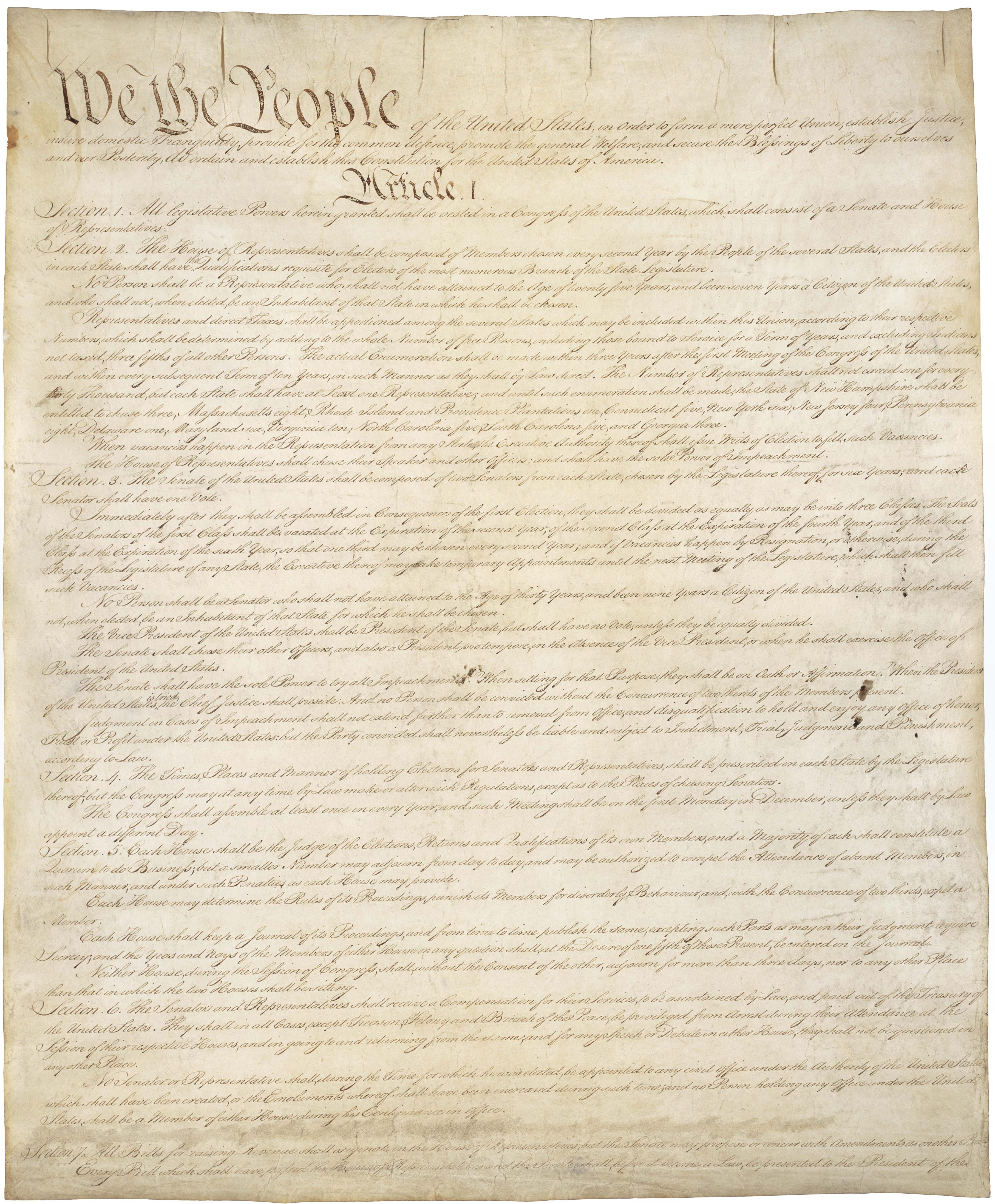
We- I talked about it, um, when Amanda Nelson was on the show, and we talked about the United States Constitution, but Melissa Murray, who's a constitutional law professor, one of the hosts of the Strict Scrutiny podcast, put out a great book earlier this summer called The US Constitution, and it is the full text of the Constitution broken down clause by clause into a plain text interpretation and a history of what were the framers solving for.
Rebecca SchinskyHOST
So much of it was their own very recent PTSD, uh, and a real, like, failure of imagination that we would still be using the Constitution in mostly its original form 250 years later.
Rebecca SchinskyHOST
Um, it was illuminating for me as a person who has, like, read the Constitution and pays attention to a lot of politics, but really to get into the details of, you know, what they were trying to address, what they were trying to set the new country up to do, and what they were trying to prevent.
Rebecca SchinskyHOST
That preventative part was so significant.
Rebecca SchinskyHOST
Um, I learned so much from it, and, uh, I think that having the, just the background of these, like, founding documents and-
30 MINS LATER
Jeff O'NeillHOST
Because even as I read it today, I'm still motivated by it.
Jeff O'NeillHOST
But how, you know, sort of the work of angels, Whitman's vision seems to me, rather than the work of man.

Carol OffGUEST
Sure.
Steve PaikinHOST
Eight years later, Brian Mulroney tried to do the same thing with the Meech Lake Constitutional Accord.
Steve PaikinHOST
Initially, he got everybody to sign on, but then of course, with the three-year period for each province to ratify, some provinces fell off, and in the end, it didn't happen.
Steve PaikinHOST
Should the Meech Lake Constitutional Accord, had you had a vote at the time, would you have voted yes or no to it?
Carol OffGUEST
Um, I would have voted no, but you s- you just said everyone had ratified it.
Carol OffGUEST
Well, first of all, everyone being what? The premiers?
Steve PaikinHOST
"An ele-" This is about the media coverage on CBC at the time.
Steve PaikinHOST
"An element of it all that I found bewildering was that some CBC broadcasts and broadcasters had quite early on abandoned neutrality to become players in the drama.

KoketsoAUDIENCE
The parliamentarians, Clement, do not catch enough heat for this.
KoketsoAUDIENCE
Uh, they are failing South Africans and, um, even what Doctor Sam was saying, this Constitution is perhaps also failing us.
KoketsoAUDIENCE
We need a referendum on making our laws stricter in terms of murder and rape, you know, and not leaving it to the discretion of judges.
KoketsoAUDIENCE
I think that's where we're going wrong with this.

Novella SerenaNARRATOR
Every preparation is made for a brief and successful fight for that supremacy in the government of this nation which is our birthright." Tremendous applause.
Novella SerenaNARRATOR
"By the election just thrust upon us by the Republican Party, the Constitution is violated; and were we not strong to sustain our rights, we should soon find ourselves driven to prison at the point of the bayonet." Cries of "Never, never." "Ousted from the council of state, oblivion everywhere, and nothing remaining but ourselves to represent truth and justice.
Novella SerenaNARRATOR
We believe that our ideas are the desires of the majority of the people, and the people represent the supreme and sovereign power of right." Hear, hear, and cheers.
Novella SerenaNARRATOR
"For Abraham Lincoln." Hisses.

John GreenmanNARRATOR
Let every American, every lover of liberty, every well-wisher to his posterity, swear by the blood of the revolution never to violate in the least particular the laws of the country, and never to tolerate their violation by others.
John GreenmanNARRATOR
As the patriots of seventy-six did to the support of the Declaration of Independence, so to the support of the Constitution and laws, let every American pledge his life, his property, and his sacred honor.
John GreenmanNARRATOR
Let every man remember that to violate the law is to trample on the blood of his father and to tear the character of his own and his children's liberty.
John GreenmanNARRATOR
Let reverence for the laws be breathed by every American mother to the lisping babe that prattles on her lap.
14 MINS LATER
John GreenmanNARRATOR
It will in future be our enemy.
John GreenmanNARRATOR
Reason, cold, calculating, unimpassioned reason, must furnish all the materials for our future support and defense.
John GreenmanNARRATOR
Let those materials be molded into general intelligence, sound morality, and, in particular, a reverence for the Constitution and laws And that we improved to the last; that we remained free to the last; that we revered his name to the last; that during his long sleep we permitted no hostile foot to pass over or desecrate his resting-place; shall be that which to learn the last trump shall awaken our Washington.
John GreenmanNARRATOR
Upon these let the proud fabric of freedom rest as the rock of its basis, and as truly has been said of the only greater institution, "The gates of hell shall not prevail against it." End of Abraham Lincoln's Lyceum Address Section two of Abraham Lincoln's Lyceum Address and Theodore Roosevelt's Introduction.

Hannah AdamsHOST
... like it ain't nobody's business? [laughs]
Emily Aleece BurtonHOST
So many people are just hung up on that someone deserves to be punished instead of looking at how the law works and how that, like so many people are so desperate to play God that they forget about how laws work, how the Constitution works.
Hannah AdamsHOST
Yeah.
Emily Aleece BurtonHOST
You are so hung up on wanting to be God and to punish people.

Robert H. CherneyNARRATOR
This word, which is original as applied to a political system, was first given to this form of confederation and is intended to express the greater intimacy of the relations of the parties than those of all previous examples.
Robert H. CherneyNARRATOR
It exists in the Constitution, however, only as it is used in setting forth the motives for substituting that instrument for the old articles of confederation, the Constitution being silent as to the particular polity of the country, except that it recognizes the general term of a republic.
Robert H. CherneyNARRATOR
The word Constitution, of itself, properly implies a more identified form of government than that which is usually understood to exist under a confederation; the first inferring a social compact, fundamental and predominant, the last a league between independent sovereignties.
Robert H. CherneyNARRATOR
These distinctions have a certain weight, though they are rather arbitrary than logical; since men may create any degree of allegiance, or of liability they may deem expedient, under any form or modes of government.
Robert H. CherneyNARRATOR
To deny this, is to deny to bodies of human beings the right of self-government, a gift of nature.
Robert H. CherneyNARRATOR
Though possessing a common end, governments are, in reality, subject to no laws but those of their own establishing.
Robert H. CherneyNARRATOR
The government of the United States was formed by the several States of the Union, as they existed at the period when the Constitution was adopted; and one of its leading principles is, that all power, which is not granted to the federal authority, remain in the States themselves, or, what is virtually the same thing, in the people of the States.
Robert H. CherneyNARRATOR
This principle follows as a necessary consequence from the nature of the grants to the federal government.

Nicholas CliffordNARRATOR
She was perhaps the only woman in New York who knew something of American history.
Nicholas CliffordNARRATOR
Certainly, she could not have repeated the list of presidents in their order, but she knew that the Constitution divided the government into executive, legislative, and judiciary.
Nicholas CliffordNARRATOR
She was aware that the president, the speaker, and the chief justice were important personages, and instinctively she wondered whether they might not solve her problem, whether they were the shade trees which she saw in her dreams.
Nicholas CliffordNARRATOR
Here then was the explanation of her restlessness, discontent, ambition, call it what you will.
31 MINS LATER
Nicholas CliffordNARRATOR
There are many men of fair abilities in public life, many more than there used to be, and there is sharper criticism and more of it." "Was I right in thinking that you have a strong resemblance to Daniel Webster in your way of speaking? You come from the same neighborhood, do you not?" Mrs.
Nicholas CliffordNARRATOR
Lee here hit on Radcliffe's weak point.
Nicholas CliffordNARRATOR
The outline of his head had, in fact, a certain resemblance to that of Webster, and he prided himself upon it and on a distant relationship to the expounder of the Constitution.
Nicholas CliffordNARRATOR
He began to think that Mrs. Lee was a very intelligent person.

Capriccia PaigeVOICE_ACTOR
Mr. Jefferson also is thought to favor Philadelphia for the capital.
Capriccia PaigeVOICE_ACTOR
And your father is as hot on this subject as he was on the Constitution.
Capriccia PaigeVOICE_ACTOR
My dear, you will find that society is torn in two by politics."
Tiffany Halla ColonnaNARRATOR
"But women have nothing to do with politics."

speaker_8ADVERTISER
Visit CoinStar.com to find a CoinStar kiosk near you today.
David WalesNARRATOR
the supreme court declared that marbury deserved his commission but that it could not grant it the reason was that the law saying the court could do this was contrary to the constitution and therefore invalid in the portion of the decision that follows chief justice marshall argues the principle that congress may not give powers not specifically authorized by the constitution to the courts or to anyone else excerpts from john marshall's decision the question whether an act repugnant opposed to the constitution can become the law of the land is a question deeply interesting to the united states but happily not of an intricacy proportioned to its interest it seems only necessary to recognize certain principles supposed to have been long and well established to decide it that the people have an original right to establish for their future government such principles as in their opinion shall most conduce to their own happiness is the basis on which the whole american fabric has been erected the exercise of this original right is a very great exertion nor can it nor ought it to be frequently repeated the principles therefore so established are deemed fundamental and as the authority from which they proceed is supreme and can seldom act they are designed to be permanent the original and supreme will organizes the government and assigns to different departments their respective powers it may either stop here or establish certain limits not to be transcended by those departments the government of the united states is of the latter description the powers of the legislature are defined and limited and that those limits may not be mistaken or forgotten the constitution is written to what purpose are powers limited and to what purpose is that limitation committed to writing if these limits may at any time be passed by those intended to be restrained the distinction between a government with limited and unlimited powers is abolished if those limits do not confine the persons on whom they are imposed and if acts prohibited and acts allowed are of equal obligation it is a proposition too plain to be contested that the constitution controls any legislative act repugnant to it or that the legislature may alter the constitution by an ordinary act between these alternatives there is no middle ground the constitution is either a superior paramount law unchangeable by ordinary means or it is on a level with ordinary legislative acts and like other acts is alterable when the legislature shall please to alter it if the former part of the alternative be true then a legislative act contrary to the constitution is not law if the latter part be true then written constitutions are absurd attempts on the part of the people to limit a power in its own nature illimitable certainly all those who have framed written constitutions contemplate them as forming the fundamental and paramount law of the nation and consequently the theory of every such government must be that an act of the legislature repugnant to the constitution is void marshall goes on to refute the argument that the supreme court should concern itself only with interpreting the law regardless of the constitution then he quotes specific passages from the constitution it is declared that no tax or duty shall be laid on articles exported from any state suppose a duty on the export of cotton of tobacco or of flour and a suit instituted to recover it ought judgment to be rendered in such a case ought the judges to close their eyes on the constitution and only see the law no person says the constitution shall be convicted of treason unless on the testimony of two witnesses to the same overt act or on confession in open court here the language of the constitution is addressed especially to the courts it prescribes directly for them a rule of evidence not to be departed from if the legislature should change that rule and declare one witness or confession out of court sufficient for conviction must the constitutional principle yield to the legislative act from these and many other selections which might be made it is apparent that the framers of the constitution contemplated that instrument as a rule for the government of courts as well as of the legislature why otherwise does it direct the judges to take an oath to support it this oath certainly applies in an especial manner to their conduct in their official character how immoral to impose it on them if they were to be used as the instruments and the knowing instruments for violating what they swear to support At the end of the decision, the Chief Justice concluded that the language of the Constitution confirmed and strengthened the principle essential to all written constitutions, that a law repugnant to the Constitution is void.
David WalesNARRATOR
CHAPTER IV OF THE JEFFERSONIANS.
David WalesNARRATOR
1801-1829.
6,476 more episodes mention Constitution.
Create an account to see the whole feed, search across every transcript, and follow the entities you care about.