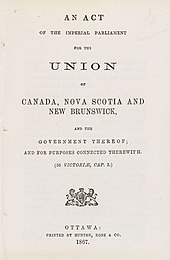
Constitution Act, 1867
33
MENTIONS
26
EPISODES
16
PODCASTS
Search complete. 33 mentions across 26 episodes found for "Constitution Act, 1867".
Sep 24, 2026

Tom MulcairGUEST
Quebec again falling flat on its constitutional face.
Tom MulcairGUEST
Section 133 of the British North America Act that today we call the Constitution Act 1867 couldn't be clearer.
Tom MulcairGUEST
A succession of Supreme Court cases, Andrew, going and the most recent ones over the past 50 years.
Tom MulcairGUEST
the most important ones concerned Manitoba that has the exact same provision in Section 23 of the Manitoba Act.
Tom MulcairGUEST
This is Elections Québec again falling flat on its constitutional face.
Tom MulcairGUEST
Section 133 of the British North America Act that today we call the Constitution Act 1867 couldn't be clearer.
Tom MulcairGUEST
A succession of Supreme Court cases, Andrew, going...
Tom MulcairGUEST
And the most recent ones over the past 50 years, m-m-the most important ones concerned Manitoba that has the exact same provision in six, Section 23 of the Manitoba Act.

Ian ThompsonGUEST
And, and, uh, I think, I think Tupper basically ignored him or tried to ignore him and successfully did.
Ian ThompsonGUEST
Howe on the other hand, worked feverishly to, um, fight against Confederation, even going to the UK, traveling to the UK to lobby with British parliamentarians before they approved the British North America Act, which effectively created Canada.
Ian ThompsonGUEST
And he was disgusted, I think, and disappointed, crushed when he realized in the British House of Commons that this legislation was being passed with only few people in the House.
Ian ThompsonGUEST
So he came back.

Sean BuckleyMODERATOR
The provinces are supposed to have jurisdiction under health.
Sean BuckleyMODERATOR
We go back to our British North America Act of 1867, Sections ninety-one and ninety-two define the federal government's roles and the provincial government's roles.
Sean BuckleyMODERATOR
The provincial governments have jurisdiction over healthcare, which is why...
Sean BuckleyMODERATOR
I live in Alberta.

speaker_11NARRATOR
The British quashed these uprisings, but did allow limited self-government and, eventually, Canadian Confederation.
speaker_11NARRATOR
The British North America Act created the Dominion of Canada on July 1, 1867.
speaker_11NARRATOR
This process of sovereignty continued with the passing of the Statue of Westminster of 1931.
speaker_11NARRATOR
This granted Canada and other Commonwealth dominions authority over their foreign policies.
Andrew CarterHOST
Mm.
Tom MulcairGUEST
It's illegal under the Constitution, Section 133 of the BNA Act.
Tom MulcairGUEST
That comes out, by the way.
Tom MulcairGUEST
Section ...
speaker_2UNKNOWN
Mm.
Tom MulcairGUEST
It's illegal under the Constitution, Section 133 of the BNA Act.
Tom MulcairGUEST
That comes out, by the way.
Tom MulcairGUEST
Section...

Ellen StantonGUEST
In 1969, the Canadian Parliament passed the Official Languages Act, which made English and French the two official languages of Canada.
Ellen StantonGUEST
So this year, while America is celebrating our 250th year as a nation, the Canadian Federation was established by the British Parliament in 1867 through the passage of the Constitution Act.
Ellen StantonGUEST
The first four provinces were Ontario, Quebec, Nova Scotia, and New Brunswick, much like our first 13 states.
Ellen StantonGUEST
Other provinces and territories joined the Federation, and Canada eventually became a nation of 10 provinces and three territories.
Ellen StantonGUEST
There are many indigenous people in Canada.
Ellen StantonGUEST
When the first Europeans arrived, we don't know the exact numbers, but they were decimated by war and by various disease that affected all of them.
Ellen StantonGUEST
The Constitution Act of Canada actually recognizes three different types of indigenous people.
Ellen StantonGUEST
First, the First Nations people, who were the first here when the Europeans arrived, the Inuit, who reside in northern Canada, and the Métis, who are mixed European and First Nation ancestry.

speaker_2AUDIENCE
Okay.
speaker_2AUDIENCE
It goes back to the British North America Act.
Shaye GanamHOST
Yeah, no, I know.
Shaye GanamHOST
And we've had many, many fights over that, right? And that was the National Energy Program and all the rest of it.

Jason KenneyGUEST
... culture is embedded in language.
Jason KenneyGUEST
So, [chuckles] you know, it, the, the, um, 1867, the Confeder- the, the, the, the, uh, uh, BNA Act, 1982, the Constitution Act, um, 2000, or sorry, 1997, the de jure end of the British Empire.
Jason KenneyGUEST
None of these things, uh, are a rupture for us with our deep cultural roots in Europe, and now what we respect as the, as the, um, uh, the r- the, the, the roots of Indigenous people.
Jason KenneyGUEST
So we still, I mean, i- it's not, it's not a, this is not a political problem, it's a cult- Uh, I, I guess the idea of what is our, do we have a culture? What is it? Is it identifiable? Damn right we do.
16 more episodes mention Constitution Act, 1867.
Create an account to see the whole feed, search across every transcript, and follow the entities you care about.