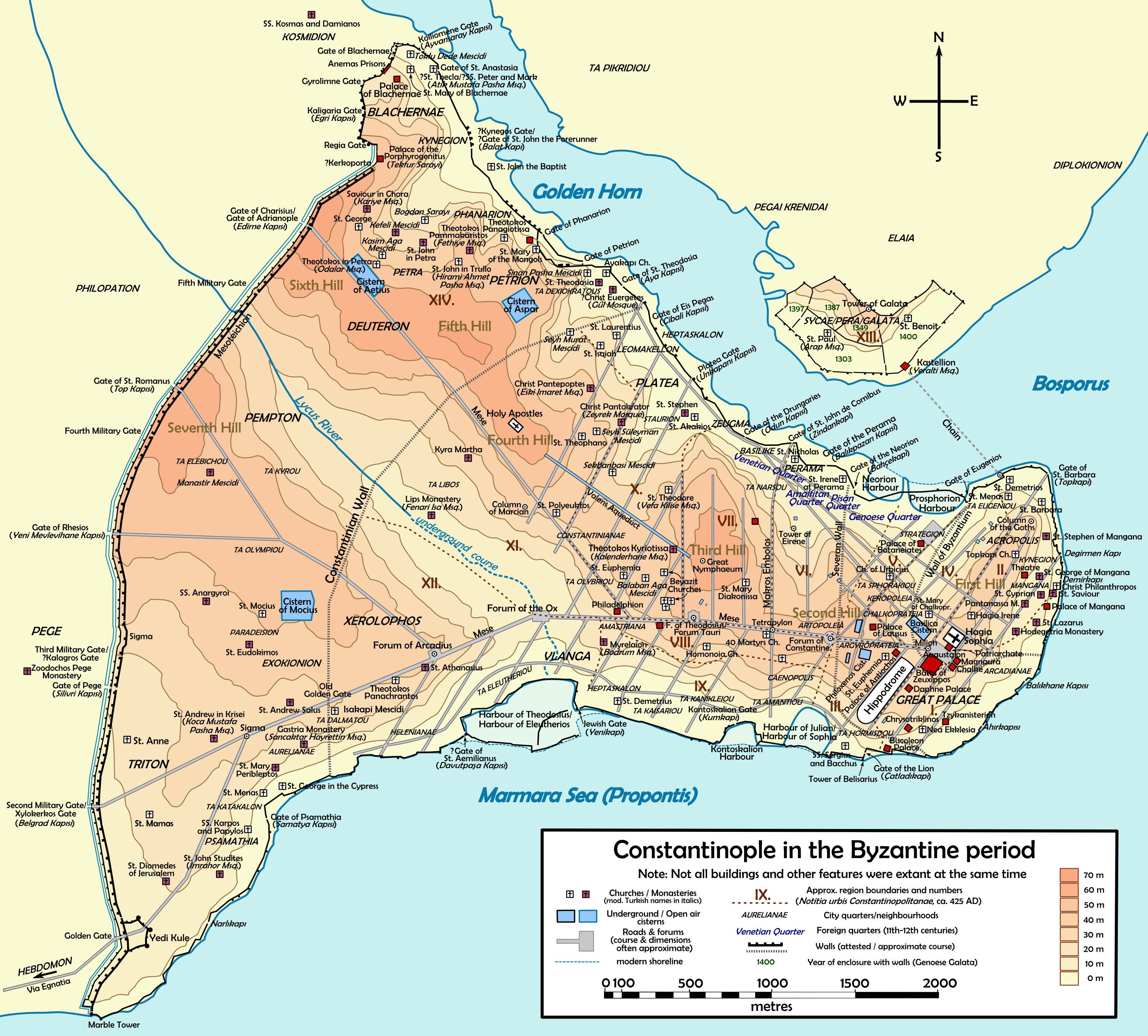
Constantinople
4.7k
MENTIONS
1.1k
EPISODES
765
PODCASTS
Search complete. 4693 mentions across 1114 episodes found for "Constantinople".
Sep 15, 2026

Alain de BottonNARRATOR
My general view is that people who meddle with politics usually meet a miserable end, and indeed they probably deserve to.
Alain de BottonNARRATOR
I never bother with what's going on in Constantinople.
Alain de BottonNARRATOR
I only worry about sending the fruits of the garden, which I cultivate, off to be sold there." Having said these words, the old man invited the strangers into his house.
Alain de BottonNARRATOR
His two sons and two daughters presented them with several sorts of sherbet, which they had made themselves with kaymak enriched with the candied peel of citrons, with oranges, lemons, pineapples, pistachio nuts, and coffee.
Alain de BottonNARRATOR
Take some beds and grow asparagus and carrots.
Alain de BottonNARRATOR
Stop worrying yourself with humanity if you ever want peace of mind again.
Alain de BottonNARRATOR
Who cares what's happening in Constantinople or what's up with the next Grand Mufti? Live quietly like the old Turk, enjoying the sunshine in the orange bower next to your house.
Alain de BottonNARRATOR
This is Voltaire's stirring, ever-relevant form of horticultural quietism.

Tom PriceCORRESPONDENT
And sometimes the only way to get to Istanbul was to drive.
Tom PriceCORRESPONDENT
And Edirne has the distinction of being, I don't remember if it's the second or the third Ottoman capital, but the Ottomans had a number of capitals before they finally conquered Constantinople in 1453.
Tom PriceCORRESPONDENT
And Edirne was one of them, and its buildings, and particularly its monumental buildings, its mosques and its palaces, reflect its status as an Ottoman capital.
Tom PriceCORRESPONDENT
But what all these places have in common is, yes, they were greatly reduced in size because of the Holocaust, but they still have thriving, active Jewish communities, and they have the accumulated wealth of the generations that preceded them.

Roderick BeatonGUEST
But they went and dug through monastic libraries, and they found forgotten works by Romans who had not been Christian but had done, you know, works of engineering, works of philosophy, works of geography.
Roderick BeatonGUEST
And then some of the same people actually they discovered behind the Romans, be- older even than Roman civilization, was ancient Greek civilization, and that was just the time when the Roman Empire in the East with its center in Constantinople was finally being overrun by the Ottoman Turks.
Roderick BeatonGUEST
So lots of Greek speakers who retained their links to ancient Greek civilization fled westwards to Italy in particular, and then they taught ancient Greek.
Roderick BeatonGUEST
So the Renaissance was able to rediscover not just the ancient Roman but also the older ancient Greek roots of their own European civilization, and in that way, Christendom became more of, if you like, organically bolted on to the older heritage of the pre-Christian Roman and Greek civilizations of Europe.
Roderick BeatonGUEST
One is sheer technological development.
Roderick BeatonGUEST
For the first time, they're able to do that.
Roderick BeatonGUEST
People talk a lot about how the developments to the east in Asia had kind of blocked the trading routes to the east through Constantinople and, and so on.
Roderick BeatonGUEST
But I take a slight-- I take the slightly stronger view of that, that what was actually happening in the fifteenth century was that just as the Europeans were fighting their way westwards and they were reconquering Iberia, Spain, and previously Portugal, from the Muslims who had already co-- who conquered them in the early Middle Ages, so Islam, in the form of the Ottoman Turks, was moving right into Europe through the Balkans.

Irenaeus DunlevyGUEST
Visualizations of the Lord and the saints act as useful means of devotion that can be said to help purify the human imagination.
Irenaeus DunlevyGUEST
This idea, however, was greatly challenged by the iconoclast controversy in the Byzantine Empire, which commenced in 726 AD when Emperor Leo III removed the icon of Christ from the Colche Palace gate in Constantinople.
Irenaeus DunlevyGUEST
So we have Leo III on the left, graven image, and we have his son, Constantine V.
Irenaeus DunlevyGUEST
Sorry, Leo III on the left and Constantine V on the right.
Irenaeus DunlevyGUEST
And within that, they condemn three iconophiles, so theologians arguing in favor of the icons.
Irenaeus DunlevyGUEST
[clears throat] There's a, there's a lot more literature on this, but this is sort of three, three major figures of the first part of the controversy.
Irenaeus DunlevyGUEST
So you have a patriarch, Germanus of Constantinople, you have a monk, George of Cyprus, and then you have Saint John Damascene.
Irenaeus DunlevyGUEST
Saint John Damascene.

Timothy FlandersHOST
That's on May 3rd, and that date is significant because it was on that date that Mehmed II was struck dead by God's hand.
Timothy FlandersHOST
He was the conqueror of Constantinople.
Timothy FlandersHOST
That's a whole another story.
Timothy FlandersHOST
We'll get to that another time.
8 MINS LATER
Timothy FlandersHOST
But unfortunately, the story goes that he didn't after this miracle happened, he did not humble himself.
Timothy FlandersHOST
And this is where we'll turn to my book because there's this great moment in history where God works all these miracles.
Timothy FlandersHOST
And this is while we didn't even go into the other story about the mother of God saving Constantinople during this time.
Timothy FlandersHOST
That's another miraculous event.

E. Michael JonesHOST
Pope.
NathanielGUEST
Now, the Byzantine emperor and the Constantinople archbishop always recognized that Rome was the mother church.
NathanielGUEST
And St. Gregory the Great points this out in his epistles, okay? And that lasted, I think, until the 9th century, 10th century AD, that the Constantinople, even though it said that he was the ecumenical patriarch, which is bull, and St.
NathanielGUEST
Gregory the Great said, no, you're not, They recognized the seat of St. Peter as the mother church, period.
NathanielGUEST
Now the schism starts and the Greeks, the emperor and all his lackeys went into schism in 1040 A.D.

speaker_1NARRATOR
That's crisis management showing up in the historical record.
speaker_1NARRATOR
Then there's John of Ephesus, a Syriac church historian writing from a completely different cultural and linguistic tradition, hundreds of miles east of Rome and Constantinople.
speaker_1NARRATOR
His original account doesn't survive complete, but later writers who copied from him describe the sun as being darkened for eighteen months, giving only a feeble light, like something you'd see through smoked glass.
speaker_1NARRATOR
Some later chroniclers who drew on similar Eastern sources go even further, describing terror among the population, people wondering if this was some kind of divine judgment, some sign that the world itself was ending.
speaker_1NARRATOR
When the sun stops behaving like the sun, people don't reach for scientific explanations.
speaker_1NARRATOR
They reach for scripture, for omens, for the terrifying possibility that God himself has turned his face away from humanity.
speaker_1NARRATOR
And then thousands of miles away, in a place with no contact with Rome, Constantinople, or Syria, Irish monks were keeping their own quiet records.
speaker_1NARRATOR
The Irish annals, particularly what's known as the annals of Ulster, don't describe a dimmed sun in dramatic language.

KarlHOST
down, Istanbul.
KarlHOST
Dude, when he committed the crime, it was Constantinople.
VinnyHOST
Come on.
KarlHOST
Come on.
KarlHOST
It's been a long time.
KarlHOST
Whoa, buddy.
KarlHOST
That Constantinople.
speaker_1UNKNOWN
Whoa, buddy.

speaker_5NARRATOR
The etymology is disputed, the function is not.
speaker_5NARRATOR
Venice, as one of the Mediterranean's great trading ports, the hub of a commercial network that stretched from the eastern Mediterranean to the North Sea, from Constantinople to London, from Alexandria to Bruges, was perpetually vulnerable to plague.
speaker_5NARRATOR
The city's wealth depended on trade.
speaker_5NARRATOR
Trade depended on ships.

Estevan CovarrubiasHOST
I mean, either one, you were going to choose the turban, or you were going to choose to be a martyr.
Estevan CovarrubiasHOST
And that's theoretically what happened at Constantinople, without getting into too much into it, because we are...
Estevan CovarrubiasHOST
Focusing on, why stay Catholic? Amen.
Anthony AcostaHOST
I love bringing up Peter as well because...
1,104 more episodes mention Constantinople.
Create an account to see the whole feed, search across every transcript, and follow the entities you care about.