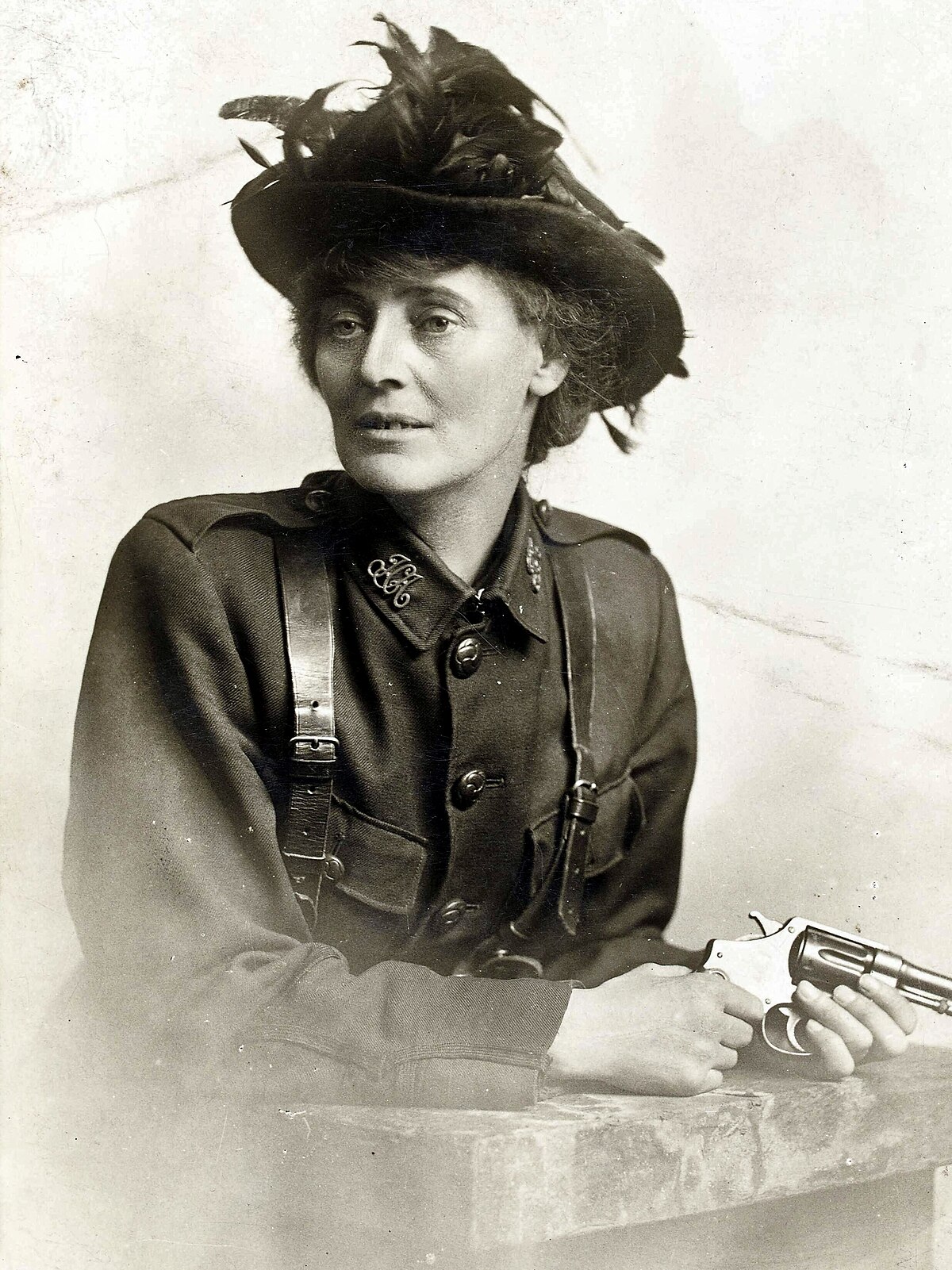
Constance Markievicz
Former Minister for Labour of the Republic of IrelandWikipedia
10
MENTIONS
8
EPISODES
6
PODCASTS
Search complete. 10 mentions across 8 episodes found for "Constance Markievicz".
Sep 16, 2026

SineadHOST
Hang on a second.
SineadHOST
I studied history in college and I was always told that Countess Markievicz was up there like in St. Stephen's Green or wherever she was.
AlvaHOST
Yeah, that's what I'm saying.
AlvaHOST
They were equal in the battlefield with the Republican ideal.

SineadHOST
Hang on a second.
SineadHOST
I studied history in college and I was always told that Countess Markievicz was up there like in St. Stephen's Green or wherever she was.
AlvaHOST
Yeah, that's what I'm saying.
AlvaHOST
They were equal in the battlefield with the Republican ideal.

speaker_3NARRATOR
The general election held in 1918 was the first time that women in the United Kingdom were able to cast their votes, provided they were over 30 and owned property.
speaker_3NARRATOR
During this election, Constance Markievicz became the first woman ever elected to the House of Commons.
speaker_3NARRATOR
However, she did not take her seat due to her political affiliations.
speaker_3NARRATOR
The first woman to actually serve in Parliament was Nancy Astor, who was elected in 1919.

Ray D'ArcyHOST
your verdict after
Jenny KellyHOST
well I think you can tell I think you can tell I'm sorry we didn't even mention the fabulous Siobhan McSweeney who this year is a mix of Enya and Countess Markievicz that is So that is who she is dressing as.
Jenny KellyHOST
So she is absolutely brilliant.
Jenny KellyHOST
She so adds to it, doesn't she? She brings so much to it.

Gary MurphyGUEST
know? So you can transplant that story to national level in ministerial terms.
Gary MurphyGUEST
You had Countess Markievicz and then you had to wait until 1979 when Charlie Hawhey appointed Moira Gagan Quinn.
Gary MurphyGUEST
And what did he do when he came back in power in 1981? He got rid of her and he sent her down to the junior benches, Moira Gagan Quindess, as he made her Minister of State.
Gary MurphyGUEST
So he put her into his first cabinet in 79, but in his second cabinet in 1981, he relegated her to the second tier, so-called.
Shane MoynihanHOST
Maybe give us a flavor of those women, their part to play in this, because obviously de Valera and Lamasse were large figures in this.
Shane MoynihanHOST
We know Constance Markievicz was in The Chair and The Scala, but maybe give us a flavor of the role of the revolutionary women that period in the formation of Fianna Fáil and the following years.
Sinéad McCooleGUEST
Yeah, I suppose the main thing is that I have looked for many years at the founding mothers and I think that in the 90s when we were looking at even anything political, there was this element that the women made the sandwiches and there are photographs in terms of gatherings where those images survive and I suppose it's back down to the roots of Fianna Fáil and what you call the grassroots and how quickly it grew within those parishes.
Sinéad McCooleGUEST
And you can see it later on when women are elected as the widows of TDs, and I can talk about that a little bit more later on.

Fran CurryHOST
Well, it's g- it's great to have you back indeed.
Fran CurryHOST
In, in your own blurb from The Countess, you speak about Countess Markievicz, and you say that her and her contemporaries, they were all about achieving equality for women and affording adequate social and economic protection for all of children.
Fran CurryHOST
Um, is, is there an element of that or is there any of that in this new strategy?
Laoise de BrúnGUEST
I think what we were, um, mindful of when we were kinda drafting that back in the early days of The Countess, and we were scoping out what our mission was and who we were and what we wanted, we were really, um, inspired by Countess Markievicz because w- we feel, we view her as a visionary, whose vision of a republic has yet to be achieved like the other visionaries.
Laoise de BrúnGUEST
Um, and when you look at the Proclamation of 1916, it's an incredible document.
Laoise de BrúnGUEST
It's so ahead of its time.
Fran CurryHOST
Well, it's g- it's great to have you back indeed.
Fran CurryHOST
In, in your own blurb from The Countess, you speak about Countess Markievicz, and you say that her and her contemporaries, they were all about achieving equality for women and affording adequate social and economic protection for all of children.
Fran CurryHOST
Um, is, is there an element of that, or is there any of that in this new strategy?
Laoise De BrúnGUEST
I think what we were, um, mindful of when we were kinda drafting that back in the early days of The Countess, and we were scoping out what our mission was and who we were and what we wanted, we were really, um, inspired by Countess Markievicz because w- we feel, we view her as a visionary whose vision of a republic has yet to be achieved like the other visionaries.
Laoise De BrúnGUEST
Um, and when you look at the Proclamation of 1916, it's an incredible document.
Laoise De BrúnGUEST
It's so ahead of its time.