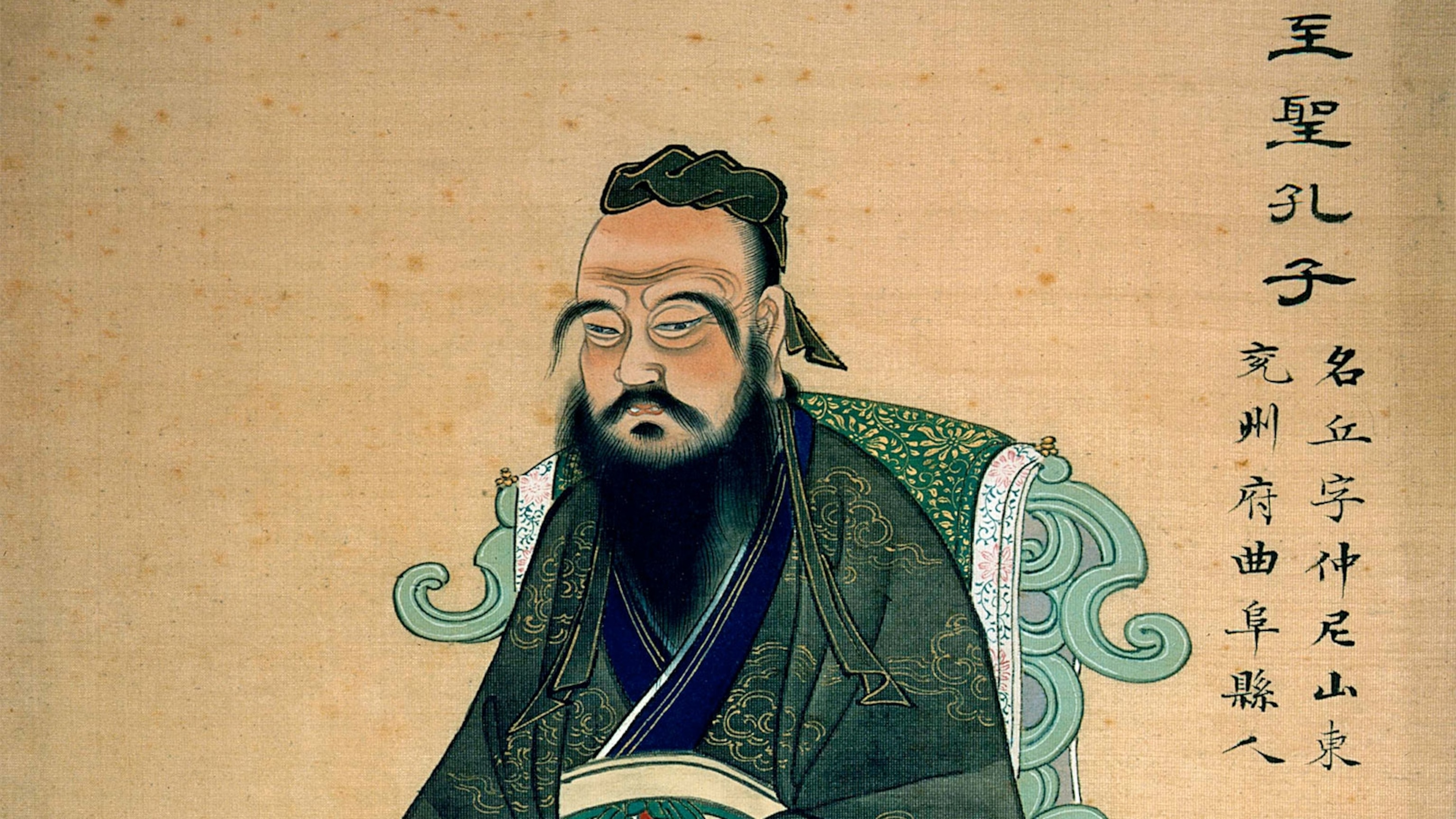
Confucius
Chinese philosopherWikipedia
1.1k
MENTIONS
441
EPISODES
353
PODCASTS
Search complete. 1099 mentions across 441 episodes found for "Confucius".
Nov 1, 2026

Belinda DovestonHOST
It's how we interact with other people.
Belinda DovestonHOST
And there's a wonderful part of this line that comes from kind of a judgment or a commentary from Confucius on this line.
Belinda DovestonHOST
And it's a brilliant way to live our lives.
Belinda DovestonHOST
One is, we are silent before we speak.

Paul VanderKlayHOST
It is also the way in which every man should tread in imitation of that cosmic and supercosmic progression, confronting all activities to that great exemplar.
Paul VanderKlayHOST
In ritual, says the intellect of Confucius, it is harmony with nature that is prized.
Paul VanderKlayHOST
The ancient Jews likewise praised the law as being true.
Paul VanderKlayHOST
It is true that if you have rules in your life, you will do better.

Melanie Schleter-McCalmontNARRATOR
He held the position of custodian of the secret archives of the state of Chu.
Melanie Schleter-McCalmontNARRATOR
Confucius went to Chu to consult Lao Tzu about certain ceremonials.
Melanie Schleter-McCalmontNARRATOR
Lao Tzu told him, The bones of these sages concerning whom you inquire have long since decayed, only their teachings remain.
Melanie Schleter-McCalmontNARRATOR
If a superior man is understood by his age, he rises to honor, but not being understood, his name is like a vagrant seed blown about by the wind.
Melanie Schleter-McCalmontNARRATOR
These add no real value to your person.
Melanie Schleter-McCalmontNARRATOR
That is my advice to you, and it is all I have to offer.
Melanie Schleter-McCalmontNARRATOR
Confucius departed, and when he later described to his students his visit to Lao Tzu, he said, I understand about the habits of birds, how they can fly, how fish can swim, and animals run.
Melanie Schleter-McCalmontNARRATOR
For the running we can make snares, for the swimming we can make nets, for the flying we can make arrows.

Elliott BernsteinHOST
When someone who did everything right encounters the unthinkable, the books don't balance, and we start looking for any possible answer, even one that's not obvious yet.
Elliott BernsteinHOST
When Confucius stood outside the window of a dying student, one of the most virtuous men he'd ever met, he didn't try to offer a reason.
Elliott BernsteinHOST
He just took the man's hand and said, in effect, this is what heaven ordered, and as much as anyone might want to make sense of it, I can't tell you why.
Elliott BernsteinHOST
Exploring the Analects, Episode 28, Passages 6.10 and 9.1, When Heaven Sends Orders.
Elliott BernsteinHOST
Hey folks, this is Elliott Bernstein.
Elliott BernsteinHOST
Thanks for joining me for Episode 28 of Exploring the Analects.
Elliott BernsteinHOST
In this episode, we'll be covering passages 6.10 and 9.1 of the Analects, looking at what Confucius had in mind when talking about Tianming, Heaven's Orders.
Elliott BernsteinHOST
We'll learn about how the concept differs from plain luck, and why it was one of the things he rarely talked about.

Mike ParryHOST
Really? And there are many, many chapters in the book.
Mike ParryHOST
Confucius say, book never closed till last chapter.
Mike ParryHOST
Is that what it says?
Mike GrahamHOST
Yes.
Mike GrahamHOST
Yeah, OK. Really? Yeah.
Mike GrahamHOST
If we had three points for each win, what do you think it would be then? Confucius say...
Mike GrahamHOST
13 times three? No,
Mike ParryHOST
no, no, no, no.

E.G. MarshallHOST
Things that are passed, it is needless to blame.
E.G. MarshallHOST
So spoke the great Chinese philosopher Confucius.
E.G. MarshallHOST
Confucius believed by many to be the wisest man that ever lived.
E.G. MarshallHOST
Since our story is about wisdom, we had to put Confucius in there someplace.
E.G. MarshallHOST
Wisdom, a quality so often associated with the mind, can also spring from the heart as well.
Carol TytelVOICE_ACTOR
I tell you, her death wasn't an accident.

JessHOST
for your
AGDFEVHOST
prayer groups and everything, Jesus and others, we can say Jesus, Confucius, and others said you cannot go through life without helping anyone.
JessHOST
Come on.
AGDFEVHOST
to where you need to be.

Kaiser KuoGUEST
I think that there was something in the habit of mind that had developed over, you know, that's an exaggeration, but two millennium of Confucian dominance that, you know, where you had a nation where Confucianism had been sort of the guiding ethos for the bureaucracy for so very long.
Kaiser KuoGUEST
And it rested sort of on this idea, it was codified by Mencius, one of Confucius' disciples and one of the more influential Confucians, that those who labor with their heads ought to rule over those who labor with their hands.
Kaiser KuoGUEST
not an idea that would necessarily have appeal to your audience, which is, you know, stands admirably with working
Richard HamesHOST
class.
Kaiser KuoGUEST
Anyway, so I think that these two things are paired.
Kaiser KuoGUEST
I mean, Confucianism... has had a rocky experience in China.
Kaiser KuoGUEST
Before Mao's death, there was this criticized Confucius and Lin Biao movement.
Kaiser KuoGUEST
The May 4th movement, this movement that came out of that betrayal at Versailles, they were cultural iconoclasts in the main who decided that the problems with China all sort of come out of the slave mentality of the Confucian era.

Chen LiHOST
Each of these reasons deserves kindness, because each was once a way of coping, and some of them still are.
Chen LiHOST
Confucius had a disciple named Zixia who was appointed governor of a small town and who asked his master before leaving how he should go about governing it.
Chen LiHOST
Confucius told him not to be in a hurry and not to chase small advantages, because whoever wants to go fast does not arrive.
Chen LiHOST
And whoever looks at small gains never accomplishes great things.
Chen LiHOST
The first half of that answer has become a proverb in Chinese, and most of us have learned its truth the hard way.

Andrew M. HenryHOST
It's often called the Laozi because early Chinese books are usually named after their author.
Andrew M. HenryHOST
The traditional story of its composition describes Laozi as an older contemporary of Confucius.
Andrew M. HenryHOST
He worked in the royal archives of the Zhou Dynasty sometime in the 500s or 400s BCE, when he wrote the Tao Te Ching, rode west out of China, and vanished from history.
Andrew M. HenryHOST
But most scholars today think the man is a legend, so why in this one case have historians become the mythicists? And if Laozi wasn't real, where did this character come from? And where did the Tao Te Ching come from? Our earliest full biography of Laozi comes from the records of the Grand Historian.
Andrew M. HenryHOST
He passed into the West and was never seen or heard from again.
Andrew M. HenryHOST
The text says none knew where he went to in the end.
Andrew M. HenryHOST
Embedded in this biography is a scene where Confucius himself comes to visit Laozi.
Andrew M. HenryHOST
He travels to where Laozi is working as an archivist, and he comes with a question about proper ritual, the subject of the entire life's work of Confucius.
431 more episodes mention Confucius.
Create an account to see the whole feed, search across every transcript, and follow the entities you care about.