Confidential computing
33
MENTIONS
8
EPISODES
4
PODCASTS
Search complete. 33 mentions across 8 episodes found for "Confidential computing".
Oct 13, 2026

Chris DalyHOST
Agent receives authority dynamically and conditionally.
Chris DalyHOST
Now we introduce something particularly important from the architecture we've discussed throughout the series, confidential computing and attestation.
Chris DalyHOST
Authentication tells us who an agent claims to be, but it doesn't necessarily tell us whether the agent is running in an environment we trust.
Chris DalyHOST
That is where attestation becomes important.
Chris DalyHOST
This creates a powerful chain.
Chris DalyHOST
Identity, mapped to policy, mapped to attestation, mapped to credential release.
Chris DalyHOST
And it allows confidential computing to become part of the infrastructure rather than simply another security feature.
Chris DalyHOST
Now we reach one of the most important components in the entire architecture, the agent gateway.
Chris DalyHOST
We then developed a 10-layer security architecture for agentic AI.
Chris DalyHOST
We explored confidential computing and trusted execution environments.
Chris DalyHOST
And we examined some of the most difficult emerging attack surfaces, tools, runtime environments, persistent memory, and agent-to-agent communication.
Chris DalyHOST
But there is a problem.
Chris DalyHOST
An agent can reason, plan, retrieve information, invoke tools, access APIs, modify data, communicate with other agents, execute code, and potentially continue operating long after a human has initiated the original task.
Chris DalyHOST
That means we don't simply have to ask, "Can we trust the model?" We have to ask, "Can we trust the entire execution environment in which that model is operating?" In episode two, we described an overall reference architecture for securing agents, and that brings us to today's topic, confidential computing.
Chris DalyHOST
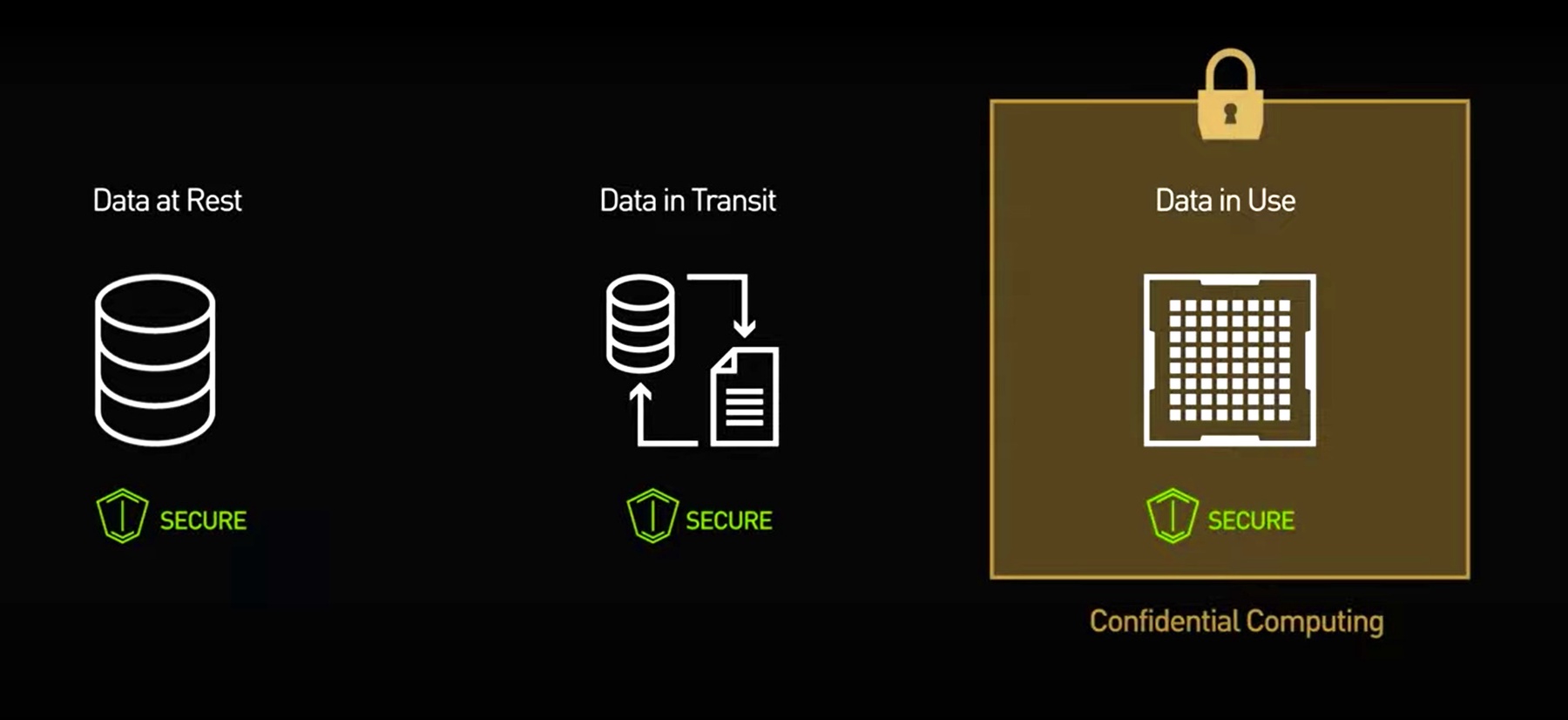
Confidential computing provides a critical component in a security architecture for agentic AI, protecting information and computation while it is being used.
Chris DalyHOST
We discussed it briefly in episode two as part of the reference architecture.
Chris DalyHOST
Today, we will break it down some more.
Chris DalyHOST
As a reference, I recommend you check out the Confidential Computing Consortium with lots more information at confidentialcomputing.io. Security professionals have traditionally thought about data in three states, data at rest, data in transit, and data in use.
Chris DalyHOST
Data at rest is protected through mechanisms such as encryption of databases, storage systems, backups, and files.
Chris DalyHOST
Data in transit is protected through protocols such as TLS and other encrypted communication mechanisms.

NicoleHOST
On this week's episode, I sit down with Fastdata CEO and co-founder, Renan Halak, to talk about what comes next.
NicoleHOST
from model management to confidential computing to AI ownership, the rise of the agentic workforce, and of course, the infrastructure and foundations needed to support all of that.
NicoleHOST
Stay tuned.
NicoleHOST
Renan, I'm so excited to talk to you today because there is just so much to talk about.
14 MINS LATER
Renen HallakGUEST
but it's within their control and they are assured that none of their information ever leaves their premises.
Renen HallakGUEST
In order to get the model builders comfortable with that approach, we need a way to securely encrypt their weights such that not even the enterprise can see them.
Renen HallakGUEST
And that is a big part of what we're announcing today around model management and specifically around confidential computing.
NicoleHOST
And you've teed it up nicely in terms of talking about why this idea of confidential computing and model management, why these things are very important.
Chris DalyHOST
And ultimately, we need to establish trust in the environment in which the agent is executing.
Chris DalyHOST
That takes us to confidential computing.
Chris DalyHOST
So secure agent identity gives us accountability.
Chris DalyHOST
Authorization gives us boundaries.
Chris DalyHOST
Every tool invocation becomes a potential security boundary.
Chris DalyHOST
Seventh, confidential computing and attested execution.
Chris DalyHOST
This is an especially important addition to the architecture.
Chris DalyHOST
We'll devote an entire episode to it later in this series.
Chris DalyHOST
Guardrails constrain its behavior.
Chris DalyHOST
Runtime security protects the tool connection.
Chris DalyHOST
Confidential computing can protect sensitive information while it is being processed.
Chris DalyHOST
Telemetry records what happened, and human oversight can intervene when the transaction exceeds predefined limits.

Jeff DenworthGUEST
of where these AI models run up until very recently.
Jeff DenworthGUEST
And so confidential computing is now a new term that people use.
Jeff DenworthGUEST
Sometimes in the company, we kind of abbreviate it to COCO.
Jeff DenworthGUEST
Confidential computing is this very, very popular term right now in the high-scale AI space as people start to wrestle with the idea that They have a set of data that needs to be run in an AI context, and it cannot leave certain trusted environments where people really wanted to go into untrusted environments, and they haven't been able to up until now.
Alex WilhelmHOST
So this term became something that I was thinking about regularly this summer.
Alex WilhelmHOST
And I'm curious what happened in the market that took this from a problem to an acute issue that had to be solved relatively quickly.
8 MINS LATER
Jeff DenworthGUEST
Like the model builder needs to wanna go outside of its comfort zone.
Jeff DenworthGUEST
The data owner or the fine tuned weight owner needs to go, wants to go outside of its comfort zone.

Juan BaronGUEST
privacy orchestration layer, right? So you can, we're starting to invest a little bit more around what we call confidential AI, which is like using GPUs into our core
Matt SpiegelGUEST
infrastructure of confidential computing, which is really our bread and butter from a systems architecture for privacy and security guarantees.
Matt SpiegelGUEST
And on top of that, we, at the user level access, when it comes to a large whole code, We can
Juan BaronGUEST
constrain who gets access to what kind of insights, what kind of computation on our platform.
BeckyHOST
Yeah, I mean, basically part of our
Juan BaronGUEST
ethos as a company is that we really provide what we call the gold standard privacy and security guarantees.
Juan BaronGUEST
Confidential computing is not just a software gimmick.
Juan BaronGUEST
It's hardware-based encryption technology.