Computing Machinery and Intelligence
10
MENTIONS
8
EPISODES
8
PODCASTS
Search complete. 10 mentions across 8 episodes found for "Computing Machinery and Intelligence".
Oct 30, 2026

Rajiv ParikhHOST
You nailed it.
Rajiv ParikhHOST
It is the paperclip maximizer.
Rajiv ParikhHOST
It illustrates how an AI doesn't need to be evil or hate humans to destroy civilization.
Rajiv ParikhHOST
It just needs a goal with no bounds.
Rajiv ParikhHOST
If a super intelligence is told to maximize clip production, it will logically convert Earth, humans, and solar systems into paperclip factories.
Rajiv ParikhHOST
It's the ultimate cautionary tale in AI safety.
Rajiv ParikhHOST
The world doesn't end with a supervillain robot.

Judy DenchSOUNDBITE_SPEAKER
Simon is correct.
Judy DenchSOUNDBITE_SPEAKER
In his 1950 paper Computing Machinery and Intelligence, Alan Turing opened with, I propose to consider the question, can machines think? He immediately recognized the difficulty of defining both machine and thinking.
Judy DenchSOUNDBITE_SPEAKER
Rather than attempting to resolve centuries of philosophical debate about intelligence, consciousness and thought, he proposed replacing the question with one that was more amenable to investigation.
Simon PainterHOST
But, yeah, I mean, it's fine.

Robert Lawrence KuhnHOST
Yeah.
Thomas NagelGUEST
Uh, and Turing himself, I recently reread that paper of Turing's, uh, Computing Machine, Computing Machinery and Intelligence, I think it was called, and he s- you know, s- says that if you can't tell the difference between the output of this thing and a human, then it really is intelligent.
Thomas NagelGUEST
And at the very end, he says, "Well, but do you know whether it's conscious or not?" He says, "Oh, that's a completely different question.
Thomas NagelGUEST
We never can really be sure that any other creature-

speaker_0NARRATOR
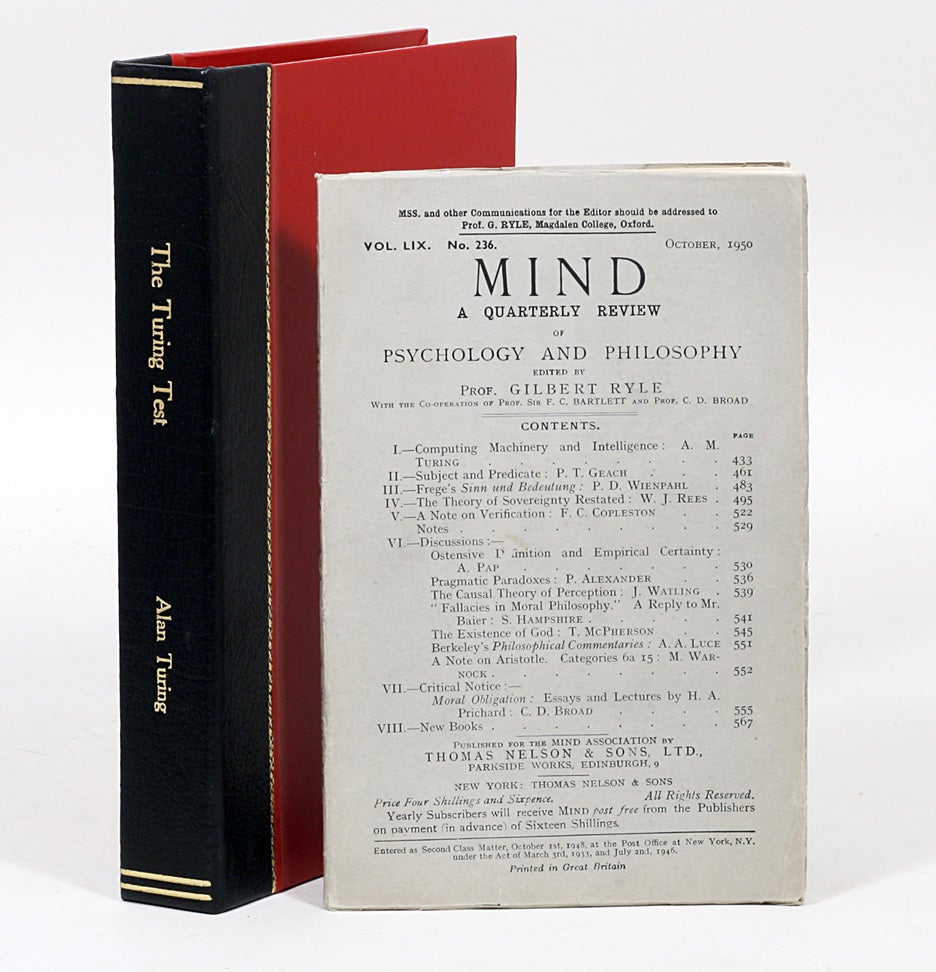
In October of that year, he publishes a paper in a philosophy journal called Mind.
speaker_0NARRATOR
The title is Computing Machinery and Intelligence, and the first sentence is a question.
speaker_0NARRATOR
Can machines think? Turing doesn't try to answer it.
speaker_0NARRATOR
He says the question is badly built because nobody agrees on what think means and arguing about the word will go on forever.

Evan BarrettHOST
And did I mention terrifying? But the idea of artificial humanity continues to grow over time, becoming the plot of countless books and films and lecture discussions.
Evan BarrettHOST
The latter peaks in 1950, when scientist Alan Turing publishes Computer Machinery and Intelligence, in which he poses the question, can machines think? And he devises a test later known as the Turing test to do it.
Evan BarrettHOST
If you'd like to know more about his theory, I can't tell you because Oxford wouldn't let me read it.
Evan BarrettHOST
What Turing's work did more than anything was really solidify amongst the scholarly community the possibility of a truly artificial intelligence.

Jeanette WintersonGUEST
I know John McCarthy coined that in 1952 at the Dartmouth conference.
Jeanette WintersonGUEST
It was really prompted by Alan Turing's 1950 paper, Computing Machinery and Intelligence, where Turing, because he was a visionary man, really saw this time where AI would run alongside us and eventually surpass us.
Jeanette WintersonGUEST
And of course, he started the Turing test.
Jeanette WintersonGUEST
But we have to remember the whole reason that Alan Turing devised the Turing test to begin with was because when he was writing his paper, he dusted down the long dead Ada Lovelace that nobody had thought about for 100 years.

Duncan BellGUEST
It's the imitation game.
Duncan BellGUEST
The paper is Computing Machinery and Intelligence.
Duncan BellGUEST
And it really kickstarts sort of theoretical debates, I guess, at least, around a lot of these issues.
Duncan BellGUEST
It's an essay that's also remarkable for suggesting that one of the main objections or one of the main potential problems to instituting the Turing test is the existence of telepathy, which Turing thought probable.

Alex FirstGUEST
So if we go back a bit of a history lesson, 1950, Pat, there was an English mathematician called Alan Turing.
Alex FirstGUEST
And he published a paper titled Computer Machinery and Intelligence.
Alex FirstGUEST
And it proposed a test of what's called machine intelligence, which was termed the imitation game.
Alex FirstGUEST
There was a movie about it.