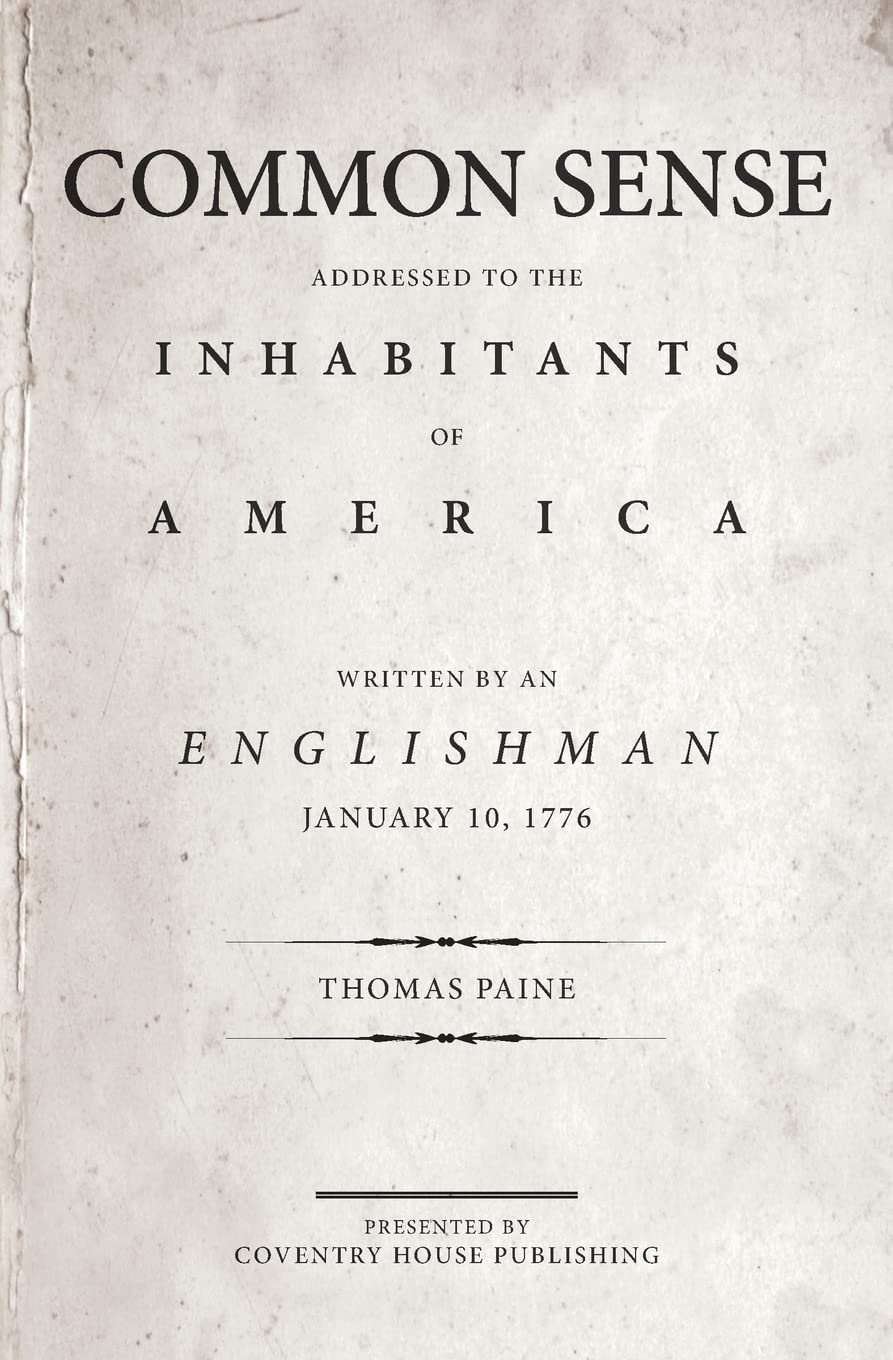
Common Sense
Book by Thomas PaineWikipedia
258
MENTIONS
53
EPISODES
50
PODCASTS
Search complete. 258 mentions across 53 episodes found for "Common Sense".
Sep 11, 2026

Ken BurnsGUEST
They still think maybe there's a way that we can convince Parliament to help us out, to see their way, and independency, as it's often called, is not on everyone's mind, certainly not in the spring of '75 on George Washington's mind.
Ken BurnsGUEST
But in early '76, in January 9th, Thomas Paine, an Englishman, publishes Common Sense, the most important political tract in American history, and he's basically just saying, he's literally saying, "Not since the time of Noah do we have a chance to sort of make things new, that we could create an asylum for mankind." And there's something about the corruption and the familiarity, the old religious wars, the avarice, the ambition of the Old World, and this sort of what they say is this kind of blank slate of, of natural possibilities here.
Ken BurnsGUEST
And it's gonna create an American catechism in which Emerson and Thoreau and, uh, Muir and Whitman are going to fill up- With the sense of all of these things, all of the contradictions.
Ken BurnsGUEST
This is Whitman, you know, "Do I have contra-" Yes.

speaker_0HOST
...
speaker_0HOST
Franklin having persuaded Thomas Paine to write Common Sense, and then against Thomas Paine knowledge, with- against his knowledge, publishing that and spreading it around bars and eateries in his town, we may not have had a, a successful revolution.
speaker_0HOST
Um, so...
KevinHOST
Yeah.

speaker_0ADVERTISER
Discover it at Dolby Cinema.
Scott RankHOST
I agree with the point of your book that one of the most respectable thing about Washington is that he could have assumed nearly absolute power, but decided to give it up, and authors of Washington will come back to that point.
Scott RankHOST
But I was interested that you note that you found respect for this in the most unlikely places, and one of these places is in China by a family member who, in twenty-first century CCP-controlled China, there are people there who think, "Man, that Washington, he could have taken power, but he didn't.
Scott RankHOST
What a great guy." Tell me more about this.
Richard LimGUEST
He just kinda threw it out there, and it struck me because we hadn't brought up American history or anything like that, but he just talked about how much he admired Washington.
Richard LimGUEST
And I thought to myself, w- what is it about a guy who lived 200 years ago in a different culture that would really capture somebody like that? And I realized it was because Washington gave up power.
Richard LimGUEST
And one thing I talk about in my book is that Washington's so familiar to us, literally.
Richard LimGUEST
He's in our dollar bills, he's on our quarters.

Nathan Pearl RosenthalGUEST
Well, the first thing that makes it an age of revolutions is that Thomas Paine calls it that in 1791.
Carolyn BeelerHOST
Thomas Paine, the author of Common Sense, that very influential pamphlet during the American Revolution.
Nathan Pearl RosenthalGUEST
Absolutely.
Nathan Pearl RosenthalGUEST
So there's this idea that he's encapsulating at the very beginning of the French Revolution, really, that there's something bigger happening than any one revolution.
Nathan Pearl RosenthalGUEST
The constitutions of the states and the federal constitution are printed and reprinted in France and really debated a lot.
Nathan Pearl RosenthalGUEST
This is one of the big questions in the early French Revolution is how are we going to restructure our government? And they looked to the United States for answers.
Nathan Pearl RosenthalGUEST
In Spanish America, by contrast, one of the first things that a lot of Spanish Americans are looking at is Thomas Paine's Common Sense, which is an argument for the independence of former colonial possessions.
Carolyn BeelerHOST
Were there echoes, for example, of the Declaration of Independence in other places, or did writings in other countries inform what happened in the U.S.?

Steve BrownNARRATOR
All national institutions of churches, whether Jewish, Christian, or Turkish, appear to me no other than human inventions set up to terrify and enslave mankind and monopolize power and profit.
Steve BrownNARRATOR
I do not mean by this declaration to condemn those who believe otherwise They have the same right to their belief as I have to mine But it is necessary to the happiness of man that he be mentally faithful to himself Infidelity does not consist in believing or in disbelieving It consists in professing to believe what he does not believe It is impossible to calculate the moral mischief, if I may so express it, that mental lying has produced in society When a man has so far corrupted and prostituted the chastity of his mind as to subscribe his professional belief to things he does not believe, he has prepared himself for the commission of every other crime He takes up the trade of a priest for the sake of gain, and in order to qualify himself for that trade, he begins with a perjury Can we conceive anything more destructive to morality than this? Soon after I had published the pamphlet Common Sense in America, I saw the exceeding probability that a revolution in the system of government would be followed by a revolution in the system of religion The adulterous connection of church and state, wherever it had taken place, whether Jewish, Christian, or Turkish, had so effectually prohibited by pains and penalties every discussion upon established creeds and upon first principles of religion that until the system of government should be changed, those subjects could not be brought fairly and openly before the world But that whenever this should be done, a revolution in the system of religion would follow Human inventions and priestcraft would be detected, and man would return to the pure, unmixed, and unadulterated belief of one God and no more Every national church or religion has established itself by pretending to some special mission from God, communicated to certain individuals The Jews have their Moses, the Christians their Jesus Christ, their apostles and saints, and the Turks their Muhammad, as if the way to God was not open to every man alike Each of those churches show certain books, which they call Revelation or the Word of God The Jews say that their Word of God was given by God to Moses, face to face The Christians say that their Word of God came by divine inspiration And the Turks say that their Word of God, the Quran, was brought by an angel from heaven Each of these churches accuse the other of unbelief, and for my own part, I disbelieve them all As it is necessary to affix right ideas to words, I will, before I proceed further into this subject, offer some other observations of the word revelation Revelation, when applied to religion, means something communicated immediately from God to man No one will deny or dispute the power of the Almighty to make such a communication, if he pleases But admitting, for the sake of a case, that something has been revealed to a certain person, and not revealed to any other person, it is revelation to that person only When he tells it to a second person, a second to a third, a third to a fourth, and so on, it ceases to be a revelation to all those persons It is revelation to the first person only, and hearsay to every other, and consequently they are not obliged to believe it It is a contradiction in terms and ideas to call anything a revelation that comes to us at second hand, either verbally or in writing Revelation is necessarily limited to the first communication After this, it is only an account of something which that person says was a revelation made to him And though he may find himself obliged to believe it, it cannot be incumbent on me to believe it in the same manner, for it was not a revelation made to me, and I have only his word for it that it was made to him When Moses told the children of Israel that he received the two tables of the commandments from the hands of God, they were not obliged to believe him, because they had no other authority for it than his telling them so And I have no other authority for it than some historian telling me so The commandments carry no internal evidence of divinity with them They contain some good moral precepts, such as any man qualified to be a lawgiver or a legislator could produce himself without having recourse to supernatural intervention Footnote It is, however, necessary to accept the declaration which says that God visits the sins of the fathers upon the children It is contrary to every principle of moral justice End footnote End of section one This is a LibriVox recording All LibriVox recordings are in the public domain For more information or to volunteer, please visit LibriVox.org Recording by Steve Brown The Age of Reason by Thomas Paine Part First, Section Two When I am told that the Quran was written in heaven and brought to Muhammad by an angel The account comes to near the same kind of hearsay evidence and second-hand authority as the former.
Steve BrownNARRATOR
I did not see the angel myself, and therefore I have a right not to believe it.
Steve BrownNARRATOR
When also I am told that a woman called the Virgin Mary said or gave out that she was with child without any cohabitation with a man, and that her betrothed husband Joseph said that an angel told him so, I have a right to believe them or not.
1 HR 44 MINS LATER
Steve BrownNARRATOR
When therefore I turned my thoughts toward matter of government, I had to form a system for myself that accorded with the moral and philosophic principles in which I had been educated.
Steve BrownNARRATOR
I saw, or at least I thought I saw, a vast scene opening itself to the world in the affairs of America, and it appeared to me that unless the Americans changed the plan they were pursuing with respect to the government of England and declared themselves independent, they would not only involve themselves in a multiplicity of new difficulties, but shut out the prospect that was then offering itself to mankind through their means.
Steve BrownNARRATOR
It was from these motives that I published the work known by the name of Common Sense, which was the first work I ever did publish.
Steve BrownNARRATOR
And so far as I can judge of myself, I believe I should never have been known in the world as an author on any subject whatever had it not been for the affairs of America.

Nathan Perl-RosenthalGUEST
Well, the first thing that makes it an Age of Revolutions is that Thomas Paine calls it that in 1791.
Carolyn BeelerHOST
Thomas Paine, the author of Common Sense, that very influential pamphlet during the American Revolution.
Nathan Perl-RosenthalGUEST
Absolutely.
Nathan Perl-RosenthalGUEST
So there's this idea that he's encapsulating at the very beginning of the French Revolution, really, that there's something bigger happening than any one revolution.
Nathan Perl-RosenthalGUEST
The constitutions of the states and the federal constitution are printed and reprinted in France and really debated a lot.
Nathan Perl-RosenthalGUEST
This is one of the big questions in the early French Revolution is how are we going to restructure our government? And they looked to the United States for answers.
Nathan Perl-RosenthalGUEST
In Spanish America, by contrast, one of the first things that a lot of Spanish Americans are looking at is Thomas Paine's Common Sense, which is an argument for the independence of former colonial possessions.
Carolyn BeelerHOST
Were there echoes, for example, of the Declaration of Independence in other places, or did writings in other countries inform what happened in the U.S.?

Michelle FryNARRATOR
These are the times that try men's souls.
Michelle FryNARRATOR
From The American Crisis by Thomas Paine, a.k.a. Common Sense.
Michelle FryNARRATOR
Published December 1776.
Michelle FryNARRATOR
Read for Essay Collection Volume 1 by Michelle Fry, Baton Rouge, Louisiana, in October 2023.
23 MINS LATER
Michelle FryNARRATOR
Look on this picture and weep over it.
Michelle FryNARRATOR
And if there yet remains one thoughtless wretch who believes it not, let him suffer it unlamented.
Michelle FryNARRATOR
Signed Common Sense, December 23, 1776.
Michelle FryNARRATOR
End of The Crisis I by Thomas Paine.

speaker_9NARRATOR
in colonial congresses and assemblies.
speaker_9NARRATOR
Paine's Common Sense In the midst of this ferment of American opinion, a bold and eloquent pamphleteer broke in upon the hesitating public with a program for absolute independence, without fears and without apologies.
speaker_9NARRATOR
In the early days of 1776, Thomas Paine issued the first of his famous tracts, Common Sense.
speaker_9NARRATOR
passionate attack upon the British monarchy and an equally passionate plea for American liberty.
speaker_9NARRATOR
Casting aside the language of petition with which Americans had hitherto addressed George III, Paine went to the other extreme and assailed him with many a violent epithet.

speaker_11NARRATOR
in colonial congresses and assemblies.
speaker_11NARRATOR
Paine's Common Sense In the midst of this ferment of American opinion, a bold and eloquent pamphleteer broke in upon the hesitating public with a program for absolute independence, without fears and without apologies.
speaker_11NARRATOR
In the early days of 1776, Thomas Paine issued the first of his famous tracts, Common Sense.
speaker_11NARRATOR
passionate attack upon the British monarchy and an equally passionate plea for American liberty.
speaker_11NARRATOR
Casting aside the language of petition with which Americans had hitherto addressed George III, Paine went to the other extreme and assailed him with many a violent epithet.

speaker_11NARRATOR
in country conventions and conferences or committees, in colonial congresses and assemblies.
speaker_11NARRATOR
Paine's Common Sense In the midst of this ferment of American opinion, a bold and eloquent pamphleteer broke in upon the hesitating public with a program for absolute independence, without fears and without apologies.
speaker_11NARRATOR
In the early days of 1776, Thomas Paine issued the first of his famous tracts, common sense, a passionate attack upon the British monarchy and an equally passionate plea for American liberty.
speaker_11NARRATOR
Casting aside the language of petition, with which Americans had hitherto addressed George III, Paine went to the other extreme and assailed him with many a violent epithet.
speaker_11NARRATOR
He condemned monarchy itself as a system which had laid the world in blood and ashes.
43 more episodes mention Common Sense.
Create an account to see the whole feed, search across every transcript, and follow the entities you care about.