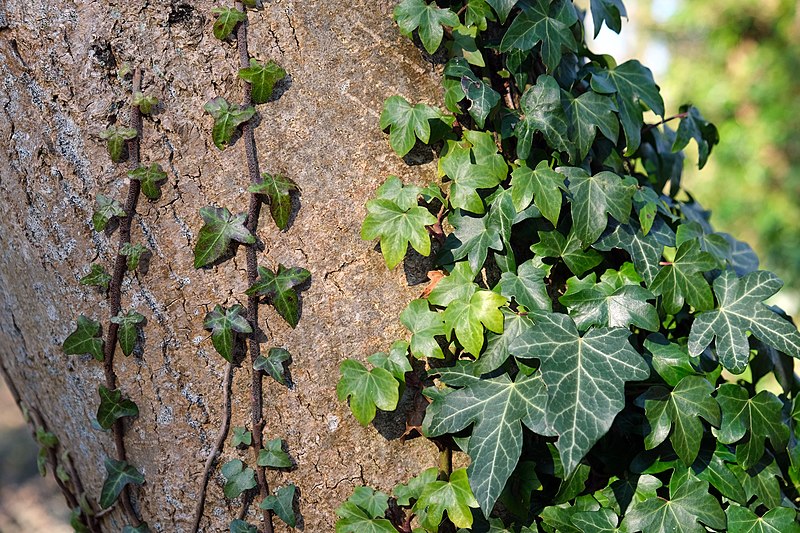
Common ivy
PlantWikipedia
15
MENTIONS
7
EPISODES
6
PODCASTS
Search complete. 15 mentions across 7 episodes found for "Common ivy".
Oct 10, 2026

Chris SkinnerHOST
It shows it doesn't kill the tree.
Chris SkinnerHOST
No, you can put my hand between the ivy trunk and the tree, it's a good four inches away and it's not attached at all but it clings, it's a stem twiner we call it and it can go up into trees up to 100 feet up so it's our tallest native stem twiner, Hedera helix a scientific name.
Chris SkinnerHOST
Now, if we just walk over here, here's one of the many trees and there are hundreds.
Chris SkinnerHOST
There's a huge avenue of oaks on the other side of that field and every one of them has ivy on it and I'll explain why.

Kate McAlpineGUEST
It's probably double that, to be honest.
Kate McAlpineGUEST
We've got arum lily, we've got pampas, we've got brush wattle, English ivy, um, licorice bush down the road a bit.
Phil PenningtonCORRESPONDENT
What does...
Phil PenningtonCORRESPONDENT
Does that taste like licorice?

Terry NaturallyHOST
Now, what really works? Two natural herbs.
Terry NaturallyHOST
Ivy, English ivy, the kind of ivy that you see on homes.
Terry NaturallyHOST
Ivy will crawl up the walls.
Terry NaturallyHOST
And if you don't trim it back, it's going to go right over the house.
Terry NaturallyHOST
I'm just kidding.
Terry NaturallyHOST
But ivy is that plant that can crawl anywhere.
Terry NaturallyHOST
Ivy, English ivy.
Terry NaturallyHOST
And thyme.

Ken AndersonHOST
Yeah.
Ken AndersonHOST
Number two on the list is an English Ivy.
Ken AndersonHOST
And I, I, I have to disagree with that.
Ken AndersonHOST
I agree.
Ken AndersonHOST
Absolutely.
Ken AndersonHOST
It's a horrible plant.
Ken AndersonHOST
But English ivy, English ivy, needlepoint ivy, that's not that bad.
John ClementsHOST
No.

Phil WilliamsHOST
And we'll find out what's going on with UT Ag.
Phil WilliamsHOST
And then we've got questions about English Ivy, hostas, and yards going to seed, and more.
Phil WilliamsHOST
It's the Phil Show, Digging Into the Earth with Neal Denton on News Talk 98.7, doing it live in local kids.
Phil WilliamsHOST
Here's Pete Michaels.
19 MINS LATER
Phil WilliamsHOST
feeding.
Phil WilliamsHOST
Mike out of Greenville this morning says, Good morning.
Phil WilliamsHOST
Could you ask Neil, what's the best way to get what looks like English ivy out of my hay field? The field is a mix of fescue and red clover.
Phil WilliamsHOST
Is there anything I can use to do this without killing the clover and the fescue? Thank you, Mike Greenville.

Phil WilliamsHOST
And we'll find out what's going on with UT Ag.
Phil WilliamsHOST
And then we've got questions about English Ivy, hostas, and yards going to seed, and more.
Phil WilliamsHOST
It's the Phil Show, Digging Into the Earth with Neal Denton on News Talk 98.7, doing it live in local kids.
Phil WilliamsHOST
Here's Pete Michaels.
19 MINS LATER
Phil WilliamsHOST
feeding.
Phil WilliamsHOST
Mike out of Greenville this morning says, Good morning.
Phil WilliamsHOST
Could you ask Neil, what's the best way to get what looks like English ivy out of my hay field? The field is a mix of fescue and red clover.
Phil WilliamsHOST
Is there anything I can use to do this without killing the clover and the fescue? Thank you, Mike Greenville.
Matthew GudginHOST
Yes.
Chris SkinnerHOST
So anyway, this is a new species, the little bees that we're looking at, Coleta hedera, and the second part of the scientific name is the same name as Hedera helix, so it's the ivy bee, and it's quite widespread over Europe.
Chris SkinnerHOST
Um, you get it in Germany, Switzerland, France, Belgium, um, right down into Spain.
Chris SkinnerHOST
And what's happened is, in 2001, it was first recorded in the UK, in Dorset of all places, and it's spread quite well.